SKOCH Summit
Mr IPS Sethi
Director General, NIC
Mr. I.P.S. Sethi outlined the institution’s five-decade journey in driving India’s digital transformation. He highlighted NIC’s key contributions to e-governance—from eOffice, CPGRAMS, and Digital Life Certificate to UPI, PM-Kisan, and One Nation One Ration Card—underscoring how technology has enhanced transparency, service delivery, and citizen empowerment across all levels of government.*
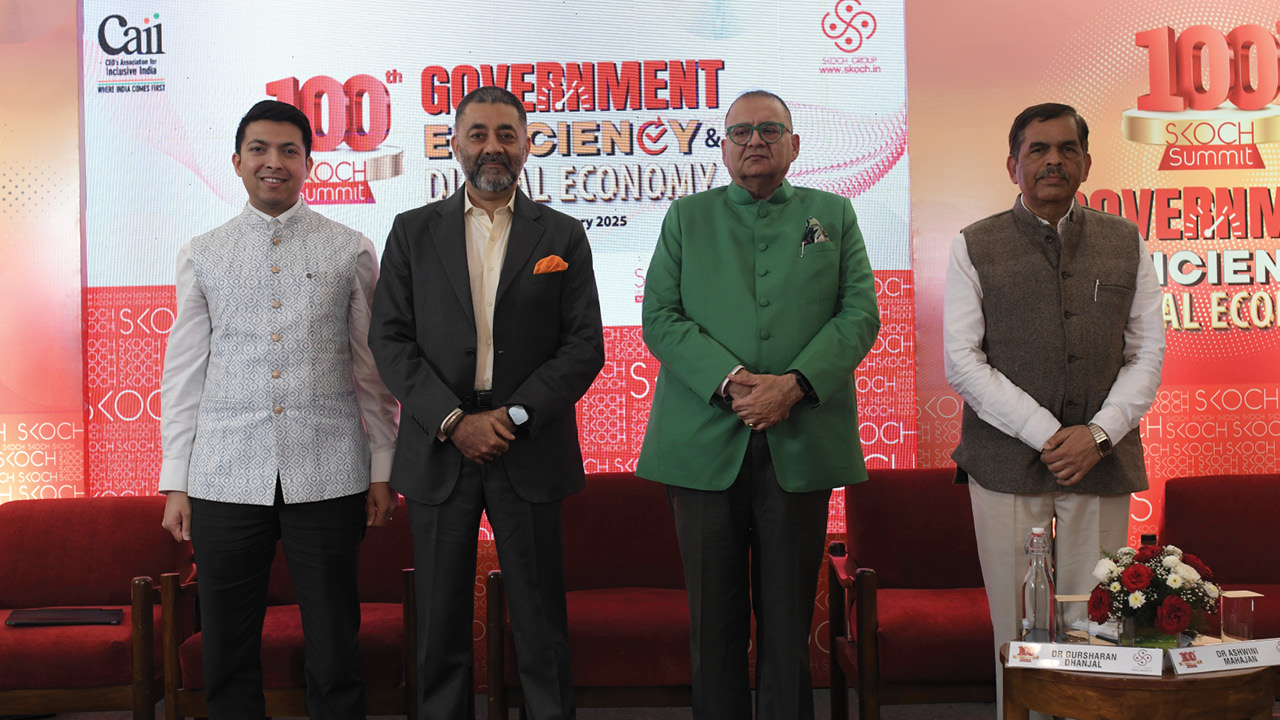
Mr IPS Sethi at the 100th SKOCH Summit: Government Efficiency & Digital Economy
Mr IPS Sethi
Director General, NIC
Key Points*
- Highlighted NIC’s legacy since 1976 and its central role in India’s digital transformation, as it approaches its 50th (golden jubilee) year.
- Emphasized NIC’s alignment with the Digital India mission and its support to all levels of government—from the President and Prime Minister to central ministries, states, and over 750 districts.
- Described NIC’s early technology milestones, including digital displays at the 1982 Asian Games and expansion to district-level digital systems from the late 1980s.
- Explained the creation and impact of the eTaal portal as a national transaction aggregator, now tracking around 91 crore daily transactions across 4,400 e-services in real time.
- Outlined NIC’s role in enabling and monitoring India’s cashless economy post-demonetization, including dashboards tracking UPI and other digital payment systems at massive scale.
- Showcased flagship citizen-facing platforms such as eCourts, e-Office, CPGRAMS, and Digital Life Certificate, which have reduced physical visits and improved service delivery.
- Highlighted large-scale welfare platforms supported by NIC, including One Nation One Ration Card, National Scholarship Portal, and PM-Kisan, benefiting crores of citizens through direct transfers.
- Discussed advanced governance dashboards (e.g., Darpan and PRAGATI) that enable data-driven monitoring, decision-making, and predictive analysis at state and national levels.
- Presented NIC’s work in emerging technologies—AI, blockchain, data analytics—covering judgment summarization and translation, faceless RTO services, identity verification, and secure collaboration tools.
- Emphasized the importance of robust infrastructure and cybersecurity, including nationwide data centers, upcoming facilities, real-time election systems, and 24×7 defense against millions of cyberattacks.
* This content is AI generated. It is suggested to read the full transcript for any furthur clarity.
Transcript
Very good morning to all. Sameer ji, Garan—kudos and big compliments to them for working tirelessly year on year to do research, to develop indices, to give the governance reforms index, health of the states, and today we are standing at the 100th Summit by SKOCH—the big round of applause for them.
National Informatics Centre: it’s an organization set up in 1976. We are completing 49 years this year and entering into our golden jubilee 50th year. During all these years we are marching ahead for digital transformation of the country, improving efficiency, transparency, and ensuring that efficient service delivery are given to the citizens of the country.
We are fully aligned with the mission and vision of Digital India program of Government of India which Honorable Prime Minister launched 10 years ago, and we have been providing digital governance service to governments at various level—right from Excellency President of India, Honorable Prime Minister, central government ministry/department, state government, and 750 plus districts.
1982 we were first recognized when during the Asian Games in New Delhi—the big display boards in the Jawaharlal Nehru Stadium, the teletext service—using, we were showing the players their ranking, medals and all those things.
1987–88 we have expanded and gone to district level. That time there were only 400 districts in the country and today we are close to 800 districts. In last 35 years districts have been created politically by various governments for ease of administration. So all these years we have been working tirelessly and working to give the products platform for the population scale.
eTaal, which Sameer ji was mentioning, was born in 2012–13 when government was reviewing National e-Governance Plan 1.2, which was launched in 2006. Suddenly somebody asked: can anybody tell how many driving licenses are issued today? how many properties are registered? how many people have gone abroad? how many have come to India? how many treasury transactions have done? But there was not a single portal in the country which could aggregate all the services and tell that this is the figure. Though departments were maintaining their individual portals and dashboards, but that was not an integrated platform.
So 2013, the then secretary, Satyan Naran sir, decided that we’ll come up with a portal. NIC was interested. That time we were having 20 lakh transactions per day, and today 91 Cr transactions per day are recorded on the eTaal portal from 4,400 e-services which are integrated on this, and we are ranking states, we are ranking projects, and monitoring every transaction. This portal is like a population clock and gets updated every 6 seconds, and around the clock it is working. And any service delivered to citizen anywhere in the country—be Ladakh, be Kerala, Nagaland or Jamnagar, anywhere—so the portal gets updated through the API without any human intervention.
2016, 8 November, 8:00 p.m., Honorable Prime Minister announced demonetization. We were called that we have to promote cashless economy, we have to have a monitoring mechanism to monitor all the digital payment transactions which citizens will be doing across the country. We have come up with a Digidhan dashboard, monitoring every single payment transaction done by citizen in the country—be it a credit card, debit card, NEFT, RTGS—you are traveling, crossing the toll plazas, metro cards, gift cards, UPI, wallets.
So that time UPI was born. Close to 20 million transactions happened 2017–18, and today only in one month—last month—16 billion transactions of UPI were recorded, worth 2 trillion rupees. So that is the power of technology. And 46% of the digital payment transactions are happening only in India, and 83% of our citizens are using some form of digital payment. So that is the power of technology given to the hands of the citizen by this government in the country.
We have come up with number of initiatives like eCourts is our flagship program for Supreme Court, High Court and district courts, and 22 crore cases were digitized. And now citizens or litigants need not have to travel all the way to High Court, Supreme Court or district court. Sitting at their home they can find out: when is my date, what is the cause list, when is my number, who is the judge, who is my government advocate—who is all the details are available sitting at his home.
SAS sir talked about the governance reform, administrative reform, and he talked about e-Office, Digital Life Certificate, and CPGRAMS. NIC is an integrated part of that journey and we are supporting DARPG in all the three initiatives.
And today 1300 organizations across the country are using e-Office leading to the green revolution—paperless things. Digital Life Certificate: 70-year-old, 80-year-old senior citizens were used to travel 5 km, 10 km from their villages to come to the bank branch to prove that they are alive, and they are coming to bank—sometime bank is closed, sometime officer is not there. And now with the face authentication using Aadhaar KYC and Jeevan Pramaan application, sitting at home you can prove to the government that you are alive.
Government is running the National Food Security Act under which 81 Cr beneficiaries are getting free ration or subsidized ration from the government. So this is the largest beneficiary database which has been built by NIC for the Department of Food and Public Distribution, and through 5.3 lakh ration shops with PoS devices people are getting ration, and based on this government is calculating subsidy and passing the benefit to the state government.
Everybody knows that during COVID when everything was closed, migrant worker was running here and there with no food and everything. This—with the help of this One Nation One Ration Card—the migrant worker of Bihar was able to get ration in Delhi and survive. Similarly, their family was getting ration at their residence wherever they were. So that is the power of technology, power of integration, power of processes which NIC has worked closely with the government department and providing the services government is giving.
I’m telling that the scale with which we are working because India is a country with 140 billion population and we have to have services to every citizen across the country.
National Scholarship Portal given to the students—pre-matric, post-matric—and 6.5 Cr students are registered, and they are getting, based on their authentication, through PFMS the funds get transferred.
PM-Kisan: 11 Cr farmers are registered and quarterly Honorable Prime Minister is giving them the funds of 2,000 rupees every quarter, which with a single click of button gets transferred to the bank account of the people.
Now to monitor all this we need effective dashboards. 2018–19 we developed a Darpan dashboard for analytical review of programs across nation. UP Chief Minister, Uttarakhand Chief Minister—their entire monitoring is done on this dashboard where all the government schemes implemented by them are integrated on a single screen with defined key performance indicators, and they monitor. Suppose they take food sector, they see that in entire UP 75 districts what is the performance—red, green or orange, yellow—they marked it, and accordingly district collector, concerned officers were asked to monitor based on the performance.
Similarly for Government of India we did PRAGATI. PRAGATI is monitored by Honorable Prime Minister Office where 186 schemes of government of various ministry with 1237 KPIs are integrated on the portal, and every ministry/department schemes—their output, outcome, informed decision, actionable point and predictive analysis is done based on the power of the data. So we are building data lakes, data warehouses, and decisions were taken or the advisories were given based on this dashboard to the government that if this happen what will be the net result.
Similarly keeping with pace with the Atmanirbhar Bharat—everybody is using Google Docs, Google Sheets, Google Forms, and we don’t know where our data is going. We are just entering the data but it’s going in the space in cloud we don’t know, and how this data is used by the foreign agencies. We have come up with CollabFiles which is replica of Google Docs/Sheets, and it also has a government drive so that we can keep secure our important documents. And during some of the critical departments have we started using CollabFiles for their day-to-day operation to collaborate and share the confidential documents.
Similarly there are number of initiatives which NIC has taken not only for the government but for the state government also. We are working on the e-Passport. Soon you will be getting a chip-based passport—chip embedded in your passport—and we have already started pilot in Bhopal and Nagpur. And your all data will be there in the chip. When you come to the immigration counter it gets read by the devices and it passed on to the International Civil Aviation Organization and to the destination country so that before you land to that country they have a complete 360° profiling of you and they can recognize what kind of your history is there and all the details are available.
Lot of students go abroad for study—Canada, USA, UK, Europe country—and they were struggling that the degree which they did from any of the universities whether it is valid or not valid. So apostille service is the service by the Ministry of External Affairs where they put a stamp that the degree from, say, Chandigarh University or Khetra University or any university where the student has—that is valid.
Earlier this was a manual process. People were spending anything from 10,000 to 50,000 rupees—students—to get the apostille done through the local. When we launched the service in Punjab and integrated all the 40 universities there, now these touts have went on. NIC has closed their business. People sitting at home were able to apply for the apostille service and within 15–20 days, after verification by local intelligence unit, they could get their document verified and stamp and they are happily going abroad without any hindrance and problem.
Similarly, we are supporting government in citizen engagement platform, open data policies, and talking of the emerging technologies like artificial intelligence, blockchain and data analytics.
Supreme Court—you know that judgments are passed by the Honorable judges which run sometime into hundreds of pages. So using AI text summarization service now we are giving the executive summary of the judgment to the judges running into only two-three pages, which help them to see what is the gist of judgment.
And similarly the litigant must get the judgment copy in his or her local language. So using the Bhashini-powered AI APIs and the text translation services of AI we have started giving the judgment in local language to the litigant.
Text analytics, video services we are using to verify that I am a genuine person. If a student is going for an exam he’s carrying an admit card and that carries some photographs, then using the video and text analytics we are able to identify that he’s a genuine person.
And similarly in the transport sector, VAHAN and SARATHI, where through 1100 RTO we are giving service for vehicle registration and driving licenses. 53 services are made faceless where the citizens don’t have to go to the RTO to get the service. And there we have used AI tools where anybody can get driving license sitting on the computer without any problem, with all the payment gateways and everything integrated.
Now talking these numbers is very easy, but to run this we need a very robust infrastructure in terms of data center and clouds. We have set up state-of-the-art data centers at Delhi, Hyderabad, Pune and Bhubaneswar. And our new data center—400 Cr data center—is coming up at Goa, which will be operational only next 3 to 6 months’ time, where we will be able to give seamless services to the Northeastern states.
Similarly cyber security is of paramount importance, and we have seen that when any important event happens—be it a G20 event or any international event or elections—the attacks increases. Close to 5.5 million attacks we were receiving on the various applications of government. And our cyber security team is alert around the clock, working 24x7 to give alert to the application owner that from such and such state actor there is malicious activity going on, likely attacks may happen, to safeguard the government infrastructure as well as the government applications.
Yesterday I met Chief Election Commissioner Rajiv Kumar G and he said that without NIC it is impossible to conduct Parliament and assembly elections, where during the counting day all the results are disseminated. And I tell you that during Delhi election counting on 8th February, 3.7 lakh hits per second we were receiving on our Election Commission website. So that is the power of infrastructure. Launching a website is very easy, but such a mission-critical website where you are getting close to 4 lakh hits per second on the site, you need to have a robust and reliable infrastructure with foolproof security.
So there are many initiatives NIC has taken. It’s not that journey is very smooth for NIC—we have walked the trodden path, we have seen, and we are continuing serving the government despite good experience or bad experience. And last 49 years of our journey, NIC has delivered to the expectation of government. We are fully aligned with the government and working to provide them best of our services.
Thank you very much.