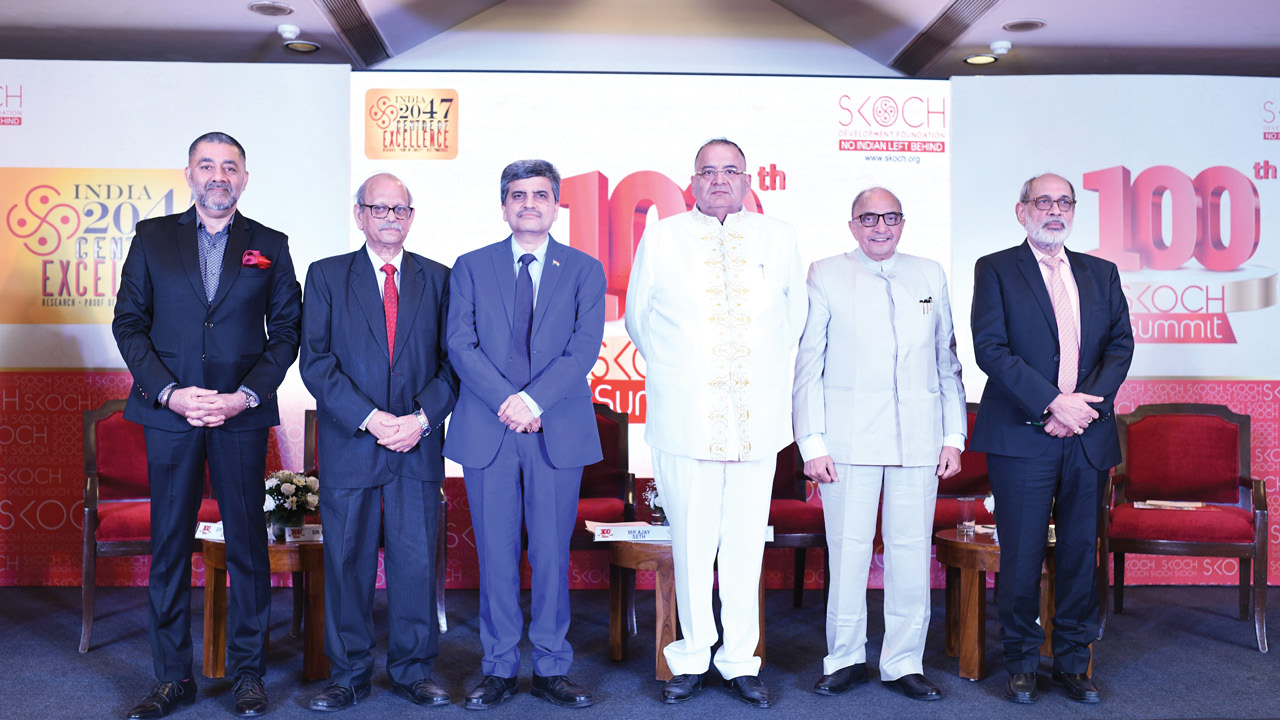
SKOCH Summit
Dr N C Saxena
Distinguished Fellow, SKOCH Development Foundation and Former Secretary, GoI
Dr. N.C. Saxena is a former Secretary to the Government of India and a distinguished civil servant known for his significant contributions to the Indian government. Over the course of his career, Dr. Saxena has held key positions in various sectors, including rural development, planning, and public administration. He played an instrumental role in shaping policy and spearheading numerous initiatives aimed at improving governance and development at the grassroots level. Dr. Saxena's work has had a lasting impact on India's development programs, particularly in areas related to poverty alleviation, rural employment, and social welfare.
Dr N C Saxena at the 100th SKOCH Summit: Navigating New Frontiers in Economic Justice and Legal Frameworks
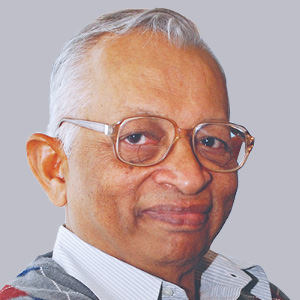
Dr N C Saxena
Distinguished Fellow, SKOCH Development Foundation and Former Secretary, GoI
Key Points*
- India has achieved strong economic growth and infrastructure development since liberalization, but this progress has been uneven across states.
- Interstate inequality has widened sharply, with poorer states like Bihar now far behind richer southern and western states.
- In the 1960s, the richest state was not even twice as rich as the poorest, but today the gap has expanded to five or six times.
- Historical factors such as colonial land systems and work culture have played a major role in shaping long-term regional disparities.
- Economic rankings of states have changed significantly, with southern states performing strongly post-liberalization and states like West Bengal declining.
- Excessive regulation and licensing in poorer states have constrained industrial activity and discouraged small-scale enterprise.
- Fiscal capacity in poorer states is weak, with low tax collection, inadequate central transfers, and shortages of government staff.
- Finance Commission transfers and centrally sponsored schemes have not adequately targeted states with the highest poverty levels.
- Development outcomes such as education and public services differ starkly across states, reinforcing a cycle of inequality.
- Reducing interstate inequality requires improved governance at the state level and reforms in central funding allocation to better reflect poverty and need.
* This content is AI generated. It is suggested to read the full transcript for any furthur clarity.
Transcript
Thank you very much for this opportunity. I would like to congratulate the entire team for organizing this grand function and also congratulate and wish Sameer many happy returns on his birthday.
Friends, as we all know, India has done exceedingly well in achieving a very high rate of growth — 6 to 7% — over the last 30 years after liberalization. It has also improved physical infrastructure — roads, electricity, sanitation, etc. — and reduced poverty to a great extent. So, therefore, there has been a lot of good progress, but it has also increased interstate inequality, which means that richer states are doing much better than poorer states.
In the 50s and 60s, the gap between the richest and the poorest state was two to one. If Bihar was the poorest and Maharashtra was the richest, then Bihar was just about half as poor as Maharashtra. But now Bihar, which continues to be the poorest state, is one-fifth or one-sixth of richer states like Karnataka or Telangana or other southern states.
Therefore, one finds that this increase in interstate inequality has very grave political implications. As we all read in the newspapers, whether it is the issue of language or delimitation or Finance Commission terms of reference, there is a great deal of political opposition. Therefore, reduction in interstate inequality has become quite difficult.
Friends, I will show you some slides which will prove what I am saying. As you can see, this is the picture in 1961. If we take Bihar’s income as 100, then the income of the richest state, Maharashtra, was 190. Then you have West Bengal at 181, Gujarat at 168, and Punjab at 170. So, the richest state was not even twice as rich as the poorest state.
Another development that has taken place is that the interstate rank has changed. Some states like West Bengal, which was the second highest, have not done so well in the last 70 years. Therefore, the ranking has also changed.
Let us look at what progress took place between 1960 and 1990. As you can see, Punjab did very well because of agriculture and the Green Revolution. Haryana also did very well. Interestingly, southern states like Tamil Nadu, Kerala, Karnataka, etc., did well but not as much because these are states where soil was not so rich and irrigation was not available. Therefore, southern states could not do as well during this period.
As you can see, West Bengal’s rank slightly fell, whereas states like Punjab, Maharashtra, and Haryana did quite well.
Now let us look at the latest period. After liberalization, one finds that southern states have done exceedingly well. Karnataka, Tamil Nadu, Kerala — all have done very well in the last 30 years. Punjab’s rank has fallen because of various problems in agriculture. Odisha, interestingly, has done quite well and its rank has improved, as opposed to West Bengal, which has fallen. West Bengal was the second richest in 1960, and now it is even below Rajasthan and Odisha.
So, in the last 70 years, the picture has totally changed, and interstate inequality is not easy to address because of political opposition from states.
Now this slide shows the share in population and the share in overall GSDP. For example, Uttar Pradesh has a population share of 17%, but its share in GSDP has constantly fallen — from 17% to 14%, then 12%, then 9%, and now 9.5%. Bihar also did quite well during the first five or six years of Nitish Kumar’s regime from 2005 to 2010 due to improvements in infrastructure, roads, and power, but after that its share did not improve.
Some poorer states like Madhya Pradesh or Rajasthan have been doing quite well. Odisha, as I said, did very well. Southern states and Gujarat are the states that have done very well.
This shows net state domestic product per capita in 2022–23. Bihar is the poorest at ₹54,000. Telangana is at ₹3 lakh, Karnataka also at ₹3 lakh. Gujarat and Maharashtra are around ₹2–2.5 lakh. Odisha has done quite well and is above West Bengal, Rajasthan, and Madhya Pradesh.
Interestingly, if you look at the last 200–300 years, up to the early 18th century, eastern states were richer than southern or western states. There was better rainfall, more fertile soil, and more migration, which changed work culture. Zamindars became complacent.
During the colonial period, western and southern states did better due to better land systems like the Ryotwari system, whereas eastern and northern states had the Zamindari system, where development was neglected. Infrastructure, education, and gender outcomes improved more in western and southern states.
Thus, historical factors combined with developments in the last 70 years have led to rapidly rising interstate inequality.
Backward states like Bihar and UP suffer due to historical factors, political instability, excessive regulation, and licensing. In states like UP, one cannot establish cold storage, rice shellers, flour mills, or even cut a tree without a license. Leasing land is also not allowed. These controls hinder development.
Fiscal issues also matter. Poorer states generate less per capita revenue and receive inadequate grants. They also face staff shortages and governance issues.
In contrast, southern and western states benefited from better infrastructure, social movements, higher education, urbanization, and stronger local governance. For example, Tamil Nadu has over 50% urban population, and Kerala and Karnataka have well-run local bodies.
Finance Commissions should ideally give more funds to poorer states, but political constraints make this difficult. Even centrally sponsored schemes often allocate more funds to richer states. The Economic Survey has recognized this problem.
For example, under MGNREGA, states like Tamil Nadu and Kerala receive more funds despite having fewer rural poor than Bihar. Bihar has six times more rural poor than Tamil Nadu, yet receives half the funds.
Allocation rules need to change. Funds should be linked to the number of rural poor or unconnected habitations, as was done successfully in the Pradhan Mantri Gram Sadak Yojana.
Fiscal comparisons show that Bihar, despite having a much larger population than Andhra Pradesh, has far lower per capita revenue and expenditure.
This results in stark differences in outcomes. Schools in Bihar often lack buildings and furniture, while even schools in poor districts of Kerala are well equipped. This creates a vicious cycle of poor education and poor workforce.
Finally, government staffing levels are low in poorer states. The world average is 30 government employees per thousand population; in Europe it is 60. India is much lower, and poorer states have fewer frontline workers like teachers, doctors, and police.
So friends, what I am trying to say is that state governments must improve governance and implementation, while the Government of India must evaluate programs better and apply pressure to improve outcomes in poorer states.
I will stop here as time is limited. Thank you very much.