SKOCH Summit
Mr Ajay Seth
Finance Secretary, Government of India
Mr. Ajay Seth is a seasoned civil servant and policymaker, currently serving as the Secretary, Department of Economic Affairs (DEA), Ministry of Finance, Government of India. With extensive experience in economic governance, fiscal management, and financial sector reforms, he plays a key role in shaping India’s economic policies.A senior Indian Administrative Service (IAS) officer, Mr. Seth has held various leadership positions in central and state governments, driving initiatives in infrastructure, public finance, and investment strategies. His expertise in economic planning and financial reforms continues to strengthen India’s fiscal and economic landscape.
Mr Ajay Seth at the 100th SKOCH Summit: Navigating New Frontiers in Economic Justice and Legal Frameworks
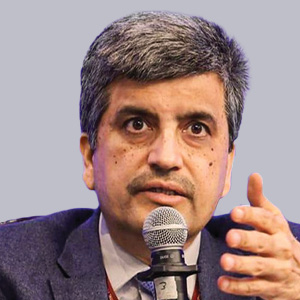
Mr Ajay Seth
Finance Secretary, Government of India
Key Points*
- The 100 SKOCH Summits over 22 years have consistently focused on producing actionable, cross-sector reform recommendations that build bridges between government, business, and society.
- India’s goal of becoming a developed nation by 2047 requires every stakeholder to play a role, with platforms like SKOCH identifying and scaling good work across the country.
- India must develop its own solutions for growth and development, learning from global mistakes but not importing ready-made models.
- While India has achieved significant economic progress and is now the fifth-largest economy, per capita income and equitable distribution remain critical challenges.
- The next 23 years demand a fundamentally different, more purpose-driven reform path; past growth strategies alone will not be sufficient to reach 2047 goals.
- Sustained high growth for 20–25 years, combined with inclusive development, is essential to ensure that “no Indian is left behind.”
- The four engines of growth outlined in the Union Budget—agriculture, MSMEs and manufacturing, investment (including people and innovation), and exports—must drive India’s development journey.
- Economic justice requires targeted policy support where markets fail, especially in rural areas and agriculture, alongside climate resilience and adaptation.
- Legal and regulatory frameworks should balance rights and opportunities, shifting from excessive control to trust-based, light-touch regulation with strong deterrence for violations.
- Digital technology offers transformative opportunities but must be deployed carefully to avoid overregulation, inefficiency, and social costs, while supporting productivity and inclusive growth.
* This content is AI generated. It is suggested to read the full transcript for any furthur clarity.
Transcript
Good morning to everyone. It is a real privilege to be here today and to be talking to this excellent set of stakeholders and awardees who have done wonderful work in their respective fields.
Especially on this occasion of the 100th Summit, from 2003 to 2025 — in 22 years — this long journey of 100 Summits, each one of them coming out with actionable recommendations on what society needs, what people in governments have to do, and what businesses have to do, building bridges — that is what the Summits have done. We heard Dr Phatak and thereafter we heard Mr Kochhar about it.
The agenda for reforms for our journey to become a developed nation by 2047 is a goal which we aspire to, and we are all committed to do our best to reach there. In that, each one of us is expected to play our respective role. I am glad that the SKOCH Group, the SKOCH Development Foundation, are doing their bit to the fullest of their capacity, looking for more options on how they can create more such platforms and also identify good work and take it to the entire country, as Dr Phatak said.
And if I can quote — it is not a quote by any great person, but it is a great quote — “Everyone can’t be great, but a great person can come from anywhere.” It can come from a rural family, it can come from an urban family, it can come from any state or any section of society. But as a nation, if we can identify that good work happening and then see what are the lessons for us in this journey towards Viksit Bharat, we have to find our own solutions.
It is our journey, different from the rest of the world. We have to see their lessons — what they did wrong — so that we don’t repeat those mistakes. But solutions have to be ours. They cannot come from somewhere else. We can’t import those solutions. The solutions are: let a thousand flowers bloom — get that replicated across the country. That is the kind of platform which this Summit represents, and I find the theme very, very appropriate at the current stage of our journey.
The overall theme of navigating new frontiers in economic justice and legal frameworks, with two sub-themes or two sessions happening today — one on agenda for reforms, and thereafter sizing and regulating the digital economy — on which I understand Dr Deepak Mishra has done a huge amount of work, and he will be talking to all of us in the afternoon.
Towards this journey of Viksit Bharat, India at 100, in terms of our goals, we have achieved a lot. We should be proud of where we are at this stage of our journey. Our goal is very ambitious, but we have achieved a lot, especially in the last 10 years, supported by structural reforms, macroeconomic stability, inclusive growth, and strengthening the supply side of the economy.
But that is not the end of the challenges. Our challenges are immense. In particular, Mr Kochhar talked about various indices. Each one of them shows so much diversity within our own country, in terms of various states being at different ends of development.
I was pleasantly surprised reading the budget of the UP government, which came out about four weeks back. Their capital expenditure outlay is 5% of GSDP of the state. Such a large state, with such a large population, has maintained that fiscal prudence — not generating enough revenue surplus, maintaining it, and spending 5%. At the same time, there are high-income states which are spending 2% and running into revenue deficit.
That shows the resolve of a large state saying that they have to invest in the economy while also investing in people. That makes a change. There are examples within our own economy.
But a few things are very clear. What got us here will not take us there. Meaning that India at 77 — that journey has important lessons for the next 23 years. It has to be a much more purpose-oriented and much more difficult journey to reach there. We have to do things differently. If we do what we did in 77 years, we will progress, but not achieve our goals. Meaning we have to do things differently.
And there comes the relevance of these sessions — where do we take our reforms, and where do we invest in our economy. What we have achieved today: we are the fifth largest economy. But fifth largest economy does not mean that the level of per capita income is adequate. From a citizen’s perspective, per capita income is important.
In 10 years, we have moved from 10th to fifth place. We will keep moving up. In terms of purchasing power parity, 25 years back we were 4% of global purchasing power; today it is about 8.5%. Another five years, by 2030, we may have 10% of global purchasing power in India. But we are 18% of the population. That means even in purchasing power parity, we have to at least double.
Then comes the question of distribution. It is national income; it is not that everybody is at that level of purchasing power. There is wide variation in income levels.
So what is the way forward? We need to grow. We need to grow fast. We need to grow over a sustained period of time — not 1, 2, or 3 years. We have to grow for at least 20–25 years at a pretty high pace. And we have to grow by adopting the path of inclusive development.
I bring that aspect because I particularly noticed — and pardon me, Dr Phatak — that I had not noticed it earlier while reading papers pertaining to the SKOCH Group or Foundation — that the SKOCH Foundation has in its logo itself “No Indian is Left Behind.” That is inclusive growth.
If you compare with other organizations — for example, “No Child Left Behind” in the education sector — meaning every child in school is learning well. That is inclusive development. Not talking only about how well we have done in higher education, which is important, but for India of 140 crore people, that kind of mindset is needed — that nobody is left behind and everybody gets a good outcome.
In the words of the Hon’ble Prime Minister, “Sabka Saath, Sabka Vikas.” It is not just about growth; it is about inclusive growth. But we have to be clear that without growth, inclusiveness is meaningless. Without growth, distributive policies will have suboptimal results. We have to find ways to achieve both.
We are in a connected world. We are in the midst of a very tough global environment — geopolitical as well as economic. My sense is that economic difficulties faced by nations — developed or developing — are getting accentuated in their geopolitical stance. It is not the other way around.
There are more uncertainties, and going forward, I don’t see those uncertainties subsiding, at least in the medium term. We are in an era of uncertainties. Nations today seem to be moving away from cooperation towards competition.
With this kind of challenge, aspiration, and goal, what should our journey be? This is what the Hon’ble Finance Minister mentioned in this year’s budget — about four engines of growth — and there is a purpose and design in the order of those engines.
The first is agriculture. There is a general discussion that secondary and tertiary sectors will generate jobs, that urban areas will generate opportunities. No. Even in 2047, half of our population will be in rural areas. A large population will depend on agriculture. So the first engine of growth has to be agriculture.
The second is MSMEs and manufacturing — not services. Services are important, but agriculture and manufacturing are equally or more important.
The third is investment. Not just infrastructure investment, but investment in people — education, health — investment in the economy, and investment in innovation.
The fourth is exports. But in the medium term, this engine may face headwinds.
And reforms are the fuel. All this is for Viksit Bharat.
Now let me dwell on economic justice and legal frameworks. What is economic justice? To my mind, it is being conscious of investing in people where markets cannot deliver, where environmental and economic conditions make things difficult.
Private sector will go where profits are. Government policies, think tanks, and platforms like this must focus on those left behind. The not-for-profit sector’s role is to generate ideas; replication is the government’s responsibility.
Rural prosperity and resilience is critical. Migration should be an option, not a necessity. Climate change is here to stay, and adaptation is essential — especially in agriculture, which is most vulnerable to extreme weather.
On legal frameworks, do we focus on a rights approach or an opportunity approach? It cannot be either-or. We need balance. Control versus deterrence — are we over-controlling, or are we creating conditions where economic activity can flourish and only deviations are penalized?
In the next 23 years, we need not only investment but productivity from all factors of production. We need smart trade-offs, because resources are limited. Development can be financed only by taxpayers, ratepayers, or the next generation. We must be conscious not to burden the future unless investments are productive.
We must move from a “fail-safe” mindset to a trust-based approach. I’ll give three scenarios: octroi checkposts, rumblers on roads, and modern expressways with guardrails and cameras. We must move to the third model — enable activity, deter violations.
This is how productivity increases. Entrepreneurship requires allowing failure and recovery, not zero-risk policies.
Finally, on the digital economy — it is a huge opportunity. Financial inclusion and payments have transformed lives. But it can also become a drag if it leads to overregulation or information overload.
Digital technology must be used carefully. Social media distractions, shrinking attention spans — these are societal challenges.
The budget announced a new approach to reforms — light-touch regulation, modern, flexible, people-friendly frameworks. A high-level committee on regulatory reforms and mechanisms for financial sector reforms are coming up. Competitive cooperative federalism among states is also crucial.
Our journey towards Viksit Bharat is possible only when all regions, states, and people come together.
We look forward to actionable recommendations from this Summit. Thank you very much for your patience. It has been a real pleasure. Thank you very much.