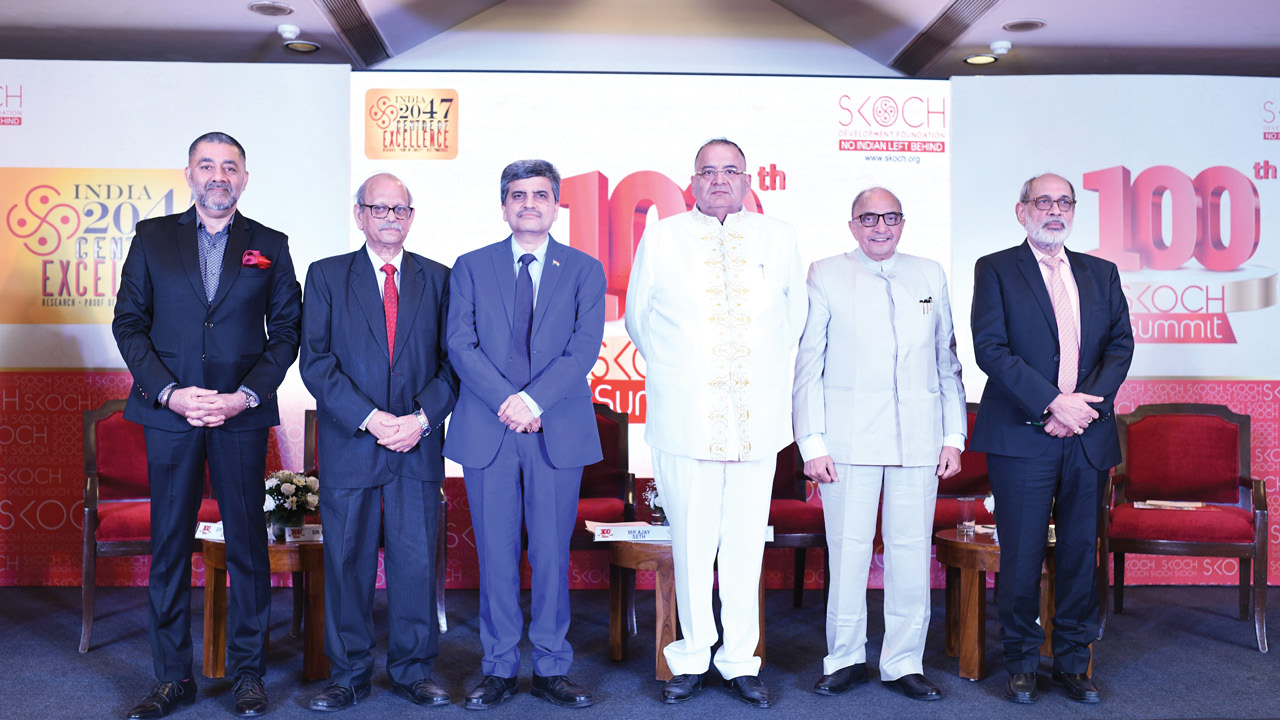
SKOCH Summit
Mr Sameer Kochhar
Chairman, SKOCH Group
Reforms historian and author of best-seller ModiNomics, Sameer Kochhar is Chairman, SKOCH Group. He is a passionate advocate of social, digital and financial inclusion and is a foremost expert on governance and inclusive growth. His work has been acclaimed globally and endorsed by Mr Narendra Modi, Mr M Venkaiah Naidu, Dr Manmohan Singh, Mr Arun Jaitley, Mr P Chidambaram, Mr Yashwant Sinha, Dr C Rangarajan and Dr Montek Singh Ahluwalia and so on. In his thinking and writings and activities, his profound admiration for India's economic reforms and in extension, those outstanding personalities who strive to make these reforms more meaningful and broad-based comes out clear and unambiguous.
Mr Sameer Kochhar at the 100th SKOCH Summit: Navigating New Frontiers in Economic Justice and Legal Frameworks
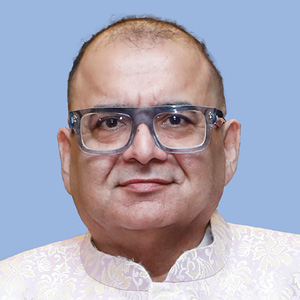
Mr Sameer Kochhar
Chairman, SKOCH Group
Key Points*
- The 100 SKOCH Summits over more than two decades have built a nationwide platform to recognize grassroots initiatives and document India’s journey toward equitable growth.
- SKOCH has created a large knowledge repository by conducting around 3,000 impact assessments annually, preserving project-level evidence often missing from official records.
- The speaker’s personal experience of poverty has shaped SKOCH’s strong focus on inclusive growth and understanding people’s lived realities beyond data alone.
- Traditional global indices often misrepresent India due to biased criteria that do not account for India’s federal structure, scale, or technology usage patterns.
- SKOCH developed alternative, Global South–sensitive indices to more accurately measure governance, development, and digital progress in India.
- Project-level impact assessments allow diverse development interventions to be compared using a common quantitative framework.
- SKOCH’s research has helped reframe national debates on employment, governance outcomes, and development performance using evidence-based narratives.
- Indian-specific ESG standards and business responsibility indicators have been developed to better reflect India’s priorities such as jobs, poverty reduction, and sustainability.
- Studies comparing Indian companies with global peers show India performs strongly on codified legal and human rights standards, with scope to improve reporting on non-codified areas.
- The keynote calls for strengthening socio-economic research in India through institutional support, as applied economic and sociological research is currently underrepresented.
* This content is AI generated. It is suggested to read the full transcript for any furthur clarity.
Transcript
Namaskar. I was only 38 years old when I started SKOCH. Today I’m 61. I had a full head of hair. I had one toddler and a schoolgoing son.
Looking back at these 100 Summits that we have done, you’re supposed to reflect back as to what is it that I have gained, what is the ground that I have covered. I think what makes me absolutely proud is that I have gained all of you.
Today, between this morning and evening, there will be 150 people, 180 people from across the country — from small districts, panchayats, cities, state capitals — who have contributed to make India a better place, a more equitable place. All of them will be sharing their stories, get recognized.
If you look at it, we do 3,000 such assessments in a year, and we are creating them as a knowledge repository. So if you want to know what NIC did 20 years back in Majuli, the only record of that is possibly with SKOCH, and it’s on a video.
So we are very soon going to put up a museum of equitable growth of India, or something of the sort, where we’ll capture journeys of various people and what they did.
The second thing that I have gained is all my friends here. I was, as I said, 38. Dr Phatak must have been about 50–55. Dr Ramchandra was also a young person. And they are still there. They are there with me, so many years later — 25, 30 years later. It’s my 100th Summit, and all of them have left whatever important things that they were doing across the country and they’re here to talk to you and to share the experience.
My heart essentially bleeds for inclusive growth of India. I come from a very poor family, which I’ve talked about. So I was a practitioner of poverty for the first 17 years of my life. My parents were physically challenged. So I have known problems and hunger firsthand. Right? So that has been my privilege — that I have known these things firsthand.
I have also seen — I am a child of transition. So when you look at 1991, when the Indian reforms started, till today, India is on a vast journey. All of us sitting here have seen the ration days. We’ve seen the telephone lines. We’ve seen kerosene lines. We have seen the era of shortages.
One thing has remained constant, which probably is noted — and that burai is not because they’ve done something wrong. That burai comes out of the angst of somebody who is much lesser privileged than those guys, but without realizing that if those guys were not there, you would not even have that vanaspati that you were eating. So someone actually has to explain them that.
Also, we found that over the years, the entire system of the country has been taken over by what I call the economists or scientists — people who look at data. Now poverty alleviation cannot happen on a spreadsheet. It is a thing that you have to bring felt needs of the people. You have to address those, and you have to assess whether whatever you have done.
So we became the first socio-economic think tank where we were doing these impact assessments of little-little government interventions and seeing what is the change that they’re bringing about. Then we realized that we can actually put a number to it.
So suppose if you’re doing water supply in Uttarakhand and you’ve done school education in Majuli, and we are able to rate both of them with a number — that this project gets seven, this project gets eight — then immediately all development works become comparable.
So that’s the methodology we’ve done. We are saying that you may be doing well in education, somebody else is doing better in climate, but net-net this is the number.
When we started doing this, we said, why is it that India is so criticized across the world? And we started looking at all these indices. There’s a season of indices. So where if you look at the e-governance development index — and all of us are extensive users of e-governance — India’s rank is 105 out of 193 countries. Would anyone believe?
And this is the same situation: index 134 in human development, on BAA3 in sovereign rating, so on and so forth. So we are like a bad narrative — so bad that even the harshest critics within India would not believe this to be a true story.
So what we did was we started looking at these indices and we said, what are they measuring? And we realized that these indices are very biased.
For example, in e-governance, they are saying what is the percentage of wired internet. Now India never had wired internet. We are all wireless internet. Even my driver has a wireless internet. My grocer has a wireless internet. So if you take out 90% of my internet users, obviously my rank is going to be 105.
Similarly, women empowerment — they say what is the percentage of women in your parliament. Now you are in Europe, you have a croissant-size country, you only have parliament. I have parliament, I have state legislatures, I have panchayati raj, and I have millions of women who are elected and they are doing legislative work at the relevant level. We are a federal country. So if you say, no, I will count only the 120 that you have in parliament and I will ignore the 1.2 million that you have in other tiers, you’ll obviously have a low rating.
Now the nefarious design is that all of these indices are used to deflate each other. So you’ll find that you’re doing sovereign rating, women empowerment — so your sovereign rating will be very bad.
So what we did was we looked at all of this and we said, what are the more Global South-sensitive criteria? And we put a number, and you find that our rank on EGDI is two. I think Dr Deepak Mishra has done a study where the rank is three. So I’ll say okay, I’ll agree to his number. I’ll concede. But we are certainly not 105. Right?
So index after index we were able to fix it, and then we went to the government and we said, this is what we have done. Unfortunately, there is no ministry of indices in the government. So it is no one’s baby. So this is very good work.
Now we’ve done it for top 20 economies. Can you do it for 193 countries? So there is no budget, nothing. So we were asked specifically on sovereign rating: can you do this pro bono? I said, listen, we are a foundation. We are too small to subsidize Government of India.
So we did that, and then we realized: how to make it more useful, or a business model where we can actually do a conference and invite people and maybe get some money out of it? We started doing Indian indices.
We realized that if we have to answer the world, then we must have our own indices, which we go and tell them: our indices are better than yours.
So just to give you another example of EGDI. In EGDI, they’ll say what is your education level. Now you tell me: who needs to be educated to use e-governance in India? Education has its own merit, I am not brushing it aside, but here we have intermediaries. You can ask your neighbor, you can ask your son, you can go to a CSC center, you can go to a banking correspondent, and you have a voice-activated system. So education really has nothing to do with your ability to have e-governance.
So we built in those kind of correctives, and we said now this is what is more appropriate for India. And we started creating baseline data for every Indian state.
What I’m sharing with you today is some of that data. This is the possible Indian ranking of India in various ratings in top 10 economies.
So the first use case of this data, when you are doing project-level findings and studying, is this wonderful scheme called Mudra Yojana, or PMGSY, or Pradhan Mantri Awas Yojana, where so much building and money has gone.
Now our statistical system fails to capture all of this. Our economic systems don’t capture all of this, because micro or applied economic research is something that has been stopped in India, and there is certainly no sociological research.
So we have been studying Mudra Yojana, SHG formation, infrastructure development for years. So we were actually able to translate all of that into many years of jobs, and all of them were new, could not be disputed.
So if you find that between phase five and phase six of the Lok Sabha elections, the conversation became only the SKOCH report, and the number of seats actually went up between five and six because we were able to very adequately handle the employment issue, and it could not be countered by anyone. Even till date it remains uncontested.
Then we said that Indian industry is… I don’t know. So how do you measure the sense of goodness? So we started creating.
Globally, there is something called governance reporting indicator, which is done by a private institution somewhere in Sweden. No one asked. So if you go to SEBI guidelines or any other guidelines, they’ll say we will accept ESG — whether they’re good, bad, ugly, no one knows.
So we created 1,200 indicators which were defining: when you say you are a good business, what does it mean? And we have come out with a book which is this thick. So this is the first stack of Indian standards on what ESG means.
Because this ESG and DEI — fortunately now President Trump is doing away with it — it is addressing Global North problems. If climate change is your problem, my problem is jobs and poverty. So what do you expect me to address first? Right?
And so can you give equivalent? So we used the same model. Seven number in job creation is same as seven in climate risk mitigation. So I’m at par. Why don’t you — let’s discuss the index.
So last year we came up with a baseline study where we ranked Indian companies. So we say here: we’ve ranked only Indian companies within India and what they’re doing. And this is a very exhaustive report.
What is the intervention they’re doing? When we say Hindustan Unilever has done well, we actually went to 20 factories of Unilever to look at how they have done pollution management, and we documented all of that. So none of this is fake. Each one of them has got underlying data and base.
Then we said one area where India gets really beaten up is human rights. Now human rights is not a central subject; it is a state subject. It is a state business. So since I did not want it to get controversial, I said let’s look at just human rights in business.
So we did a study of Nifty 50 companies versus Fortune 500 top 20 companies, and we find that on anything that is codified — which is law — we are doing far better. Anything that is not codified, like mental health, psychological risk management, managerial training, etc., because there’s no law in India that says you have to do this, we are not as good — but still we are neck to neck. So overall we are actually at par between the two of them.
And only on the codified indicators we are far ahead of top 20 Fortune 500 companies. Right?
So what is the learning? The learning is: digital, mental health, human rights — codify for business, and our people start reporting that. It’s not that they’re not doing this; they’re just not reporting this. So if they start reporting it, your position improves.
This is the Nifty 50 versus Fortune 500 top…
All of us are facing a huge digital addiction problem. Foundation was the first one to pick up digital addiction as an issue. It is leading people to suicides. It is leading to credit overload. It is leading to all of us being tied to Netflix and so on and so forth.
And we did a benchmark of three industries where we find the most. So we came up with a responsibility framework where we found that OTT was the most responsible, followed by real-money gaming, and the really bad guys are the digital astrology guys.
And we are trying to now set up a digital mental wellness helpline. We thought we will do it at our small budget, which is nothing. Mrs Nirmala Sitharaman and MoS in the current budget have kindly offered 79.66 crores for this program, which I think is going to be implemented by… so it is actually being planned at a scale where it is required.
Token, but this is something which is going to become national. So kudos to the Government of India for taking note of this.
This is the State of Governance report, which is coming out of primary research and outcomes. So when we do deflators, we don’t really have to take people’s opinion because we have real data of project-level outcomes. So we can use that to say this is what the quality is.
And by published data, what is available, which can be counted in kilograms, we can do an evaluation which is quantitative. So we say: quantitatively you are here, qualitatively you are here — add them together — this is the status. That’s our methodology.
So we’ve come up with State of Governance Index, which is what we call Governance Outcomes Index. This is a heat map of that. Maharashtra is topping it, followed by Gujarat. This is for only 2024. We have this data going back 10 years. So from 2014 to 2024, we can give you a decadal assessment of who moved and how.
And all of you have actually contributed because each one of your projects is a part of micro-level data that is going into evaluating your state here. So that is why it is incredibly important for states to participate in these surveys.
We don’t have a discovery process. The state government has to come and tell us that these are the 10 projects we think we’ve done well on our own. We cannot look at your 100 projects and identify these 10 are doing well. That’s a limitation of being small in size.
Second is e-governance infrastructure index, which is similar to EGDI but it is more attuned to the Indian reality. We are looking at three parameters: telecom infrastructure (number of internet subscribers per 100 population), state-wise teledensity, human capital index — we left it to gross enrollment ratio because no one really needs to be educated beyond that to use e-governance.
And more importantly, which is not there anywhere in the world, is OSI. We have, thanks to NIC, a website called eTaal where every electronic transaction is captured in real life. So even in America they’re guessing; in the UK they’re guessing how many services. We can actually tell you the exact number of services, number of transactions — by day, by year, by month. This data is not there. I don’t know why India has not been able to use it.
But we should be able to use it and say this is why our EGDI is better than yours and therefore my sovereign rating is higher than yours.
Then we do Financial Prudence Index. NITI Aayog has come up with something like Financial Health Index, which we felt was slightly different from what we would like to do. So we’ve come up with Financial Prudence Index where we have rated states on fiscal sustainability and prudence, which is debt-to-GSDP ratio and GFD (gross fiscal deficit) to GSDP ratio.
Now interestingly, in the sovereign rating they don’t take into account debt-to-GDP ratio, where India is very good. If you’re not even looking at what is my repaying capacity and then you’re rating me, then how can I get a fair rating?
Own tax revenue, non-tax revenue, development expenditure to GSDP ratio, capital outlay to GSDP ratio, per capita pendency rate to show how your contracts can be — it’s a proxy for contract enforceability and rule of law.
So here again Maharashtra leads.
This is Government Transformation Index, which is: if you keep the fiscal part aside and you take 50/50 weightage on what is your infrastructure, transactions, etc., and 50% of what is your outcome, you’ll find a beautiful thing.
Now, in all the discussions you’ll find there is this whole debate about federalism and inequality in state development, etc. Now here is some data which is telling you something different. This is not cumulative — this is only for 2024 — which is showing that actually there’s a neck-to-neck race between regions.
It is incorrect to say that the South is more advanced than the North, which is more advanced than the West, because it is not only about population alone. It is also about what else is the citizenry getting there. So this can perhaps give another view to look at what all parameters to look at while taking any decisions related to federalism.
This is Government Efficiency Index. While President Trump has just about discovered it, we’ve been doing it for a very long time. So we are looking at what is your outcome and what is your financial prudence. If you add the two, you will get your efficiency ratio.
And all these things are available at an atomic level. If you say, okay, don’t add these, do something else — the data is there.
This is State of Development, which is fiscal prudence, EGDI, and outcomes together. And here you find no state has been left behind. West is doing the best, followed by North, then South, then Central, then East, and Northeast is a problem area.
This is ethics policy.
With that, I come to the end of our presentation. All these things are available in great detail. That’s all I can tell you. What I’ve shown you is just the top view.
And what all of us are trying to do is trying to tell the government that India needs the socio-economic narrative. There is no think tank that is doing that. We have a lot of very good economic think tanks. For sociological research and applied economic research, there is nobody.
So if there can be an institutional mechanism, or we could get some help, we would be delighted to support this. Nevertheless, with whatever limited resources we have, we are doing what we can.
Thank you very much for joining us today.