SKOCH Summit
Dr Gursharan Dhanjal
Vice Chairman, SKOCH Group
Dr Gursharan Dhanjal, MA, MPhil, PhD from Delhi University and an expert in strategic affairs, is Vice Chairman, SKOCH Group. He is also the Editor of INCLUSION—a quarterly publication that focuses on development and addresses inclusive growth-related issues. INCLUSION has completed six years. He has over 20 years of work experience ranging from academics to research and business journalism to consulting. He started his career as an Assistant Professor and taught at Delhi University for five years before joining Asia Business News (India)—Dow Jones, a premier broadcaster of business and financial news during the mid-90s. He also worked for CNBC for over three years during the late 90s.
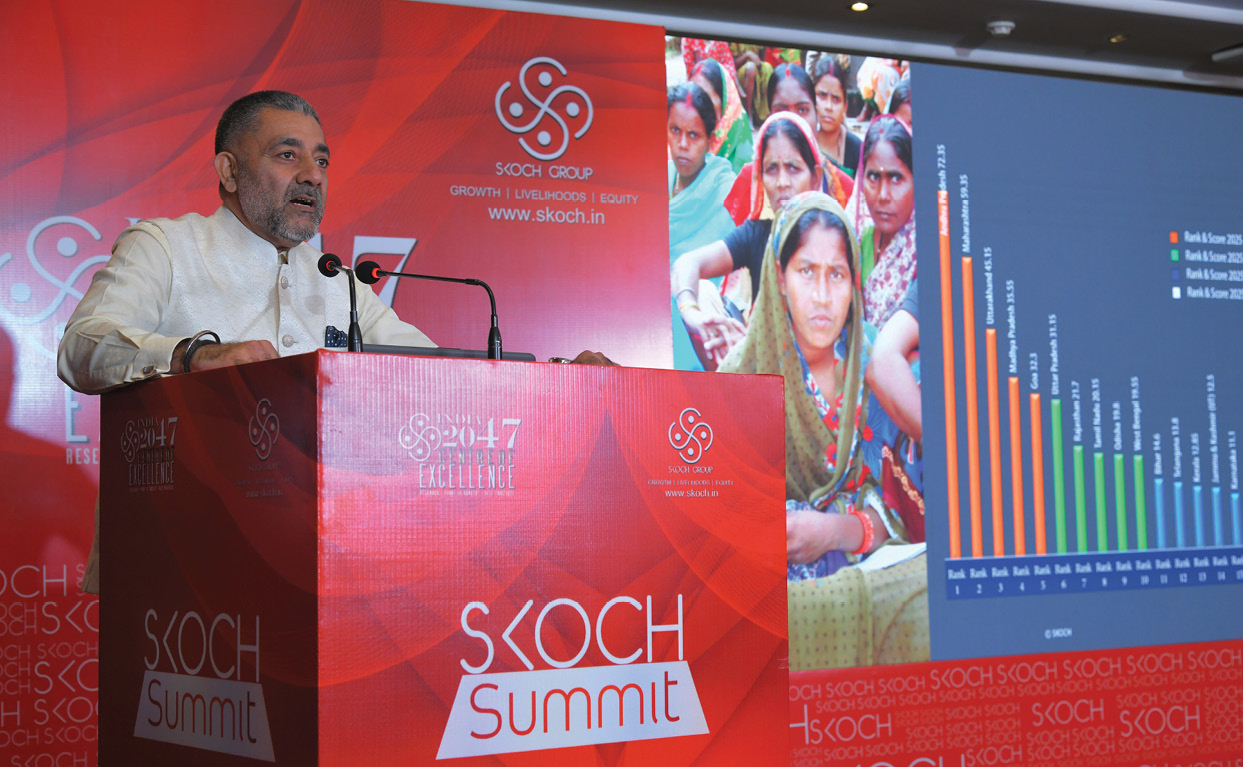
Dr Gursharan Dhanjal at the 107th SKOCH Summit: Governance Transformed
Dr Gursharan Dhanjal
Vice Chairman, SKOCH Group
Key Points*
- SKOCH’s initiative focuses on documenting and institutionalizing India’s governance journey, not just recognizing awards.
- India’s governance has already transformed, with citizens acting as equal stakeholders in the system.
- Last-mile governance at districts and municipalities is the foundation of effective delivery and impact.
- Successful local projects must scale to become national models and influence broader policy.
- SKOCH has documented over 50,000 case studies to capture real governance innovations across India.
- Key transformative decisions, like enabling SHG bank accounts, have driven financial inclusion and women’s empowerment.
- Small interventions (e.g., rural roads, SHGs, digital land records) have created large-scale national impact over time.
- State rankings show dynamic performance shifts, with Andhra Pradesh, Maharashtra, and others leading in governance outcomes.
- Governance trends indicate improvements in district administration, policing, e-governance, health, and agriculture, while some sectors lag.
- Knowledge sharing, replication of best practices, and collaboration across states are critical to sustaining governance transformation in India.
* This content is AI generated. It is suggested to read the full transcript for any furthur clarity.
Transcript
SKOCH awards. But important thing is to understand that this is not about SKOCH award. It is about institutionalizing the contemporary history of India. Mr. Kochhar, Sameer Kochhar talked about, he gave, you know, an overarching view where India has moved 2001 onwards.
Practically speaking, we are we have been totally transformed. So we are not talking about governance transforming. We are talking about transformed governance in a way wherein we are all equal stakeholders. Another important element is that whatever you have done in your own spheres of influence, in your own areas, whether it is in the district or the municipalities. In fact, you know, that only happens to be the basic element where the governance is delivered at the last mile.
That needs to scale. Until such time anything scales, it does not become a national example. We have in our experience seen that lot many projects over a period of time have scaled to an extent wherein they become national level schemes. From there, we moved on to what mister Rohan Kochhar presented was a view from a view from a window of ten years. I will take you closer to 2025, wherein we will talk about how it has all transformed and confluenced in the year 2025.
But more importantly, what we need to understand is that how do we put this knowledge together? That was a bigger challenge. Today we talk about the topmost Ivy League universities in the world. What are they known for? They are known for documenting the knowledge, analyzing it, presenting it so that it can help the communities not only in their own country, but communities worldwide.
When we found that there is a complete vacuum there, we designed this program of bringing all the successes together onto one platform. And that platform was SKOCH Summit. To enhance that platform was SKOCH Award. So ladies and gentlemen, today we would have captured more than 50,000 such successful case studies. And these have been documented.
To give you a few examples, Mr. Kochhar talked about, Majuli and Derkan and the lady who, on the same platform, you know, was interacting with a senior minister. Dr Rangarajan, as the governor of Reserve Bank of India, had taken a very important decision. So Mr. Kochhar, in his conversation with him, he said that your contribution has been immense. So the awards committee is conquering that a SKOCH Challenger Lifetime Achievement Award be conferred on you. His answer was, What have I done? There are so many things. Sitting in a seat, you obviously move the ball from one place to another.
He was reminded that one important singular decision of allowing SHGs bank accounts has brought about financial inclusion in this country. And all of you would agree with me that not only from the point of view of opening the bank account today, majority of the projects which are being implemented by different departments across states are strengthening the hands of SHGs, which is in the name of MUDRA, which is what we call micro entrepreneurship. It's actually being promoted, that level of SHGs. So women are empowered. So one decision that was taken a long time ago in 1991 has transformed the country.
Sewa has been one example. It has scaled. As recent as, you know, a few implementations by the state of Maharashtra that has scaled, wherein the women are being promoted as micro entrepreneurs. There have been examples, you know, where I'm going to be. We have heard of a very popular TV show called Shark Tank, wherein the startups come and make presentations to the investors and they make money out of there or whatever it is.
One small intervention in one state was also thought on the same lines, wherein women entrepreneurs from the villages, from the rural India were picked up and they were credit linked. They were sponsored. Many such stories. I'll share one more interesting anecdote. Today, India boasts of having the largest road network called the rural roads.
This was conceived during the time when Mr. Bajpai was the prime minister of the country and by a gentleman called Mr. M. Venkian Naidu, who was the rural development minister then for a very short term. And he took this proposal to the honorable prime minister that we need to do rural roads. He was told that this is a state subject. We will not get support. Think of something else. Then let me try. Okay, try.
Low and behold, the states were aligned. Today, Pradhan Mantri has changed the might of the country. One small intervention, such deep impact that not only from the center, Mukhyamantari Grammaraj Yojana also started it scaled nationwide and became a case study which is now being taught in Harvard. We captured it in the year 2006 when it had started reaching the people of the country, the person at the last mile.
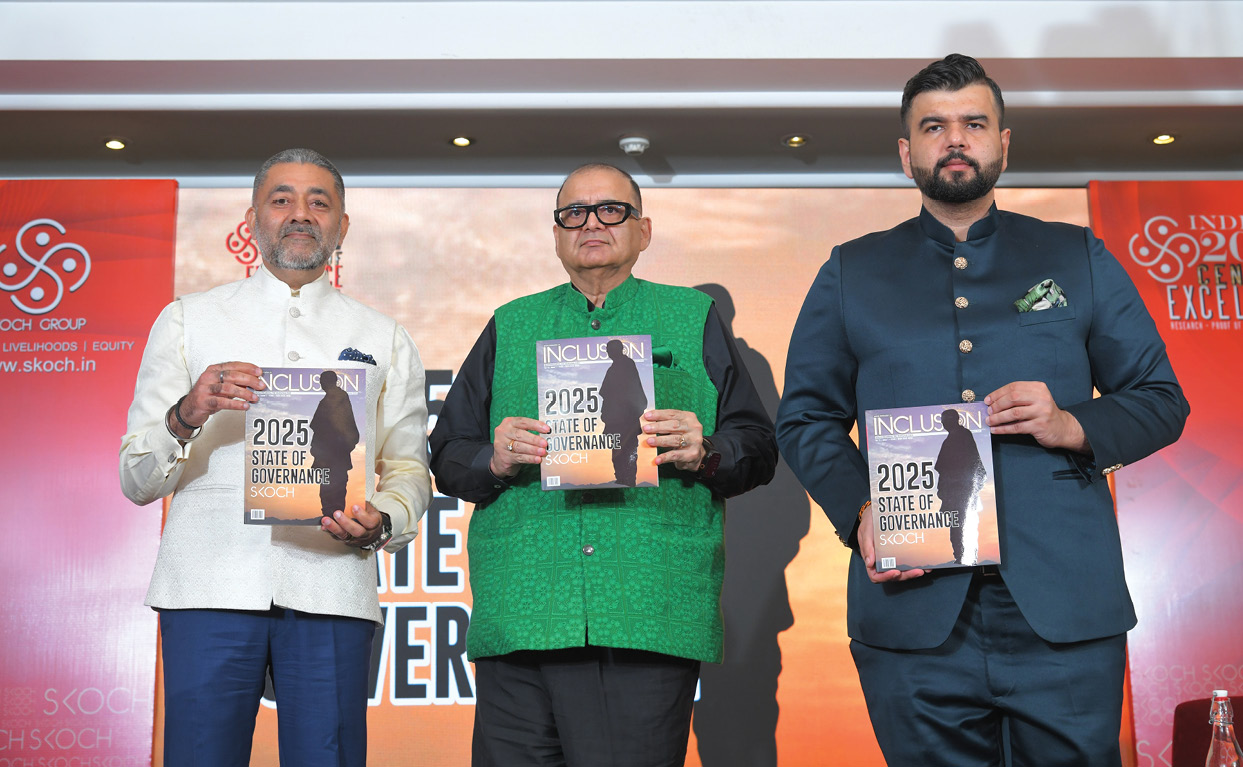
There are many such examples, which is what we have captured, we have documented, we have published. And, even today as we speak, we are talking about the year 2025 state rankings. This has been put together as the SKOCH State of Governance Report five and published in our magazine, Inclusion, which is already on display outside. You can pick a copy for yourself.
So you saw, the decadal view which Mr. Rohan Kochhar presented. This is the last year's view. So we divide the states among stars, performers, catching up and others. You can see how the states have performed. The number one on top is Andhra Pradesh followed by Maharashtra.
Let's look at the cumulative ranking 14 to 25 once again. This has already been talked about, but the element of 2025 has been added to this. And once again, the state of Andhra Pradesh stays on top, followed by Gujarat, Maharashtra, and then West Bengal.
Now this is a timeline study. You can question what's happening in Gujarat today. You can question what's happening in West Bengal. You can question what's happening in Arunachal Pradesh or Manipur today. I'm not talking of that. I'm talking about how the governance has transformed over a period of time and where we stand today. It's really a story of glorious success.
If we compare last two years, Andhra Pradesh, Maharashtra, Uttarakhand, Madhya Pradesh, and Goa, which are our star states on a sequence of one to five. Andhra was number three. It has jumped up two notches. Maharashtra is down by one. Uttarakhand is up by four. Look at Goa, up by 20 notches. From 25, it has jumped to five.
Amongst the performers, UP is down by two. Rajasthan is down by six. Tamil Nadu has not changed its score. Odisha is also down by three. West Bengal is down by five. Now when we say down by five, we are not saying that this is the final word. This is what we have studied based on what has been submits considering states, departments, municipalities, and the districts. If they are convinced they indeed are doing good work, it comes to us for assessment. So it's limited to the submission of the successes for the consideration of SKOCH assessment and award.
Now this shows the trend. In last one year, the district governance has improved. So is policing. So is e governance, health, agriculture. Now this gives us an insight into as to which way, which direction is the governance moving.
Having said this, the center increasingly is reducing its role in the growth and the states are becoming increasingly important. And within states, the districts have started performing even better. Once upon a time, districts used to suffer. That has been transformed.
Now these are the sectors which have shown stability in last one year, which is rural development for obvious reasons, then education followed by revenue and women and child development. Now such areas, if you can see even culture, sanitation, the importance of culture is being redefined, not only the dance and drama, but, you know, the heritage that we have had. And promoting it has become extremely important. Why not? Of course, India happens to be one of the oldest civilizations in the world. Why should we forget? So increasingly, there is a focus. And for the last two years, we are seeing that there is stability being maintained there.
Not so good news. There are some sectors where there is reduced focus. Municipal governance, power and energy, trans ease are doing business. Now one state is ahead, the other one is lagging. Now this is a cumulative score of all the states put together. Last year, we had participation from 30 odd states and union territories. So the data is based on what we have received, assessed, and evaluated.
Let me give you a snapshot of some of the top ranking states as to where do they stand. So Andhra Pradesh has topped the list third time, not in a row, but over a period of last ten years. From a state ranking all India level, three, they have jumped to number one. And in AP, district governance, e governance, municipal governance, sanitation and police and safety have become the top gainers. Consistently, they have performed well in environment, power and horticulture and education.
And then there are some sectors which were not performing. They had performed some time in the past, but there was a gap. They came back, and then there are first time participants, meaning to say that when we talk about that there needs to be a comparative spirit between one state and another in the true spirit of comparative and cooperative federalism within the state itself, the departments, districts, and the municipal corporations need to compete.
These are some of the well performing projects. This is the first one is transforming urban livelihoods from MAPMA. So what I talked about earlier, strengthening the hands of the rural SHGs and the urban SHGs is something which is what is done by MAPMA in the state of Andhra Pradesh. Then we have digitalization of APCO and the two megawattings solar farm. This was an innovation in Krishna River wherein a floating solar farm was created. Then we have micro irrigation project followed by waste exchange and then smart kitchen project. This was to do with the Anganwaris.
In the state of Maharashtra, which was number one last year, it has dropped to number two. So this is in the true spirit of competition. Again, there are a few gainers, which is rural development, forest, ease of doing business and transport. Recently, they have done well in agriculture, power and energy and police and safety.
And these are the national rankings. There are comeback sectors, and then there are first time participants. Now, if you look at Mukhay Mantri Saur Krishi Vahini Yojana, this is built on the framework of PM Kusum, wherein a reliable daytime energy is provided to the farmers. Now mind you, this was first started in Gujarat way back. That means to say that has also scaled. So these are those examples which are no more islands of successes. These are the oceans of successes. And there is a cross pollination, and there's a mutual learning and sharing experience as a result of which India as a country in a cohesive manner grows and moves forward.
Similarly, you have Gay Bharati. This is the one I was talking about, a TV show wherein rural women entrepreneurs as a micro entrepreneur, and they were linked with credit. So you have chia seeds and you have citizen centric digital services portal, all those services being delivered unhindered.
Uttarakhand has been a success story from number seven, jumping to number three. Gainers, top gainers have been municipal governance, social justice, rural development, urban development. As you can see here in one state, districts are performing better. In another state, municipalities are performing better. In yet another state, you have the rural development or otherwise the sanitation as those areas with more focus. Meaning to say it shows as to, you know, not only what state is focusing on, what state's priorities are. Priorities are based on the needs assessment. It is based on the demand side governance as to what people want.
Have affordable housing by private developer on private land. Now this is the maiden example in the country wherein the government invited a private developer to develop on a private land an affordable housing, which is to be given to people in need. And that has been a runaway success. Similarly, mining digital transformation and surveillance system, development of I triple C for waste management. So far we have been hearing I triple C essentially in terms of police and safety or transport. This has been done for waste management in the state.
And pre recruitment training for wards of ex servicemen. Now there are SANIC boards in almost each and every state. They have no money. They are there sitting only to ensure that ex servicemen get their benefit. So they are basically the facilitators of a demand taken to the relevant department. For the first time, it has been done in Uttarakhand that the wards of ex servicemen, they were trained, and they were also more than 2,500, and majority of them joined the armed forces.
So as I said, these are the things which will make it to the national headlines. Economic Times and the Times of India, they are just not interested in this. So you need some mad people in the name of SKOCH to be able to do it. And thank you all very much for posing your faith in us that what we are doing shows us the path and shows us the light.
In Madhya Pradesh, this has been another success story from 15 rank jumping to number four. Similarly, there are top gainers. It also shows as to, you know, which direction is Madhya Pradesh going. Police and safety, cooperation, and district governance. Consistently, they have been performing well in forest, revenue and ease of doing business.
The tiger there suggests it all. And there are a few comeback sectors and then there are first time participants, meaning there is no innovation. You have to keep moving. You have to keep walking.
Prevention of cybercrime, eMandi app, livelihood initiatives, gift a desk. Now this is a very interesting intervention in the district. Generally, the schools in the remote districts do not have desks for the primary and the secondary schools. They still sit on the floor on a chakra or a mat. This is how at the primary schools, a desk was gifted to the children so that there is more and more interest. In the modern schools, there is access to Internet to attract more and more children to the school. Those imperatives perhaps are non important for the time being when we talk about places like Sioni. If I ask you how many people in the house would have heard about Sioni, not many hands will go up. So we fly where even eagles don't dare.
Goa was number 28 in 2023, it has jumped to number five. It means that virtually Goa's participation was very feeble or non existent. There were a few sectors wherein they participated earlier education, finance, skill development, sanitation and so on, wherein they came back with their successes. This indicates Goa is now catching on. It's catching on to the national spirit.
I will draw your attention to the last one, which is Khelo Goa centers. Generally has been nonexistent as far as their participation in the national games is concerned. This was spearheaded by the chief minister himself. Under his direction, they opened academies wherein sports like volleyball, basketball, and so on and so forth were promoted, and they identified talent. And 120 such athletes were trained to be pushed to the national level.
So everything has a very small beginning. Now it reminds me of another anecdote. Mr. P. Chidambaram, people popularly recall him as the finance minister, but he was also the home minister for a short duration. One small program called the Integrated Action Plan was launched by him targeting affected areas, taking development to them. It was said it would not work. It worked. That scaled to become aspirational districts program. As a result of which, more than 220 districts which were Naxal affected, the number used today to double digits.
Who documented it? Only SKOCH did. And that was the only example based on which Mr. Chidambaram was conferred the lifetime achievement award. So when we say it's not the end, the lifetime achievement for us is the beginning.
Moving to Uttar Pradesh, similar examples there. Recruitment of sixty thousand two forty four constables happened with complete digitization. There were no paper leaks, no cancellations, and more than 40 lakh candidates appeared.
For Rajasthan, the story is of comeback. Rajasthan has not given up. There has been strong focus on e governance and ease of doing farming.
Tamil Nadu is maintaining stability with schemes encouraging education and digital transformation.
Odisha saw a shift in priorities, but innovations like rehabilitation, malaria control and entrepreneurship development stood out.
West Bengal showed strong digital initiatives like land services and community policing through Police Bandhu.
This methodology has already been explained. It is rigorous, involving expert evaluation, peer review, and field validation. Thousands of nominations are received, but only a few qualify.
Knowledge sharing is critical. Earlier, people hesitated to share innovations. Today, states actively collaborate and learn from each other to avoid reinventing the wheel.
NIC played a key role in enabling e governance. Early projects like Tamil Nilam and Bhoomi scaled nationally.
So there are several beacons of hope. Not that the journey comes to an end. It's a journey that has just begun. Jai Hind. Thank you so much.