SKOCH Summit

Dr Shekhar Aiyar
Director and Chief Executive, ICRIER
Shekhar Aiyar is Director and Chief Executive of the Indian Council for Research on International Economic Relations (ICRIER). Previously he held a number of senior roles at the International Monetary Fund, including Assistant Director of the Research Department and Mission Chief for Germany. He has been a Visiting Scholar at Johns Hopkins University, an Advisor to the Bank of England and a Non-Resident Fellow at Bruegel. He has published widely in peer-reviewed journals, while also writing columns for the New York Times and Financial Times. He holds a BA in Economics from Delhi University, an MA in Philosophy and Economics from Oxford University, and a Ph.D. in Economics from Brown University.
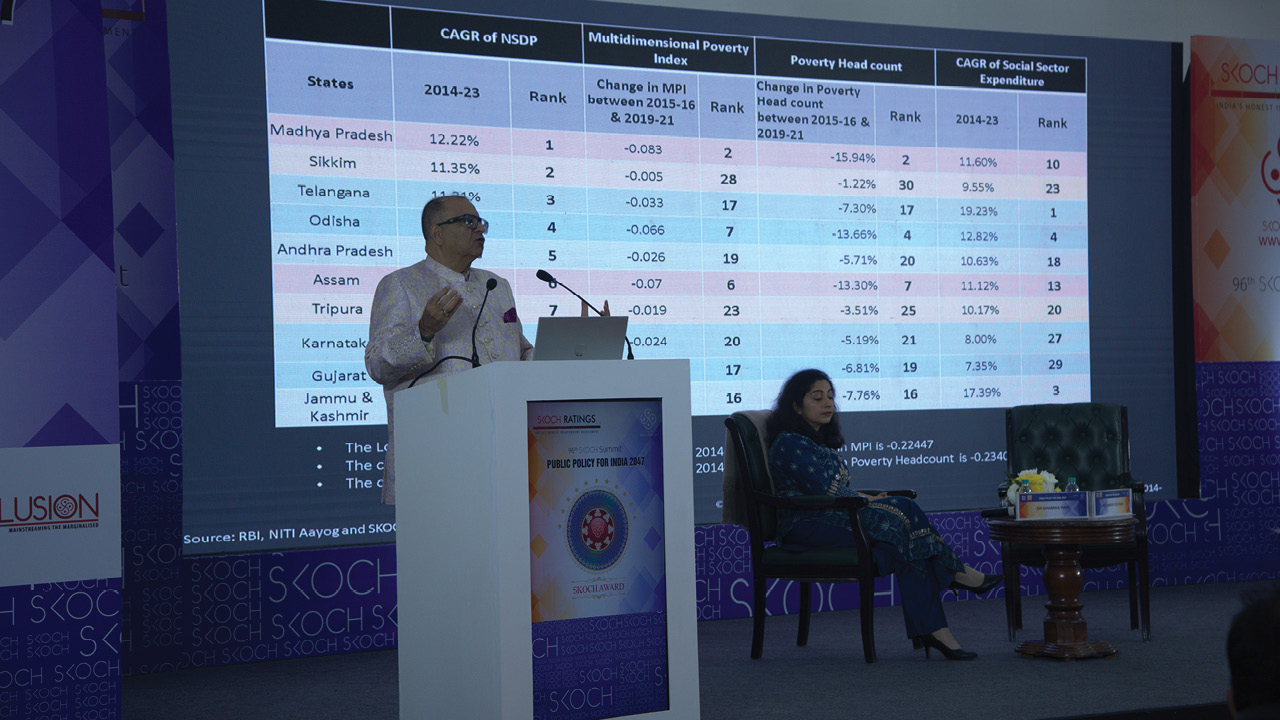
Dr Shekhar Aiyar at the 108th SKOCH Summit: Public Policy Forum - Regulatory Framework for Viksit Bharat
Dr Shekhar Aiyar
Director and Chief Executive, ICRIER
Key Points*
- The speaker framed the global backdrop as one of geoeconomic fragmentation, marked by stalled multilateral trade talks and rising trade restrictions.
- He explained geopolitical distance as an increasingly important factor shaping trade, FDI, technology transfer, and other economic engagements.
- He argued that India’s strategic advantage lies in being a well-connected “connector country” across the geopolitical spectrum.
- He noted that while India’s trade-to-GDP ratio has improved since 1991, it remains low compared to peers in Asia and Europe.
- He emphasized that India must develop labor-intensive manufacturing to improve TFP growth and leverage its demographic dividend.
- He highlighted that India exports less low-skilled manufactured goods than its labor endowment suggests, and this gap must be corrected.
- He called for cutting red tape and non-tariff barriers, stressing that imports are the lifeblood of exports.
- He identified slow customs clearance, complex paperwork, policy unpredictability, and poor agency integration as barriers to trade performance.
- He supported more bilateral FTAs while warning that India must not let such agreements restrict its strategic autonomy with third countries.
- He recommended expanding regional trade, considering CPTPP and RCEP, supporting plurilateral trade deals, and keeping the rupee liberal to boost export dynamism.
* This content is AI generated. It is suggested to read the full transcript for any furthur clarity.
Transcript
Hi, good morning everyone.
Uh thanks to Sameer ji for inviting me to this event. It's certainly a privilege to be here with all these distinguished panelists.
Uh Sameer suggested that I focus on the area of trade and what can be done to improve regulation in this area. So let me start with the international backdrop.
So we are currently in an era that several academics are calling geoeconomic fragmentation. What does this mean? Well, it has many symptoms. If you look at multilateral trade negotiations, there's been no meaningful progress since the launch of the Doha round in 2001.
Um if you look at the number of trade restrictions that countries are imposing upon each other, it has risen by a factor of more than 10 since the previous decade. The WTO appellate body which decides trade disputes between nations has been defunct since 2019 when the Trump administration uh basically stopped appointing judges and the body fell apart because of a lack of a quorum.
So that's what geoeconomic fragmentation is in essence. And the way that several academics are measuring it is by looking at United Nations voting patterns. So you can look at UN voting patterns of countries and determine how similar they are to each other or how far apart they are from each other.
And this allows us to define a concept called geopolitical distance. The nice thing about this particular data is that it's time varying and it's bilateral. So I can calculate the geopolitical distance between any two countries A and B at any given point in time t. So it's an incredibly powerful database.
You may disagree, you know, you may not think this is a perfect measure and certainly it isn't, but it's probably superior to many of the other measures out there simply because of its bilateral and time varying nature.
So now what you can do is you can try to see how geopolitical distance affects economic engagements like trade, FDI, technology transfer and various other types of economic engagement. And what we find is that geopolitical distance is very important. It's more important than geographical distance. And the slope of the curve that is the degree to which its importance has been increasing in recent years is faster than practically any other factor.
So this fits in very nicely with geoeconomic fragmentation. The concept of so let's come back to India. So what should India do in an era of geoeconomic fragmentation?
One idea that's being bandied about a lot is the notion of connector countries. The idea is that if the world is going to break up into rival blocks or fragment, then there is an advantage to a country in having as many links as possible across the geopolitical spectrum.
So if there's a shock to one particular relationship at one point in the geopolitical spectrum, there's a bunch of other links which will allow you some degree of resilience. You can think of this as portfolio diversification from finance. Ideally, in a good portfolio, you want a bunch of assets that are relatively uncorrelated with each other so that your portfolio is resilient to shocks.
You can apply the same framework to geopolitics and come up with an idea of what I and some co-authors call horizontal connectedness.
Now, the good news is that India is actually very well connected by this metric. If you take the standard deviation of our geopolitical distance from trade partners weighted by trade shares, which is a very easy metric, India is in the top quartile of connected countries in the world. We have a lot of trade links with a lot of people from diverse parts of the geopolitical spectrum.
That's the good news. The bad news is that we don't trade enough. So there has been some improvement in our trade to GDP ratio. It used to be under 15% pre-liberalization in 1991. Today it stands at about 45%, which is a vast improvement but it's still quite low compared to other peers in Asia and Europe.
So if India you know we've heard from plenty of people including Rohan about you know the need for TFP growth, which I fully agree with. One way to do that would be to develop labor intensive manufacturing. This is also crucial from the perspective of our demographic dividend and uh if you look at the development path of other countries before us, labor intensive manufacturing has been viewed as a as a necessary condition almost at India's current stage of development.
Um so part of this will be to develop export markets that's absolutely crucial. So my colleague Somitra Chhataji at Johns Hopkins has recently calculated the share of a country in global exports of low-skilled manufactured goods and compared it to their labor endowments.
So relative to their labor endowment, China exports 15% more than you would expect in low-skilled manufacturers. Vietnam exports about in line with its labor endowment. India exports 15% less than what its labor endowment would suggest. So we must correct this.
Let me make a few prescriptions on what we can do to therefore improve our trade performance.
First, we should be laser focused on cutting red tape and non-tariff barriers. Remember that imports are the lifeblood of exports. The more difficult it is to procure imports, the more difficult it is for exporters to have access to cheap inputs and cutting edge technology.
And our import procedures remain fairly antiquated. In India, it takes an average of 30 days for manufacturing firms to clear imports from customs. Compare this with an average of 12 days for G20 countries and an average of 9 days for the larger universe of emerging markets.
This is unsurprisingly reflected in the percentage of Indian firms that use foreign inputs, a mere 11%. Compared to 30% for G20 countries and more than 40% for EM.
The reasons are not hard to find and have been alluded to by some of the other panelists. Firms have to struggle with complex regulatory burdens including reams of mandatory paperwork and uh licenses. Now this is especially a burden for small firms which cannot afford an army of lawyers to check compliance requirements.
Then there is the unpredictability of policies perhaps best exemplified by sudden import bans or restrictive quality controls even for essential components like steel which can disrupt supply chains or prevent them from forming to begin with.
And then there is the lack of integration between different layers of regulatory agencies such as customs, GST and the RBI which leads to duplication and confusion.
All of this of course is fixable. Uh you know one of the my fellow panelists just referred to the idea that law must be accessible and discoverable. So I think you know that could certainly apply to the area of customs law and and and the way that we do these things.
Second, bilateral free trade agreements. There's been a very welcome flurry of activity recently uh including with the UK, Australia, and the EU. And let me just take a minute to say that the last one with the EU is particularly important.
First because of the gigantic size of the EU market, but more importantly because it reduces tariffs in labor intensive sectors like footwear and textiles to a level where we are now on a level playing field with competitors like Vietnam and Bangladesh which earlier enjoyed a 15 to 17% tariff advantage over India.
So this is a fantastic opportunity to expand into exactly the kind of labor intensive exports that India needs. So we should continue down that path. Sign more bilateral FTAs.
And one thing I would advise would be that we should be very cautious about one particular subtlety with FTAs and that is that we should not in our FTAs curb our freedom of action with third countries. So we should be very careful that any bilateral agreement that we enter into does not seek to circumscribe our freedom of action with third countries.
Let me give you an example. In February, we had a joint statement on the US India FTA which is still being negotiated. One of the clauses there referred to joint action against non-market third party economies. No prizes for guessing the stealth reference.
In my view, this is dangerous because it seeks to tie our hands with respect to third party countries. And as I outlined in the beginning of my speech, India's strategic advantage is in terms of connectedness and the richness of links that it has with different parts of the geopolitical spectrum.
Having striven for decades very successfully to develop a strategy of strategic autonomy, we must be very careful not to allow bilateral FTAs to upset that equilibrium.
We should also seek to expand regional trade which is very low by international standards. For example, if you look at trade within South Asia, even excluding Pakistan, it is a tiny fraction of intra regional trade compared to comparable blocks like ASEAN.
We should focus on lowering high regional trade barriers and seeking greater regional cooperation, for example, in energy trade, which has great unrealized potential.
And we should also consider joining trade blocks such as the CPTPP. This is a free trade arrangement between major Asia-Pacific countries and given its size and heft it is so attractive that unlikely countries like the UK and Canada have successfully applied for uh membership. So there's really no excuse for India not to be negotiating entry as well.
We should also consider joining RCEP which is another major regional uh trade agreement which happens to include China.
Third, and this is a particular bug bear of mine, we should be much more favorable towards plurilateralism. That is groups of countries moving together on trade deals in specific areas where you cannot command multilateral consensus. This is something that could benefit India a lot in areas such as e-commerce and investment facilitation.
You know there is this old Jagdish Bhagwati argument that plurilateralism is the enemy of multilateralism and I think that argument made a lot of sense in the decades where Bhagwati was writing. However, today when multilateralism is effectively deceased. It makes no sense to let the perfect be the enemy of the good and India should be wholeheartedly at the table when plurilateral deals are written and consensus is arrived at by you know a governing majority of the world body on how to move forward with trade in particular areas.
Finally and here in my view we've actually been doing a very good job recently. Let the rupee float. You know, somebody has recently said that the exchange rate is just another price. That is exactly correct.
I'm very heartened that the RBI governor has recently made it perfectly clear that the RBI does not target a particular level of the exchange rate. Instead, seeking to curb excess volatility if and when it arises. That is exactly the right thing to do.
An artificially overvalued rupee is like a tax on exports. And if we seek the kind of export dynamism that I'm outlining in my speech, it would be a mistake to do anything but keep the rupee as liberal as possible.
With that, I thank you all very much.