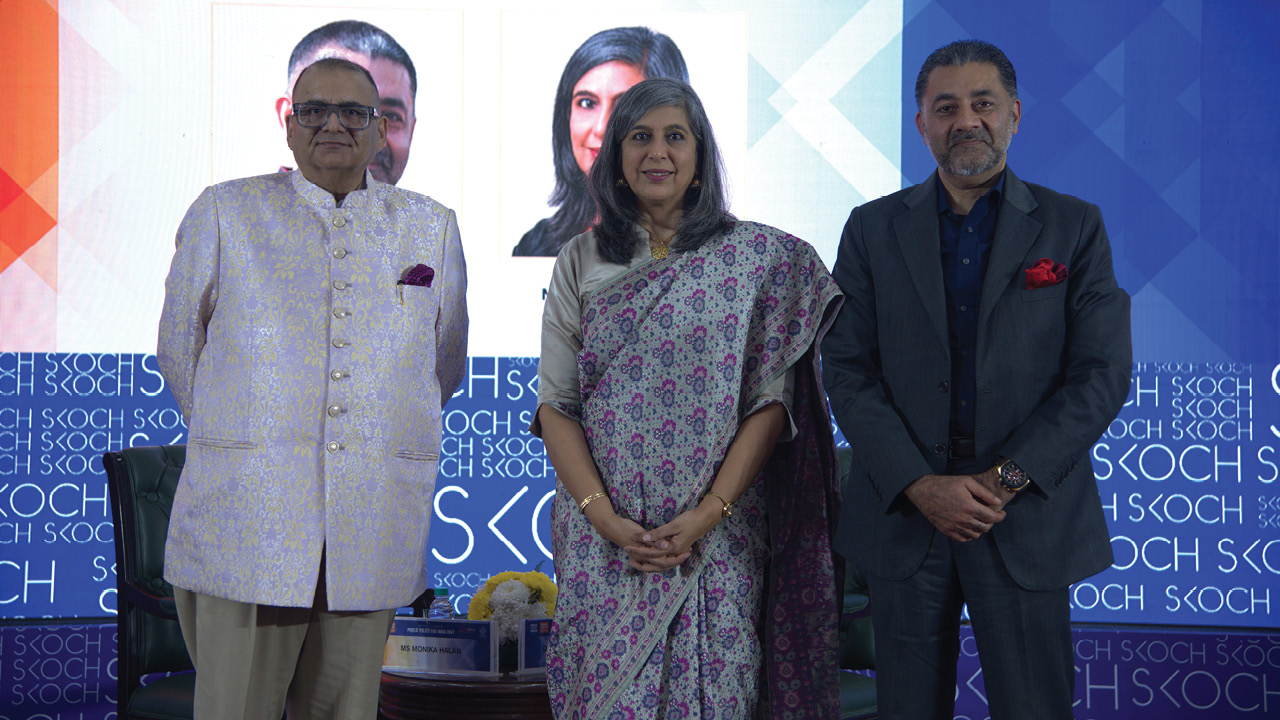
SKOCH Summit

Mr Dilip Chenoy
Chairperson, Bharat Web3 Association
Mr. Dilip Chenoy is Chairperson, Bharat Web3 Association. He has held leadership roles across India's foremost industry bodies, including as Secretary-General of FICCI, MD & CEO of NSDC, Director-General of SIAM, and Deputy Director-General of CII, with extensive contributions to policy and industry development.
Mr Dilip Chenoy at the 108th SKOCH Summit: Public Policy Forum - Regulatory Framework for Viksit Bharat
Mr Dilip Chenoy
Chairperson, Bharat Web3 Association
Key Points*
- The session framed innovation as central to India’s next phase of growth, supported by over two lakh startups and major private capital commitments.
- Speakers categorized Indian startups into copycat models, efficiency-driven ventures, and genuine innovation-led companies across emerging sectors.
- The discussion highlighted that technology and startups are often moving faster than policy and regulation.
- Drones, AI, blockchain, virtual digital assets, medical devices, and space technology were identified as areas where regulatory frameworks must catch up.
- Speakers emphasized that India must move from being a rule taker to becoming a rule creator and rule giver.
- Regulatory Impact Assessment was presented as an important tool for making regulation more mindful, productive, and capability-driven.
- India’s improved innovation performance was linked to the National IP Framework, Startup India, SIPP scheme, and stronger IP support systems.
- The session noted missed opportunities in electronics, semiconductors, renewable manufacturing, EV supply chains, data centers, and software products due to delayed or restrictive policy responses.
- Sports technology, AI-driven commentary, cricket, women’s cricket, and kabaddi were highlighted as fast-growing innovation and investment opportunities.
- Public health innovation was discussed through India’s generic medicines, vaccine capacity, TRIPS flexibilities, compulsory licensing, and the need to balance affordability, sovereignty, and quality.
* This content is AI generated. It is suggested to read the full transcript for any furthur clarity.
Transcript
Prof Subhomoy Bhattacharjee - Moderator
Countries have seen an average 20–30% rise in petroleum prices. We seem to have done well and have actually come out of that phase relatively strongly.
So essentially what I am saying is that the stage seems to have been set rather well for the next phase of growth. There is no better panel than the one we have here today. Ladies and gentlemen, please give them a round of applause. These are the people who can tell us what we should be thinking about when we think about innovation.
For a long time, innovation in India seemed limited to cricket. In Hindi films, we had the same formula for years with very little innovation. And then there was the third “C” — corruption — which was also fairly standard and predictable.
So we had the three Cs: cricket, cinema, and corruption, all operating with very little innovation. Those of us who grew up in the 1970s knew that we never had pace bowlers. We only had spin bowlers on made-to-order pitches, and that was where we won.
Innovation was not something that came naturally to us. Today, however, we are talking about innovation with over two lakh startups and nearly $350 billion already committed by them. This is not government money. These are big numbers.
Where is all this coming from?
Dip, let me start with you. You have been tracking some unusual sectors. Where is this innovation wave leading us, and what opportunities are you seeing right now?
Mr Dilip Chenoy
Thank you, Shankar, and apologies to the audience for these glasses. I recently had cataract surgery, so I cannot look directly into bright lights. I tried taking them off, but I could not manage without them. I had committed to being here, so thank you for inviting me, and congratulations as always on a great event.
Coming to your question, it is important to understand that the two lakh startups we have today can broadly be categorized into different groups.
The first category consists of startups that take ideas already working overseas and adapt them for India. Even some of the biggest names in India fall into this category. They are innovating for the Indian market, which is valuable in itself.
The second category includes startups that take advantage of inefficiencies in the system and create greater efficiency, though not necessarily through breakthrough innovation.
The third category is where things become really interesting. Whether you look at space technology, virtual digital assets, blockchain, oral care, medical devices, or several other sectors, there are Indian companies doing genuine innovation.
However, since this is a regulatory conference, there is one common theme across all these sectors: technology and innovation are moving faster than policy and regulation.
Take drones as an example. Only a few years ago, when we were advocating for drones, many people felt they were not important. It took conflicts such as the Ukraine war and more recent military developments to demonstrate their strategic significance.
Innovation today is moving ahead of traditional systems. One of the best examples was during COVID, when government, industry, and civil society worked together to develop vaccines and solutions at unprecedented speed. If we can replicate that model across sectors, it would be extremely beneficial.
China identified strategic sectors years ago—solar energy, lithium-ion batteries, electric vehicles, strategic minerals—and decided it would become a global leader in them. Young people in this audience should similarly identify the industries of tomorrow and position themselves accordingly.
There is a lot of discussion around AI today, but AI cannot function effectively without supporting technologies such as blockchain and digital payment systems. Virtual digital assets will also play an important role in enabling future AI-driven transactions.
Let me leave you with three messages.
First, there are many sectors where India still has little or no presence.
Second, I liked Dr. Manoj Kumar’s framework around the three Ts. If you apply those principles to your own industry, you can identify where innovation opportunities exist.
Third, we need to accelerate our policy response and create regulatory frameworks that keep pace with innovation. As several speakers have already noted, India must move from being a rule taker to becoming a rule creator and rule giver.
Prof Subhomoy Bhattacharjee - Moderator
That is a very useful framework.
Let me now bring in Ms Tasmita Sengupta. When we talk about innovation and the startup ecosystem, where do you position India relative to other countries? Are we still catching up, or have we begun to lead? Are we copying ideas, or are we creating genuinely new ones?
Ms Tasmita Sengupta
To answer your question, I think one important element is the adoption and institutionalization of Regulatory Impact Assessment (RIA).
This framework has already been adopted by more than 80 countries, including OECD nations as well as developing economies such as Pakistan, Vietnam, Thailand, and Uzbekistan. They have introduced it and integrated it into policymaking in a thoughtful manner.
More broadly, I believe the dream of Viksit Bharat is a genuine one. We are not simply copying the development models of other countries.
We all know that global disruptions have fundamentally altered the economic landscape. Supply chains have been disrupted, geopolitical realities have changed, and geoeconomics now plays a much larger role than before.
When we discuss value chains, we must recognize that they are not purely domestic issues. They are deeply connected to global developments.
Referring to earlier presentations, including Rohan’s detailed assessment of Viksit Bharat, I believe we need to reassess capability through a new lens. Compliance is no longer optional. But compliance itself must be capability-driven and productivity-driven.
If we are serious about Viksit Bharat, we must first put our own house in order. Structural reforms remain essential. Economic reforms must continue without hesitation.
Short-term fluctuations, including volatility in exchange rates, are important but should not undermine our confidence.
My assessment is that India is moving in the right direction. However, that does not mean we should become complacent. We must remain aware of future challenges and prepare ourselves accordingly.
Prof Subhomoy Bhattacharjee - Moderator
Thank you.
Let me now turn to Dr Raghavender GR, who represents the government perspective.
We are talking about large numbers and ambitious targets. From a productivity standpoint, how much improvement are we seeing? Which sectors offer India the greatest opportunity to build a distinctive competitive advantage?
Dr Raghavender GR
Vande Mataram.
I would like to thank Sameer ji for inviting me to this panel.
Innovation and growth are deeply interconnected. In 2014, when Prime Minister Narendra Modi assumed office, one of the major policy initiatives was the introduction of a National Intellectual Property Rights Framework.
The policy was formally released in 2016 with the vision of creating a “Creative India” and an “Innovative India.”
The results are visible. In the Global Innovation Index, India ranked around 81 in 2014. Today, India ranks 38th, representing an improvement of 43 places.
This progress has been driven by continuous policy reforms and improvements in the regulatory framework.
On patents, India is among the top six countries globally. On trademarks, we rank among the top four. We have introduced AI and machine-learning-based trademark search systems to improve efficiency.
For startups, particularly deep-tech startups, intellectual property support is critical. Alongside Startup India, the government launched the Startup Intellectual Property Protection (SIPP) Scheme.
This scheme assists startups with filing patents, trademarks, designs, copyrights, and enforcement actions. The government bears much of the professional cost through empaneled IP facilitators, while startups pay only the filing fees.
These initiatives have significantly supported innovation.
Another major effort involves harmonizing Indian legislation with international conventions and treaties. India is already compliant with TRIPS obligations, and we continue to strengthen our participation in international IP systems.
We joined the Madrid Protocol for trademarks and are taking steps toward broader participation in international systems relating to designs and geographical indications.
India is often described as the pharmacy of the world, and in our trade negotiations we have consistently protected India's pharmaceutical interests while promoting innovation.
Prof Subhomoy Bhattacharjee - Moderator
That is a useful overview of where India stands and how we have balanced both offensive and defensive interests.
Let me bring Mr Dilip Chenoy back into the discussion.
We often talk about innovation successes, but there are also examples where policy decisions caused us to miss opportunities. Could you share some practical examples?
Mr Dilip Chenoy
Certainly.
Let me take you back through a few historical examples.
The first is electronics manufacturing. During the 1980s and 1990s, India relied on high import tariffs, licensing requirements, restrictions on foreign investment, and limited integration into global supply chains.
As a result, countries such as China, South Korea, and Vietnam became manufacturing powerhouses while India lagged behind.
Imagine where we might be today if we had adopted a different approach earlier.
The second example is semiconductors. Many people may not remember that India once had early ambitions in this sector. At one stage, Intel considered investing in India, but we could not guarantee reliable power and water supplies.
Meanwhile, Taiwan and South Korea built globally dominant semiconductor industries. Today, we are trying to build capabilities that could have been developed decades ago.
Civil aviation provides another example. For years, the sector remained heavily controlled. Only later did private participation emerge.
In renewable energy, our initial focus was installation rather than manufacturing. China built overwhelming dominance in solar manufacturing while India became heavily import dependent.
Electric vehicles offer another lesson. Discussions around securing lithium, cobalt, and nickel resources began many years ago, but implementation took much longer. India has become strong in electric two-wheelers but still trails in battery manufacturing and EV supply chains.
Data centers and cloud infrastructure represent another area where opportunities emerged faster than policy responses.
Virtual digital assets are perhaps the most recent example. Regulatory uncertainty since 2018 has led many innovators to relocate to jurisdictions such as Dubai, Singapore, Dublin, and Delaware, where regulatory frameworks are clearer.
Historically, we saw similar issues in the IT sector. Banks once struggled to lend to software companies because software was considered an intangible asset. There were even instances where customs officers monitored software exports through satellite links because the regulatory system did not understand the business model.
As a result, India became a global IT services powerhouse but did not create enough globally dominant software product companies.
The lesson is clear: regulation must enable innovation rather than unintentionally constrain it.
Prof Subhomoy Bhattacharjee - Moderator
That raises an interesting question.
Is regulation the enemy of innovation, or can it actually support innovation?
Let me offer an example from artificial intelligence.
India is becoming one of the largest testing grounds for AI applications, particularly through sports.
Anyone who watches IPL cricket has seen how dramatically the viewing experience has changed over the past few years. Much of that transformation is powered by cutting-edge AI.
Today, while watching a match, viewers can instantly access detailed information about players, customize commentary, and receive personalized insights in real time.
Interestingly, some of the strongest demand for AI-powered commentary comes in languages such as Haryanvi and Bhojpuri.
Major AI companies have adapted their systems to meet these demands because the market requires it.
The scale of AI adoption through sports in India is extraordinary.
A significant amount of private equity investment in AI-related businesses is now flowing through sports technology startups.
After cricket, the next major growth story is kabaddi. Viewership has expanded rapidly, creating entirely new opportunities.
Women's cricket has also emerged as a major commercial success and is now one of the largest sports properties in the country.
With cricket returning to the Olympics in Los Angeles in 2028, the global market for cricket-related products and services is expanding rapidly.
These developments demonstrate how innovation often emerges where market demand is strongest.
Let me now turn to Dr Raghavender GR again.
Innovation is often discussed in technology sectors, but public health is equally important. Where does India stand in terms of innovation in healthcare?
Dr Raghavender GR
Innovation in public health has been central to India's development strategy.
After independence, India lacked significant pharmaceutical innovation and manufacturing capacity. Patent laws inherited from the colonial period largely benefited multinational companies.
As a result, India depended heavily on imported medicines.
This changed with the Patent Act of 1970, which became one of the foundations of India's emergence as the pharmacy of the world.
Today, India supplies approximately 20 percent of the world's generic medicines and a significant share of global vaccine production.
The shift occurred because policymakers adopted a process-patent regime rather than a product-patent regime. This encouraged reverse engineering and process innovation, reducing manufacturing costs and making medicines more affordable.
When TRIPS later reintroduced product patents, India carefully used the flexibilities available within the agreement.
The Doha Declaration reaffirmed that intellectual property rules should not prevent developing countries from pursuing public health objectives.
These provisions enabled India to continue supporting affordable medicines while remaining compliant with international obligations.
Compulsory licensing and other legal mechanisms further strengthened India's ability to address public health needs.
As a result, India successfully built a globally competitive generic pharmaceutical industry while maintaining access to affordable medicines.
Prof Subhomoy Bhattacharjee - Moderator
That brings us to an important question.
During COVID, India developed and manufactured vaccines at scale. At the same time, concerns have emerged in recent years regarding pharmaceutical quality issues, including incidents involving cough syrups.
How do we reconcile these two realities?
During COVID, India faced criticism for not relying more heavily on vaccines such as Pfizer and Moderna.
However, there were important considerations. Certain contractual provisions raised concerns regarding sovereignty and legal jurisdiction.
India chose to rely significantly on domestic innovation and manufacturing capabilities because we had the capacity to do so.
Local innovation allowed us to produce vaccines at scale while maintaining policy independence.
There were also financial and logistical considerations. Large-scale imports would have required substantial resources and infrastructure commitments.
That is why India emphasized indigenous innovation and manufacturing.
We are running short of time, so we will have to conclude this discussion here.
Thank you to all the panelists for a very insightful conversation. I will now hand over to the next session.