SKOCH Summit

Mr Rohan Kochhar
Founder, SKOCH Law Offices
Rohan Kochhar stands at the intersection of economics, social science, and law, leveraging his multidisciplinary expertise to drive impactful change in public policy, emerging technologies, and ESG (Environmental, Social, and Governance) initiatives. As the founder of SKOCH Law Offices, Rohan has built a boutique law firm renowned for its deep domain knowledge and innovative approach to legal challenges.
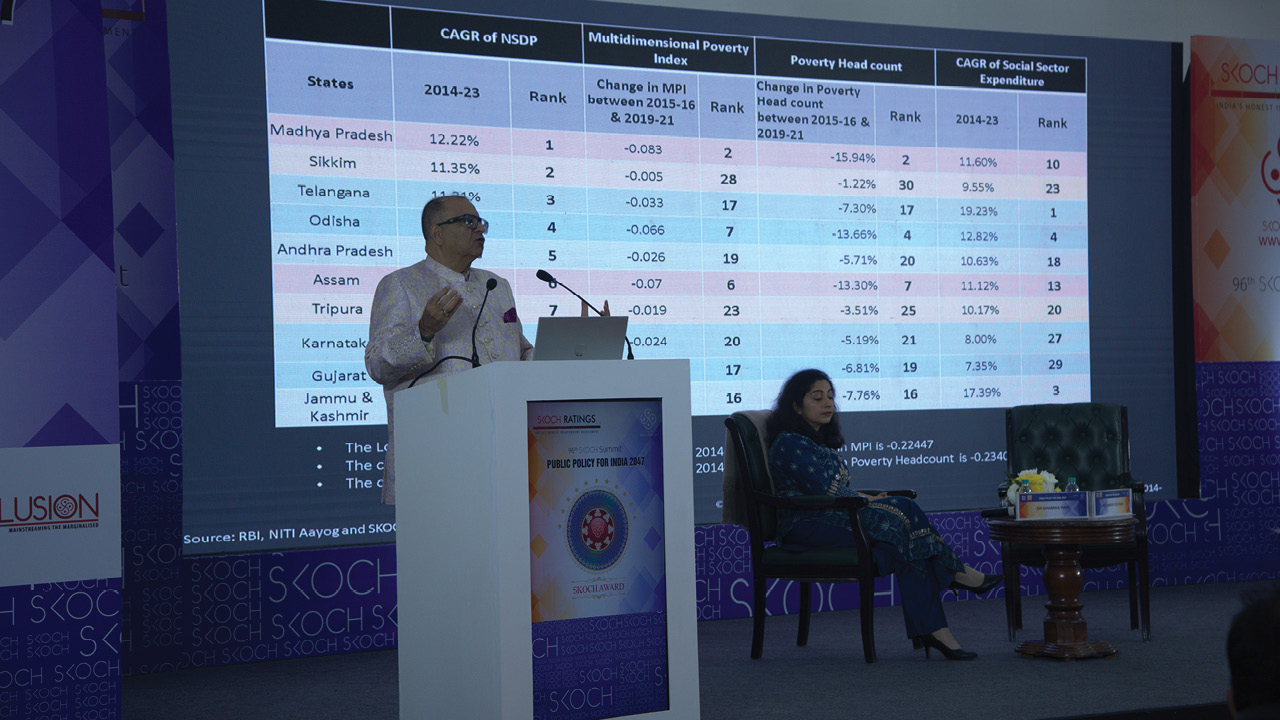
Mr Rohan Kochhar at the 108th SKOCH Summit: Public Policy Forum - Regulatory Framework for Viksit Bharat
Mr Rohan Kochhar
Founder, SKOCH Law Offices
Key Points*
- The speaker framed Viksit Bharat as India’s goal of becoming a US $30 trillion economy by the centenary of independence.
- He argued that India will achieve this goal by moving capital, labor, and ideas faster to their most productive use.
- He described Viksit Bharat as a productivity target in disguise, making regulation central to growth.
- He stated that India needs around 7.8% to 8% real growth, an IICOR below 4, and TFP growth of about 3.1% to reach the target.
- He emphasized that regulatory performance must be measured through IICOR, TFP, and approval timelines, not just schemes and notifications.
- He explained that improving capital efficiency can deliver a major growth dividend without increasing investment.
- He identified logistics costs, power losses, contract enforcement delays, R&D spending, and patent pendency as measurable regulatory wedges.
- He highlighted semiconductors, agricultural biotechnology, and pharmaceuticals as sectors where better rules can unlock productivity.
- He proposed five principles for regulatory modernization: appropriability with proportionality, administrative velocity, institutional capacity, incentive alignment, and evaluability.
- He concluded that India’s road to US $30 trillion runs through productivity, and productivity is built by rules.
* This content is AI generated. It is suggested to read the full transcript for any furthur clarity.
Transcript
Honorable members of the days, Mr Sameer Kochhar, Chairman, SKOCH Group, Professor S. Mahendra Dev, the gentleman at the helm of India's economy, chairing the prime minister's economic advisory council, Dr. Manoj Kumar furthering the cause of access to law as additional secretary in the ministry of law and justice, our long-standing research partners and two of the finest research institutions that India has produced, professor Sachin Kumar Sharma from RIS, who just completed 44 years of the institution recently, and Dr. Shekher Aiyer, who now bears the responsibility of heading ICRIER.
Distinguished public service leaders, corporate representatives, colleagues, friends, the political economy of the next quarter century will be defined by one national question. Can India become a US $30 trillion economy by the centenery of independence? That is the promise of Viksit Bharat.
And the paper that we seek to present to you today makes one central argument. It says India will reach that goal not merely by building more, spending more, or investing more, but by ensuring that capital, labor and ideas move faster to their most productive use.
In short, Viksit Bharat is in essence a productivity target in disguise. And if productivity is the target, then regulation is no longer a peripheral concern. Regulation is the operating system through which firms invest higher, build, contract, innovate and scale.
So for the US $30 trillion target what we need is 7.8% required real growth and to achieve that we need an IOR, which is an efficiency frontier of less than four, and total factor productivity of roughly 3.1%. And we'll get to that in a minute.
Let me place this in a decision frame for the senior policy makers in our midst today. The first element is the arithmetic. Uh India must sustain a high fixed growth rate. The second constraint is that India's gross fixed capital formation has recovered to around 30% of GDP. But if we have to achieve $30 trillion, that's not going to be enough. We're actually going to need 38%. And that will come from uh larger enormous additional savings amongst other things.
Therefore, the easier lever to achieve this is by improving total factor productivity and improving capital efficiency, and the two are actually linked. And that is ladies and gentlemen where regulation enters the growth equation because regulation shapes how fast capital, labor and ideas move to their best use, and that is where IICOR and TFP are won or lost.
So the policy implication for us is clear. Regulatory performance must be measured not only by outlays, scheme launches and notifications but by IICOR, TFP and approval timelines.
Let us reduce this ambition to simple arithmetic. The paper takes India's base GDP today at 3.96 trillion in fiscal year 2025. That's US dollars. The target is 30 trillion. So we need to multiply by a factor of 7 over 22 years. This requires a compound nominal dollar growth rate of about 9.6% per year.
But the nominal dollar growth rate is not the same as real growth once we net out domestic inflation and modest rupee depreciation. The required real growth rate is roughly 7.8 to 8% per year. That is a demanding constraint. No large economy has maintained that pace for two decades and without a decisive and durable improvement in productivity.
So the key point therefore is if investment is already close to 30% of GDP the binding variable is not only the quantity of investment, it is output per unit of capital and this is why the Viksit Bharat agenda must become a productivity agenda. The slogan reduces to a testable path base GDP, target GDP, required growth, investment rate, incremental capital to output ratio and total factor productivity.
Ladies and gentlemen, this slide gives you the analytical framework. There are really two lenses here for the same problem. One is grounded in classical growth theory and the other is grounded in neocclassical growth theory.
The Harodoma capital efficiency identity reads that growth is you know investment rate divided by IICOR. Here IIICOR is the number of units of investment required to generate one additional unit of output. A low IICOR simply means that capital is being used efficiently and a higher IICOR indicates waste in terms of stalled projects, misallocation, regulatory friction and capital tied in low return uses.
The second length is the solo growth accounting framework. Right? This decomposes output growth into capital, labor and the residual, which is total factor productivity.
These two frameworks are in no sense rivals. A falling IICOR is often the visible face of a rising TFP. When approvals are faster, contracts are enforced, logistics improve, power is reliable, and ideas are protected. The same investment produces more output. Therefore, capital efficiency and productivity are one problem viewed from two different angles.
Now consider capital efficiency. India's IICOR fluctuated sharply. If we look at fiscal year 12, it was around 7.5 during the post crisis investment overhang. When capital was locked in stalled projects and stressed balance sheets, it fell to around 3.5 in fiscal year 22. But that figure partly reflects a rebound from pandemic depressed base.
A defensible operating range in the policy literature is between 4.5 to 6.5. We in the paper adopt 4.9 as a blended conservative estimate and we treat 4.0 as the efficient frontier objective.
Now at an investment rate of 30% of GDP, like I'd mentioned, the implications are stark. If IR is 4.9, implied real growth is only 6.1%. But if IICOR improves to 4.0, the same investment rate produces 7.5% growth and if IICOR reaches 3.85, it produces 7.8% 8% growth, which is our requirement for keeping the Viksit Bharat target in view.
So therefore moving IOR from 4.9 to 4.0 gives India a 1.4 percentage point growth dividend without increasing investment at all. Conversely, if IICOR remains at 4.9, India needs investment of roughly 38% of GDP to reach 7.8% growth and that would require enormous additional savings mobilization, larger external deficits and sustained fiscal expansion.
The IPO route therefore is cheaper and in fact it is a realistic route. Every month saved in clearances, disputes and commissioning is capital efficiency. It's growth policy ladies and gentlemen.
Now let us read the same problem through the lens of solo and look at total factor productivity. The model assumes a capital share alpha of 0.45, a standard convention for India. Labor input growth is taken at about 2.1% per year, of which demographic growth accounts for 1.3% and human capital improvement accounts for roughly 0.8%.
On these assumptions to reach 7.8% real growth, India requires total factor productivity of growth of about 3.1% per year. But India's realized total factor productivity growth over the period of 2011 to 19 was about 1.2%. And if we take an alternative measure from one previous year as the base 2010, the number goes up to 2.2 and total factor productivity contributed roughly 30% of GDP growth in the 2010s.
So the central productivity gap and the second magic number in addition to the 1.4 percentage points of IICOR is 1.9 of total factor productivity ladies and gentlemen, and this cannot be closed by one ministry, one scheme or one announcement.
Total factor productivity captures technology, organization allocation, institutions and diffusion. In practical terms, it reflects whether the most productive firms can grow, whether resources move to their best use, and whether innovatives are rewarded. Therefore, this makes productivity a regulatory outcome.
The regulatory wedge, ladies and gentlemen, is not abstract. It is in fact measurable. India's logistics cost is estimated at 8% of GDP. This is much improved from older estimates of 13 to 14%. But it remains a systemwide cost embedded in inventory, transit, manufacturing, and exports.
Power distribution losses remain significant. ATNC losses were 15.4% in fiscal year 23, and accumulated discom losses were around rupees 6.5 trillion. A factory facing unreliable or expensive power does not merely pay for more electricity. Its entire production function becomes less efficient.
Contract enforcement takes about 1,445 days. For a firm investing in a long gestation project, that delay becomes a higher risk premium. And the private sector funding uh is you know 36% of GED, that is not gastrointestinal reflux disease, that is ladies and gentlemen gross expenditure on research and development.
And the reverse pattern is seen in research incentive economies. Patent pendency in India is still over four years against global best practice of two to three years. In sectors where technology cycles are faster, slow protection can destroy the value of intervention.
These are not scattered data points. They are a dashboard ladies and gentlemen of India's productivity gap for Viksit Bharat. Those numbers must become administrative targets.
Let us make the mechanism concrete through three sectors from rule to productivity. Right? First let's look at semiconductors and electronics. A semiconductor fab is an arctiple high I quad project. It costs billions, takes years to build and earns revenue only for construction qualification and ramp up.
India has responded with the India semiconductor mission with an outlay of above US $10 billion uh and fiscal support up to 50% of project cost. The Tata PSMC fab at Dera is about 91,000 cr rupees and Micron's Sanand assembly and test facility is about $2.75 billion US.
This is exactly the kind of frontier investment that India needs. But in such projects, every month of approval, delay or incentive uncertainty raises the effective cost of capital. Regulatory velocity is therefore not a convenience. It's the difference between a viable fab and a stranded asset.
Next, we look at agricultural biotechnology. BT cotton was commercialized in 2002 and it's cultivated at about 10.8 million hectares and delivered large productivity gains. However, BT bringil cleared by the scientific process was placed under moratorum. GM mustard received environmental clearance but remains caught in legal certainty.
The point ladies and gentlemen is not to advocate for any particular crop. On the contrary, the point is that when science-based approvals become open-ended, the innovation frontier freezes the suppressed total factor productivity is invisible because productivity never reaches the field.
Third is pharmaceuticals and life sciences. India is the third largest drug producer by volume and global supplier of affordable genetics. That is a major national achievement. But the next step, novel therapeutics, biologics, high-end research requires faster trials, better patent quality, predictable enforcement and regulatory data protection.
Access safeguards need not be abandoned, but genuine invention must be rewarded across all three sectors. The mechanism is the same.
This paper, ladies and gentlemen, is careful not to overstate the role of intellectual property and protection. Let me be very clear. IP is not the only productivity lever. There are multiple routes you can use to arrive at this target. Services, logistics, power, labor, courts, urban governance, services, agriculture, finance all matter.
But IP intensive activity is the highest upside frontier lever for a high income transition because ideas scale differently from physical capital. The marginal product of an idea is uniquely large and once discovered an idea can scale at near zero marginal cost. But that only happens you know if the rules allow innovators to capture a predictable return.
As I had mentioned, India's GED is only 6.5% of GDP. China spends around 2.4% on research and development. Germany 3.1%, the United States 3.5% and Korea spends 4.8%.
To increase India's gross expenditure on research and development, uh we would need roughly 53 billion US in additional annual R&D spending and then we'd be at about 2% of GDP. Most of this cannot come from government. It must come from private firms responding to better rules.
In advanced economies, IP industive industries account for roughly two-fifths of GDP. Uh so I reform is not a legal footnote, ladies and gentlemen. It's a productivity frontier.
The five principles that we propose to turn regulatory modernization into an operating system. The paper therefore proposes five principles.
The first is appropriability with proportionality. Innovators must be able to capture a sufficient and predictable return while the state retains narrow rules-based override powers for genuine emergencies. Investments include patent quality reform, regulatory data protection, and predictable compulsory licensing rules. And indicators include resident grant share, IP enforcement time, and R&D as a share of sales.
The second is administrative velocity, ladies and gentlemen. Now, speed must become a part of regulatory design.
The third is institutional capacity because good laws fail without capable institutions.
And the fourth is incentive alignment because India must shift more research towards firms that commercialize innovation instruments include public private missions, R&D tax treatment, commercialization platforms.
And the fifth is evaluability. Every major regulation should be assessed by whether it raises or lowers total factor productivity and capital efficiency. This is how reform becomes an operating system.
As we come almost to a close, ladies and gentlemen, the implementation ask is practical. In the first 0 to 100 days, can we publish a baseline dashboard of IICOR, TFP and five regulatory wedge indicators, select the top approval chains where delay most affects investment and within 12 months embed a TFP test in regulatory impact assessment, staff examiner offices, regulators and commercial courts publish median approval timelines.
The center cannot manage every clearance in India. But it can require every clearance architecture to be measured, time bound and productivity tested. And this is how Viksit Bharat becomes administrative discipline rather than only national aspiration.
So the scenario model shows why this matters. Ladies and gentlemen, we've come out with five scenarios with stagnation, you know, where nothing changes, almost nothing changes. IICOR is 5.5, real growth is 5.1 and India reaches 20 trillion US dollars by 2047 which is 67% of our target right.
And if we look at a business as usual scenario where we are today IICOR is assumed to be 4.9, real growth is 6.1, we reach 25 trillion US GDP by 2047 which is 83% of our target.
With reform and IICOR improving to 4.4 Four, real growth rises to 7.3% and India reaches $32 trillion crossing the target with accelerated modernization.
If IICOR reaches 4.0, real growth reaches 7.8%, India reaches $35 trillion US target. With the frontier scenario, IICOR reaches 3.85, real growth rises to 8.6% and India reaches 41 trillion US.
The difference between 20 trillion and 41 trillion ladies and gentlemen is larger than India's entire current GDP. And the difference is not primarily the volume of investment. It is the productivity of capital.
And that is why whether India reaches 30 trillion or not depends less on how much it builds and how much it invests than on the rules under which it invests and invents.
Let me close with a core message ladies and gentlemen. I won't bore you with mathematical identities and and data footnotes. The political economy of the next quarter century will be defined by Viksit Bharat.
India reaches that destination when capital works sooner, when ideas scale faster, when contracts are enforced reliably, approvals become time bound and regulation is measured by productivity. The road to 30 trillion therefore runs through productivity and productivity is built by rules.
Thank you very much ladies and gentlemen.