SKOCH Summit
Prof S Mahendra Dev
Chairman, Economic Advisory Council to the Prime Minister (EAC-PM)
He served as Director and Vice Chancellor of IGIDR, Mumbai (2010–2022) and earlier chaired the Commission for Agricultural Costs and Prices. He was Vice Chairman of IFPRI’s Board, a member of the National Statistical Commission, and Director of CESS, Hyderabad. He has 150 publications, 23 books, and has advised global agencies and Indian government committees. He has received several awards, including the Malcolm Adisesaiah Award.
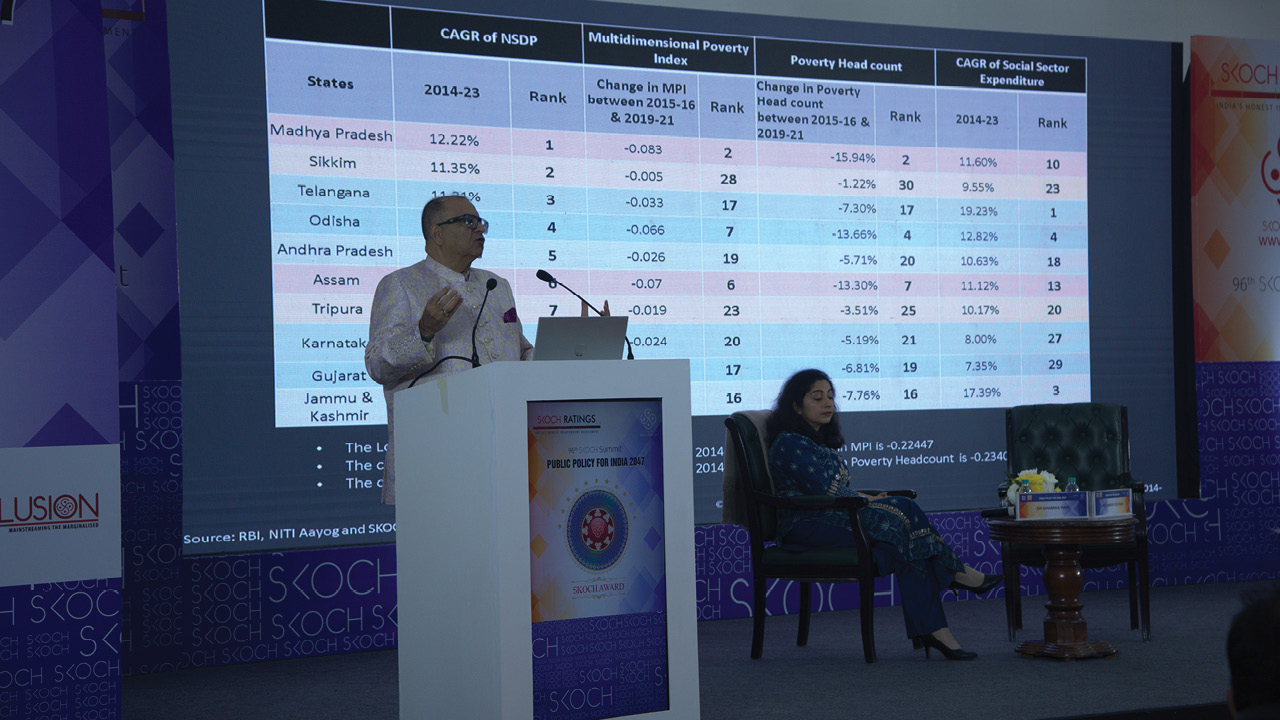
Prof S Mahendra Dev at the 108th SKOCH Summit: Public Policy Forum - Regulatory Framework for Viksit Bharat
Read Full PaperProf S Mahendra Dev
Chairman, Economic Advisory Council to the Prime Minister (EAC-PM)
Key Points*
- The speaker identified three goals for 2047: developed nation status, inclusiveness, and sustainable climate-resilient growth.
- He emphasized that India’s legal and regulatory architecture must evolve with its ambition to become a 35 trillion economy by 2047.
- He stated that law is not merely a support system for economic growth but its very foundation.
- He highlighted predictable institutions, enforceable contracts, and efficient dispute resolution as essential for attracting global capital.
- He identified investment and exports as two major engines of growth for achieving 7% to 8% annual growth.
- He argued that India must improve both investment rates and ICOR efficiency to sustain high growth.
- He clarified that Atmanirbhar Bharat and Swadeshi mean improving competitiveness and quality, not returning to pre-1991 import substitution.
- He stressed the importance of process reforms to reduce transaction costs and improve ease of doing business and ease of living.
- He called for legal reforms, faster contract enforcement, and dispute resolution to build investor confidence.
- He concluded that India’s growth will depend not only on reforms undertaken but on how effectively they are implemented.
* This content is AI generated. It is suggested to read the full transcript for any furthur clarity.
Transcript
Good morning.
So first let me thank uh Mr. Sameer Kochhar, uh Dr Gursharan Dhanjal and uh the SKOCH Foundation for uh inviting me to this public policy forum.
Uh I compliment the organizers for this important topic, uh the regulatory framework for Viksit Bharat, uh for this conference, um and we have very good panel, uh Dr Manoj Kumar, Dr Shekhar Aiyar, Professor Sachin Kumar Sharma to discuss on this uh topic.
Uh first let me say a few words on our goals for the 100th year of India's independence. There are three goals for 2047. One is to become a developed nation, which Mr Rohan Kochhar has mentioned. Second is uh inclusiveness in terms of employment, human development, uh skills and uh human development includes health education to everyone so that inequalities can be reduced. Third is to achieve these two goals uh which we have to do with sustainable and climate resilient practices.
So these are the three goals because generally people say only you know achieving the growth and world economy uh you know is and geopolitical situation is changing very fast. U mean something I write on uncertainty of tariffs earlier now West Asia something or the other will come. So the uncertaintity is increasing at the global level. So we have to keep in mind uh when you talk about vixit bar the global factors.
So as we move towards aspiration of becoming a uh 10 trillion economy in the next few years and eventually 35 trillion economy by 2047 and to achieve inclusive and sustainable growth and to keep the aspirations of the youth, uh our legal and regulatory architecture must evolve in uh tandem.
So the law is not merely a support system for economic growth. It is a very foundation. Predictable institutions, enforcable contracts and efficient dispute resolution systems are essential for sustaining high growth and attracting global capital.
Uh as Mr Rohan Kochhar has presented very nicely on you know the regular regulatory framework design needed for uh you know the macroeconomic variables and also the investment rate and total factor productivity uh and IOR, the incremental capital output ratio, uh these are very important for uh to achieve the developed nation. We need to have as he mentioned 7 to 8% growth peranom.
Uh there are many sources of growth to achieve this one. But two important engines of growth are investment and exports. So given the time constraint I will concentrate on regulatory framework relating to investment and exports.
Uh he mentioned GF GFC, the growth fixed capital formation as 30%, but if you take investment rate uh presently it's about 32, 32% or uh around 33%. Uh we need to uh he said IOR need to be increased but I feel that investment rate also has to be increased simultaneously with ICOR efficiency increase. So for example the we need investment rate may be 35% or so to achieve the 7 to 8% growth.
Similarly export growth apart from investment is important because no emerging market of India's size has grown at 7 to 8% for a decade or more without strong export growth. So private investment for both domestic and foreign capital have to improve further.
India's growth challenge today differs from that of the early reform period of 1991. The focus now is on efficiency. India today is among the world's fastest growing major economies. It has a large domestic market, uh substantial public investment and a growing manufacturing base. So the next phase of growth depends increasingly on how efficiency uh efficiently economic activity can take place, which uh Mr. Rohan also talked about.
So the Atmanirbhar Bharat and swadeshi advocated by the honorable prime minister doesn't mean we are going back to import substitution of the pre-1991 days. It means improving competitiveness and improving the quality uh for exports and com uh we have to do this and also for domestic consumption also some of the products we have to be self-sufficient because geopolitical nature like uh semiconductors chips rar uh we have to increase their production.
In fact government is also identifying some 100 items of imports where India can produce domestically and export them uh and export our domestic consumption also. Uh in fact at PM EPM also we are working on this as you know India has signed lot of FTAs. Uh in fact the tariffs uh some of the tariffs some people are saying it's higher now in India but that may come down with some of the FTAs uh now uh so there will be lot of opportunities for exports and imports. MSMEs also will benefit so we need to have efficient regulatory framework work to achieve these goals.
Exchange rate is also of course important for exports uh because there's a lot of debate now now exchange rate the but dollar uh rupee exchange rate is determined by market forces demand supply but some regulations uh and interventions are made by RBI only if there is excess volatility.
In public discourse economic reform you know debates often gravitate towards big reforms like tax overalls, free trade agreements and privatization. These are undoubtedly important structural reforms. However, there is a quieter and equally transformative category of reforms called process reforms.
So, in fact, at Economic Advisory Council to the Prime Minister, we are doing a lot of work on this process reforms. So process reforms are the nuts and bolts uh changes in governance. They involve re-engineering administrative procedures, rationalizing regulations. So individually these reforms may appear incremental or technical but collectively they have the potential to dramatically improve efficiency, reduce transaction costs and enhance both ease of doing business and ease of living.
So by documenting the flow of procedures from start to finish, policy makers can uncover inefficiencies that are otherwise invisible. Importantly, process mapping shifts the perspective from the from that of the regulator to that of the user. So how user can benefit uh from these regulations?
So encouragingly India has already embarked on a significant reform journey. Uh the government's uh efforts uh you know this shift recognizes that excessive regulation imposes what has been described as regulatory cholesterol uh clogging the arteries of economic activity and constraining innovation.
So government's efforts in this direction are noteworthy. Several obsolete laws many dating back to the colonial era have been repealed. Further, the amendment of more than 700 provisions of 79 central acts particularly through Janovishwa's act has replaced criminal penalties for minor procedure lapses with monetary or administrative sanctions. So this has reduced the fear of prosecution and fostered a more businessfriendly environment.
In fact, RBI and SEBI have also undertaken several reforms to simplify regulations. So, investment decisions are influenced by the predictability of the operating environment. So, simplifying procedures and improving regulatory clarity uh reduces these uncertaintities. Uh and reducing compliance burden allows entrepreneurs to devote more time to to the businesses. Uh and simplified processor also reduce the overhead costs and allow firms to focus on their core business activities.
So process reforms uh improve the ability of public institutions to deliver services. For example, the experience of direct benefit transfer, the national saving uh the national single window system demonstrate that better design regulatory process can significantly improve outcomes.
For example, ECPM has done a case study on reforms in investor education protection fund authority where unclaimed corporate shares and dividends will be restored to rightful owners. So we found that there are three windows one has to go to claim that and there are 25 steps and it takes 2 to 3 years to get that. So what we have said is that uh we can have one portal and the steps now have reduced to 15 and uh under the new system instantaneously we get these uh you know benefits of shares and other things. So this is one example of where process reforms are important.
Now I turn to the legal reform. In order to achieve 30 trillion economy, India needs domestic and foreign capital. Foreign capital is important as domestic savings are not enough. In order to have trust in India's judicial system, we need to have a legal reform road map to achieve higher investment in the economy and higher growth.
So several legal reforms may be needed among others uh also mentioned by Rohan. Efficient contractual enforcement and faster dispute resolution are essential for an investor. Enforcing a commercial contract through Indian court takes as he mentioned nearly 1500 days. This is nearly four times to the duration of in Singapore. Dispute resolution in India takes several years almost three times the average in OECD countries. So it is essential to have the confidence for investors that contract will be honored in letter and spirit across decades.
So we need a legal reform road map and efficient judiciary system required by a modern economy like India. Maybe in fact I suggested to chief justice of India that we should have a group of uh economist and judiciary to discuss further on this and he readily agreed for that. In fact in Indian universities also we have started courses law and economics which can complement each other.
So ultimately the vision of Viksit Bharat cannot be realized through isolated reforms. It requires a comprehensive transformation of our legal ecosystem. Simplified regulations and predictable legal outcomes uh will directly translate into higher investment investor confidence uh faster dispute resolution and enhanced global competitiveness.
Of course, some regulations are needed. For example, during global financial crisis, everyone praised Dr. Why we ready? Because the then RBI governor for the regulations of RBI which saved the country. Similarly on AI artificial intelligence and uh they are very important for productivity increase but may be required for some regulations uh along with improvement in productivity. Similarly, some of the regulations on orange economy uh and futures markets, futures and options are also based on government's views and discussions on pros and cons of these markets.
Lastly, India is a federation. The efficient regulatory framework has to be undertaken also at state level and local councils. Uh a study shows that you know we say decentralization up to state level even state governments think decentralization up to states but we need decentralization further to the local governments because a study showed that uh the spending at the discretion of local governments are 51% in China, 27% in US and Brazil and a distant 3% in India so decentralization should not stop with the states particularly with urbanization and all.
So in conclusion as we strive towards Viksit Bharat, the law and regulations must lead the way not follow economic growth. Uh the future of India's economy will be determined not only by what reforms we undertake but by how effectively we implement them.
What what we want to achieve Viksit Bharat by 2047 is not unique. In the history of a nation there comes a turning point. Some nations which have developed themselves liberaging a turning point are Japan, Germany, Singapore, South Korea and other uh Asian countries. Now it is India's time.
Thank you very much. Thank you.