SKOCH Summit

Prof Sachin Kumar Sharma
Director General, RIS
Prof. Sharma brings over two decades of expertise in international trade development cooperation, and multilateral and regional negotiations. His research, advocacy, and capacity-building work have shaped discussions on trade and development, agricultural subsidies, investment, food security, sustainability, market access, trade disputes, transparency, LDC graduation, Aid for Trade, and negotiations at the WTO, FAO, G20, and in regional trade agreements.
He holds an M.Phil. and a PhD in Economics from Jawaharlal Nehru University (JNU), Delhi, with a specialisation in the WTO, international trade, quantitative techniques, and agricultural policy. He is skilled in econometrics, Computable General Equilibrium (GTAP), Partial Equilibrium Modelling, and statistical tools, with extensive experience in trade analytics.
A prolific scholar, Prof. Sharma has authored six books, numerous peer-reviewed journal articles, several working papers, and book chapters, in addition to regularly contributing to policy debates through articles in leading newspapers and participating in global forums.
Before joining RIS, he served as a Professor at the Centre for WTO Studies (CWS) at the Indian Institute of Foreign Trade. At CWS, he led and supervised a multidisciplinary team of economists, lawyers, and officials, working on a wide range of economic, development, and legal issues. His evidence-based policy inputs, analysis, and recommendations were extensively utilised by many developing countries and LDCs to comply with WTO obligations and to advance negotiations on agriculture and sustainability, including securing the perpetual peace clause on food security and shaping disciplines on domestic support.
Through knowledge sharing, critical inputs on proposals, and capacity-building initiatives, he also coordinated with key members of the G-33 to develop and advocate common negotiating positions among high-level policymakers of developing countries and LDCs.
Representing India, he made significant contributions to South-South Cooperation through WTO proposals on domestic support, sustainability, food security, cotton, Special and Differential Treatment, and several other issues, many of which were co-sponsored by 75 countries from the G-33, OACPS, and the African Group. His initiatives played a pivotal role in invoking the Bali Peace Clause, thereby safeguarding India’s public stockholding programs for food security from WTO disputes. As an integral member of the Indian delegation, he played a crucial role in negotiations at the last five WTO Ministerial Conferences. He has conducted numerous training programmes on trade issues to strengthen South-South cooperation and collaborated with leading organisations, think tanks, and UN agencies.
As Director General of RIS, Prof. Sharma envisions strengthening RIS as the premier institution of the Global South, providing cutting-edge, development-oriented research and policy dialogue on contemporary global economic challenges. He aims to further RIS’s mission of fostering South-South cooperation, supporting evidence-based policymaking, and ensuring that the voices of developing countries are strongly represented in the international economic discourse.
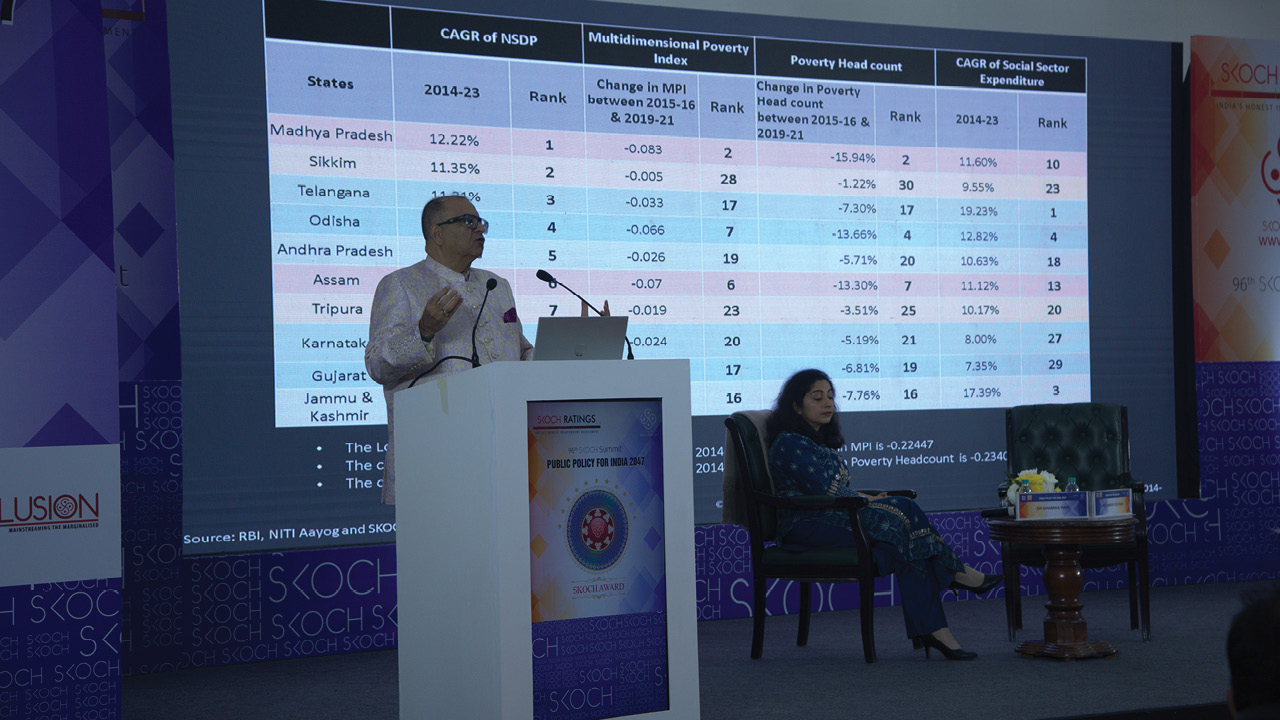
Prof Sachin Kumar Sharma at the 108th SKOCH Summit: Public Policy Forum - Regulatory Framework for Viksit Bharat
Prof Sachin Kumar Sharma
Director General, RIS
Key Points*
- The speaker emphasized that the quality of regulation is central to achieving Viksit Bharat.
- He described Viksit Bharat as a national aspiration and a promise to the next generation, not merely an economic target.He argued that India must decide whether it will follow rules made elsewhere or help shape international rules.
- He argued that India must decide whether it will follow rules made elsewhere or help shape international rules.
- He highlighted regulatory capability as critical amid rising protectionism, global uncertainty, and weakening globalization.
- He stated that international trade will play a major role in reaching the 30 trillion economy target and the 2 trillion export target by 2030.
- He identified non-tariff barriers, standards, compliance costs, and product quality as major challenges for India’s exports.
- He stressed that India must protect its policy space while ensuring international rules remain compatible with its socioeconomic realities.
- He used sustainability rules such as EU CBAM and deforestation regulations to show how countries are exporting standards along with goods and services.
- He argued that India must move from being a passive rule adopter to an active rule shaper in areas like sustainability, AI governance, digital governance, and trade.
- He concluded that India needs smart regulation, appropriate guard rails, domestic reforms, and proactive international engagement to become Viksit Bharat.
* This content is AI generated. It is suggested to read the full transcript for any furthur clarity.
Transcript
Good morning everyone.
First of all, thank you for inviting me and for inviting me to speak on this very important topic, which rarely makes headlines: the quality of regulation. You will not find many events on this topic, but it is a very important topic that you have selected for this forum. So congratulations.
I am one of the last speakers, you can say, but I noted very important points that the speakers have mentioned about regulatory compliance. Rohan already mentioned that for Viksit Bharat, we need efficiency and we need to improve productivity. Professor Dave already mentioned that we need process reform. Manoj ji mentioned the importance of legal certainty, and legal certainty is also very important for all businesses, especially in international trade.
One idea I really liked was the use of plain language, because sometimes when we read legal documents, it is really very difficult to understand, especially in matters related to property or land. You also mentioned the three things: trust, transparency, and technology, which are important for Viksit Bharat. I will add another thing: togetherness. So, 4T is important for taking Viksit Bharat forward. Finally, Shekhar ji mentioned the role of trade and the external front.
So, a comprehensive intervention has already been made. I do not know how much I am going to add, but there are a few things I really want to say. When we are discussing Viksit Bharat, the most important thing I can say is that this is the national aspiration of our time, and here the quality of regulation plays an extremely important role.
In one of the slides when Rohan was presenting, he mentioned that there are only 22 years left. Since 2025, only 22 years are left if we really want to become a developed country. Today, in 2026, let us assume that if a child is born in 2026, by 2047, when India celebrates 100 years of independence, the child would be 21 years old.
The main question here is: what kind of India will that child inherit? An India that follows rules made elsewhere, or an India that plays an important role in shaping international rules? That is the important thing. An India that struggles with compliance, or an India known for quality, innovation, and trust? That is what all the panelists have mentioned.
Therefore, the answer will depend on the decisions and the discussions we are having today because Viksit Bharat is not merely an economic target. It is also a promise we are making to the next generation.
That is extremely important. As we move towards Viksit Bharat, regulatory capability is going to play a very important role, especially as Shekhar ji mentioned, given the international uncertainty and what is happening all over the world. Protectionism is on the rise, and globalization is taking a back seat. In this environment, the quality of regulation is going to play an extremely important role.
Another thing is that international rules are also going to play an important role, and how we protect our policy space and make rules compatible with our socioeconomic situation is also key to our path towards Viksit Bharat.
Rohan already mentioned the data for Viksit Bharat. We are targeting a 30 trillion US dollar economy and around 7.8% to 8% growth rate. International trade is also going to play an important role. Even by 2030, we have a short-term target of two trillion US dollars in exports. At present, we are at about 800 to 900 billion, so even achieving that export target is a daunting task and a challenge. Here, government programs and measures are going to play a very important role.
The government has already taken many steps, which my fellow panelists have highlighted. These include initiatives on skill development, infrastructure creation, ease of doing business, innovation, technology adoption, and industrial growth. But one factor that is going to play a very important role in the next 21 years is the regulatory framework. It will also decide whether we are able to achieve the aspiration of becoming a developed country by 2047.
So that is the main importance of this topic, and thanks to Sameer Kochhar for selecting this very important topic.
Now, coming to this, Sameer ji also requested me to talk about international trade and the external front. It is true that the world order is changing very fast. For several years, we had a stable trading world order, you can say, but now things are changing very fast. As mentioned initially, for businessmen, certainty is the most important factor. But in international trade, it is now very difficult to see whether, even if we make a deal, it will actually be implemented on the ground or whether the next day these things will change.
Many countries are invoking security clauses. They are protecting their sectors. All countries want to have a greater share in international exports. It is not only India; many other countries are doing the same thing. So competition is challenging, very fierce, and very intense. This is the situation we are facing.
If you look at what has happened over the last seven or eight months, and if you go back one year, usually in international trade, no one was talking about tariffs. They said tariffs had more or less settled down and were going down. Even at the multilateral level, there was not much discussion about tariffs. Though tariffs have now come into the news, maybe they will settle down in one or two years. But ultimately, the most challenging task or problem in front of most developing countries, including India, is non-tariff barriers, standards, whether we are able to comply with them, how we can export quality products, and the cost of compliance. All these things are going to matter a lot when we are talking about international trade.
Another extremely important point is that even though a lot of international trade rules are being negotiated at the moment, whether at the plurilateral level, the multilateral level, or through FTAs, for a country like India we also need balance because the socioeconomic situation of a developing country is peculiar. What kind of policy space are we looking at? Whether we need effective policy space, and even if we have the policy space, whether we are using that policy space, is also another important issue. A lot of things are happening all over the world.
Let me give the example of sustainability, which is one of the main important things. If I ask all of you, everyone will support sustainability. Now internationally, countries are not only exporting goods and services; they are also exporting standards and regulations. Take the example of the European Union CBAM or the European Union deforestation regulation. The US and the UK are also contemplating the same kind of regulation.
Now the challenge is that sustainability has very different interpretations for different countries. Our definition of sustainability would be very different from what the EU thinks about sustainability. Maybe the European Union has more focus on the environmental side, but from the developing country or India point of view, social and economic sustainability matters a lot.
Now in this whole sustainability narrative, the main question is how India is playing its role, whether we are putting forward our narrative of sustainability and whether we are engaging on those issues. Because if we are not engaging, then someone else will make the rules, and after a few years, we will have to follow those rules.
Therefore, two things are important in this approach. One, if countries are adopting sustainability measures that restrict exports from India or other developing countries, then let us negotiate. The other thing is that we also have to increase our capacity so that we can comply with many of the sustainability measures. These are the two complementary approaches that are required.
This is also the moment when we have to see whether we are just rule adopters of international law or rule shapers. One thing that Shekhar ji mentioned was plurilateralism. India is not part of the plurilateral process at the moment, yet the rules are being discussed on these plurilateral forums. Whether India needs to go in or not is a decision the government has to take.
But one positive thing happened at MC14 in Cameroon, when the Minister of Commerce mentioned, especially on investment facilitation, that we agree to engage with countries but also have to discuss the guardrails. What guardrails need to be discussed? So that is a very pragmatic approach to discuss and influence the international rules that are going to govern in the coming years.
Otherwise, what is happening, given my negotiating experience even at the WTO, is that many countries have a reactionary approach. One country adopts rules, then we react. Why can’t we shape the narrative? Why can’t we make the rules? That is a very important issue which, I think, is going to play a very important role.
Another important point is that, given all these things, we also have to see whether, in whatever international rules are coming, we have enough policy space and whether the rules we are committing to outside should not be incompatible with the socioeconomic situation of our country.
I give the example of WTO rules. Especially in agriculture, what I find is that many of the rules in the WTO are not at all compatible with the socioeconomic situation of India, and not only India but most developing countries. The rules are very outdated. We were mainly adopters of those rules. We were not able to influence those rules when the WTO came into existence.
But now we cannot say that this will continue. We have to take a proactive role by engaging with other countries. By engaging, I mean that we have to influence the narrative, whether it is about sustainability, AI governance, digital governance, or many other issues. The point is that we need to be at the table. We need to discuss it. Whether you accept it or not, you should discuss your concerns and your guardrails. That is the important role we can play.
Internally and externally, these are some of the factors. But even internally, when we are discussing domestic reforms, a lot of reforms have already been taken up, but still we have to go a very long way.
We have already adopted the Trade Facilitation Agreement, and numerous initiatives by the Ministry of Commerce have improved trade processes and reduced transaction costs. But still, our transaction costs need to be reduced substantially.
Ultimately, if we want to achieve the two trillion dollar export goal by 2030, it means that we need to be competitive. To be competitive, the regulatory framework is going to play a very important role. Besides these internal reforms, we have also seen how things are moving. With changes made in the regulatory framework till now, we have seen a kind of movement in terms of UPI and digital public infrastructure. A lot of things are happening on the ground, but still we should not rest. We should keep moving.
For this, both things are important: internationally, how we will shape the rules, and complementarily, how domestic measures and programs can make India more competitive. This is an extremely important role, which I think is essential to achieve the aspiration of becoming a developed country by 2047.
Let me conclude with a simple message that our Prime Minister has often mentioned: reform, perform, and transform. These are very simple words but have a lot of implications for our journey towards Viksit Bharat.
We need smart regulation with appropriate guardrails to become Viksit Bharat. We need to have a strong focus on quality. One important point I will again emphasize is that, for developing countries including India, given the socioeconomic situation, policy space is not a privilege. It is a development necessity.
But even if we have policy space, whether we are using that policy space is something we have to discuss and deliberate, so that we can make our economy more competitive and increase the quality of our products. Furthermore, as a Viksit Bharat, we cannot remain a passive consumer of trade rules. We have to co-author them.
We have to reshape the existing laws, international laws, as well as shape international narratives. Therefore, from my side, it is really important that we work on the regulatory framework. The government has already taken a lot of steps. As Professor Mahendra Dave mentioned, process reforms have already been there. Mr. Manoj ji also mentioned the role of legal certainty, and these things, I think, will play an important role moving forward.
Thank you very much, and these are my few comments. Thank you very much.