SKOCH Summit
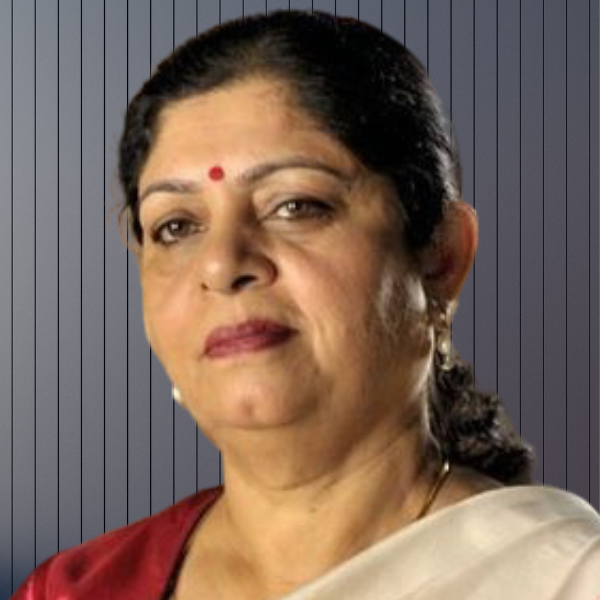
Dr Poonam Mutreja
Executive Director Population Foundation of India (PFI)
Poonam Muttreja, Executive Director of the Population Foundation of India, has been a strong advocate for women’s empowerment, reproductive justice, and rural livelihoods for over four decades. She co-conceived the popular transmedia initiative Main Kuch Bhi Kar Sakti Hoon—I, A Woman, Can Achieve Anything—inspiring millions to challenge gender norms. Poonam served as the India Country Director of the John D and Catherine T MacArthur Foundation for 15 years and has also co-founded and led the Ashoka (India) Foundation, Dastkar, and the Society for Rural, Urban and Tribal Initiative (SRUTI). Poonam is a member of the Governing Council and Board of ActionAid International and India, and has been a member of a committee at The National Academies of Sciences, Engineering, and Medicine, Washington DC
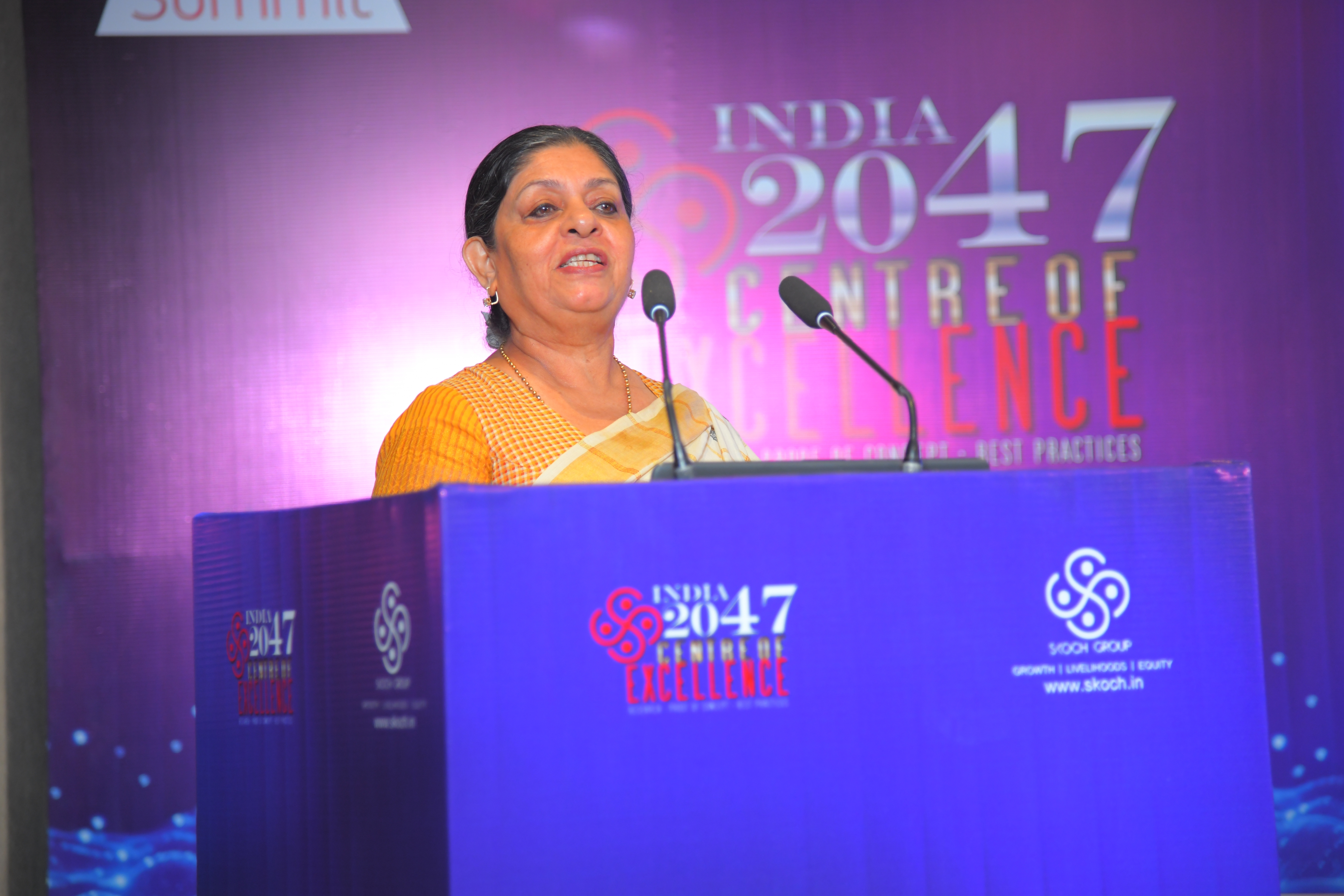
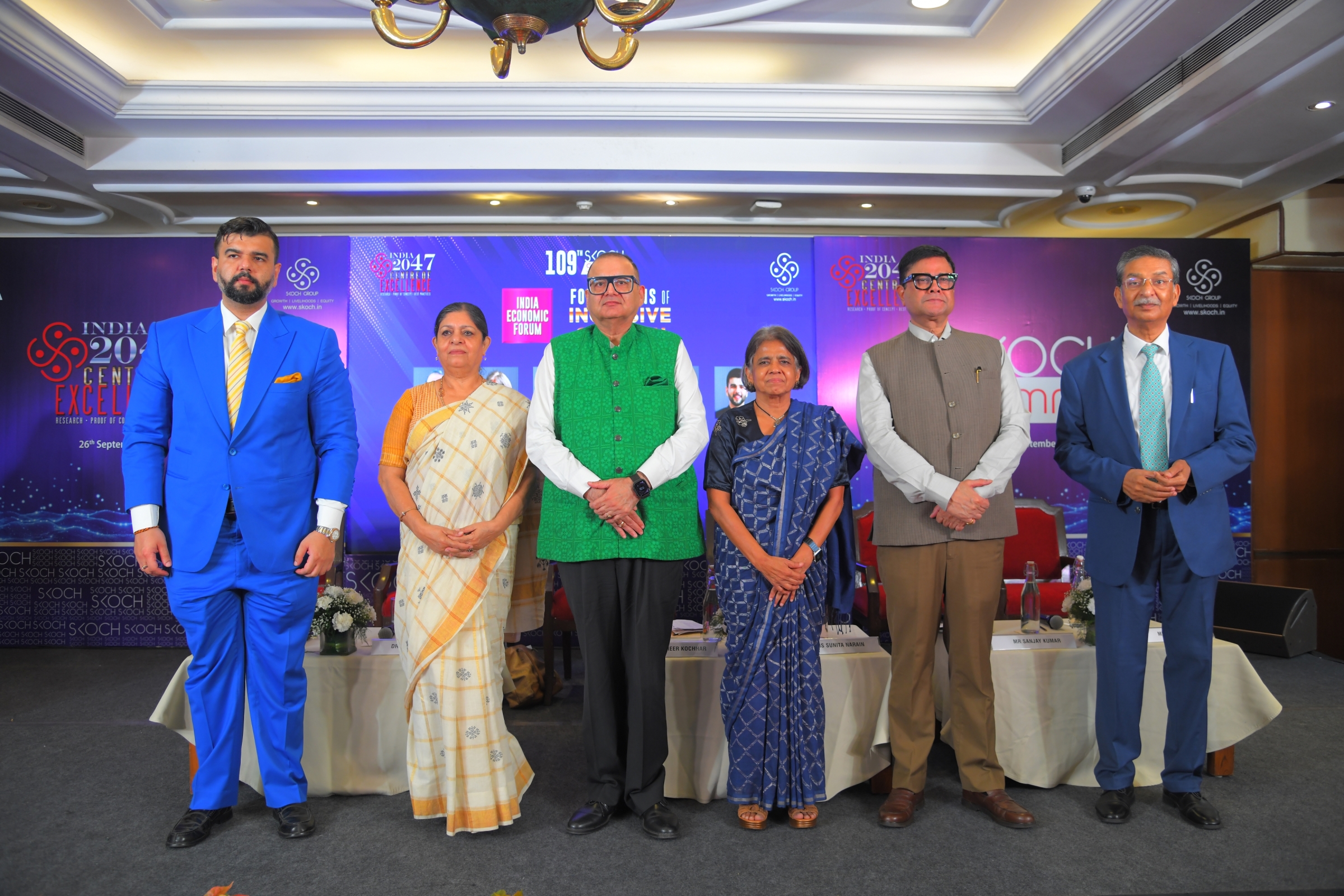
Dr Poonam Mutreja at the 109th SKOCH Summit: foundations of Inclusive Growth
Dr Poonam Mutreja
Executive Director Population Foundation of India (PFI)
Key Points*
- The speaker celebrates Sunita Narain’s long-standing contribution to environmental research, public discourse and evidence-based solutions.
- She highlights Sunita’s clarity of thought, courage and ability to identify the deeper questions behind complex environmental problems.
- She emphasizes that environmentalism is not only about nature, but also about equity, health and justice.
- She praises the Centre for Science and Environment and Down To Earth for documenting environmental change and supporting solutions with strong evidence.
- The speaker argues that India must plan its growth by accepting population realities rather than using population size as an excuse for inadequate services.
- She describes the demographic dividend as a time-bound window of opportunity that will not deliver benefits automatically.
- She notes that India’s working-age population is expected to peak and later decline, while the elderly population will rise substantially.
- She argues that population policy should shift from control and numbers toward informed choice, human development, agency, rights and opportunities.
- She places women at the centre of India’s demographic and development strategy, stressing education, skilling, reproductive choice and economic opportunity.
- She states that India cannot fully realize its demographic dividend without also realizing the gender dividend.
- She links better nutrition, education, delayed marriage, reproductive autonomy and protection from violence with stronger participation by women in society and the economy.
- She calls for greater investment in child care, elderly care, safe mobility, reproductive health, social protection and a more equal distribution of unpaid care work.
- She stresses that men must also be engaged because gender equality depends on changes within households as well as in wider society.
- The speaker presents public health and education as forms of economic infrastructure rather than merely social expenditure.
- She concludes that human development should be treated not only as an outcome of economic growth, but as a precondition for India’s future growth.
* This content is AI generated. It is suggested to read the full transcript for any furthur clarity.
Transcript
Thank you, SKOCH. Thank you, Savitri. What an honor to be part of an event celebrating Sunita. And I saw the film and Sunita, you're in good company.
But I do want to say a few words about Sunita first before I say anything else. So I've known Sunita for almost four and a half decades. It takes me, but not her. She continues to be energetic and young.
What struck me about Sunita, having known her and seen her work, is that it's not just a personal relationship. It is a field which we have both been part of.
Sunita's extraordinary clarity, when I met her the first time, was very striking. She was very clear about what she wanted to do. And that clarity, the extraordinary clarity with which she sees the world, and the courage with which she speaks about what she sees, has always stood out.
She also has an enormous ability to cut through the problem, literally and metaphorically, and to see the questions that lie beneath the questions we are all asking.
So for over four decades, as we all know, the Center for Science and Environment and Down To Earth have chronicled, documented and shared with the world a lot of what is happening, backed by evidence.
You're not just giving solutions, but you're giving evidence for the problem and the solutions, which is what I have always believed in.
I take CSE as an example in many forums to talk about what is behind their success. Sunita has consistently reminded us that environmentalism isn't just about environment. It's about equity.
Environment is about equity. Life equals health. The body of work that you have done on health, and not just the linkages between health and environment, is amazing. And it is ultimately about justice.
So those of us who know the work and know her personally know another dimension of Sunita: she enjoys what she does. She enjoys the relationships. She enjoys churning out this data.
Sunita is smiling now, but you see her laughing on any occasion in the evening when you discuss even the problems.
Sunita, despite the scale of what CSE and Down To Earth have achieved under your leadership, what is most important is that you have remained accessible and grounded in people's lived realities.
I believe that a lot of people keep saying we need to bring more science, but Sunita always argues that we need to bring humanity into science.
So it's really an absolute pleasure for me, Sunita. Congratulations for this great recognition.
We had two great presentations and we had a powerful oration by Sunita, where we do talk about climate change, AI and technology. Today, AI is something we think is going to shape the future along with everything else we do.
But another area that is changing in India and the world is population dynamics, which I will speak a little bit about.
When we talk about India's growth story, we have a number, but we don't talk enough about how many people we have and what that means for planning.
Another reason I bring out population dynamics is because I think politicians, policymakers and all of us have often used population as an excuse: we don't have enough schools, we don't have enough hospitals, we can't go to the airport, the numbers are too high.
So let's accept the numbers and start planning with the numbers.
We are at a very critical stage in India, not just globally, where we keep talking about the demographic dividend.
What we often don't recognize is that the demographic dividend is a window of opportunity. It is not permanent and it will not happen on its own.
We did some projections very recently, earlier this year, looking at population projections for India from 1951 to 2051.
The projection shows that the demographic window is time bound and that India's working-age population is expected to peak at 66% in 2031 and then begin to decline.
At the same time, our elderly population, which is close to 10% now, is expected to increase substantially. So as we plan for pensions, we have to plan for social security for a very large number of people.
India's numbers are numbing because percentages don't always tell us the scale of the large numbers which we need to look at.
So the question is, for decades population debates have often been framed around simple binaries: do we have too many people? And now we are asking, do we have too few people?
But the question is not simply how many people there are or how many people India has. The real question is what kind of lives people are able to lead, which is at the heart of Sunita's work and CSE's work.
At the Population Foundation, we have consistently argued for a shift from control to informed choice among people, especially women.
I can tell you that my throat is the best example in this room of environmental pollution. I am allergic to pollution, and there you are.
At the Population Foundation, we have consistently argued for the shift from control to informed choice, from numbers to human development, and from seeing women as beneficiaries to recognizing them as people with agency, rights and choices.
So as the population changes in India, we are at replacement level, below replacement level at 1.9. There are going to be large numbers of women who are educated, aspirational and looking for opportunities.
These opportunities are not just jobs, but also continuing education and continuing skilling.
And this is apart from the demographic dividend, the silver dividend and the gender dividend. All of these together can contribute enormously to our economy if we get it right.
So the question is also whether people have the information, services, resources and freedom to decide if and when to build their lives and if and when to have children.
And if we are serious about human capability, we have to put women at the center of this conversation.
This is not just because of the demographic situation, but also because of the aspirations of young women and young people in general across India, in both rural and urban areas.
India cannot fully realize its demographic dividend without realizing the gender dividend. The question we have to think about is the connections between these issues.
A girl who is well nourished is more likely to learn more. A girl who stays in school is more likely to delay marriage.
A woman who can make decisions about her reproductive life is more likely to pursue education and employment.
And a woman who is protected from violence and discrimination is better able to exercise her rights and contribute to her family, the community and the economy.
So we need to see these issues as part of a larger question, which means investing not only in women's health and nutrition, but also in systems that make equal participation and responsibility possible.
This includes child care, elderly care, safe mobility, reproductive health, social protection and a more equal distribution of unpaid care.
The care economy is another area which is going to define how our people live and how our people are being taken care of.
But it also means engaging men, because gender equality cannot be achieved by women alone.
Women's opportunities and roles depend a lot on how much equality we are going to see in society, but first in the household.
So this brings me to another issue that I think deserves attention: looking at public health as economic infrastructure. The same applies to education.
We often talk about health as expenditure, but poor health has an economic cost, and the effect can continue across generations.
We know that, and nutrition is a powerful example.
So as we go forward, human development needs to be seen not just as an outcome of growth alone. It is a precondition for growth.
And that is what I would argue as we think of India's economic future. We do have an important opportunity to reimagine our future by looking at the numbers, not just counting the numbers, but understanding what all those numbers mean.