SKOCH Summit
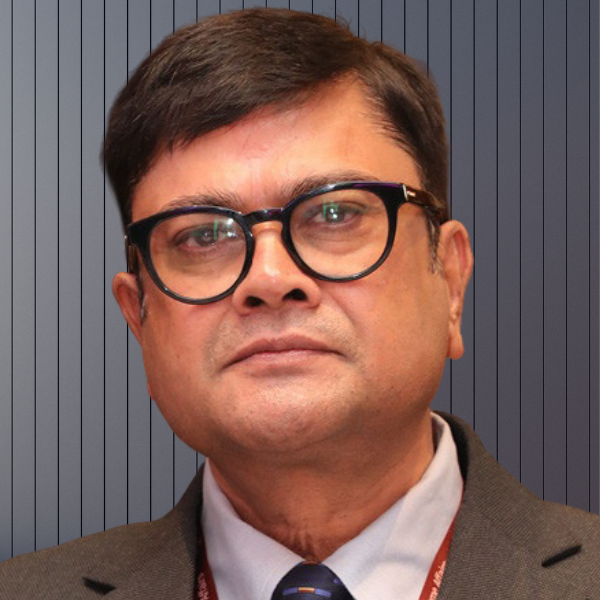
Mr Sanjay Kumar
Former Secretary Government of India
Sanjay Kumar, a 1990-batch IAS officer of the Bihar cadre, served as Secretary, Department of School Education & Literacy, Ministry of Education, Government of India. During his tenure, he played a key role in advancing the implementation of the National Education Policy 2020, with an emphasis on foundational learning, early childhood education, teacher capacity, digital education and strengthening school systems. Before leading national school education, he had worked extensively in health, skills and labour, areas that intersect directly with educational outcomes and employability He also served as Principal Secretary, Education and Health, Government of Bihar, bringing extensive social-sector experience to the national education agenda..
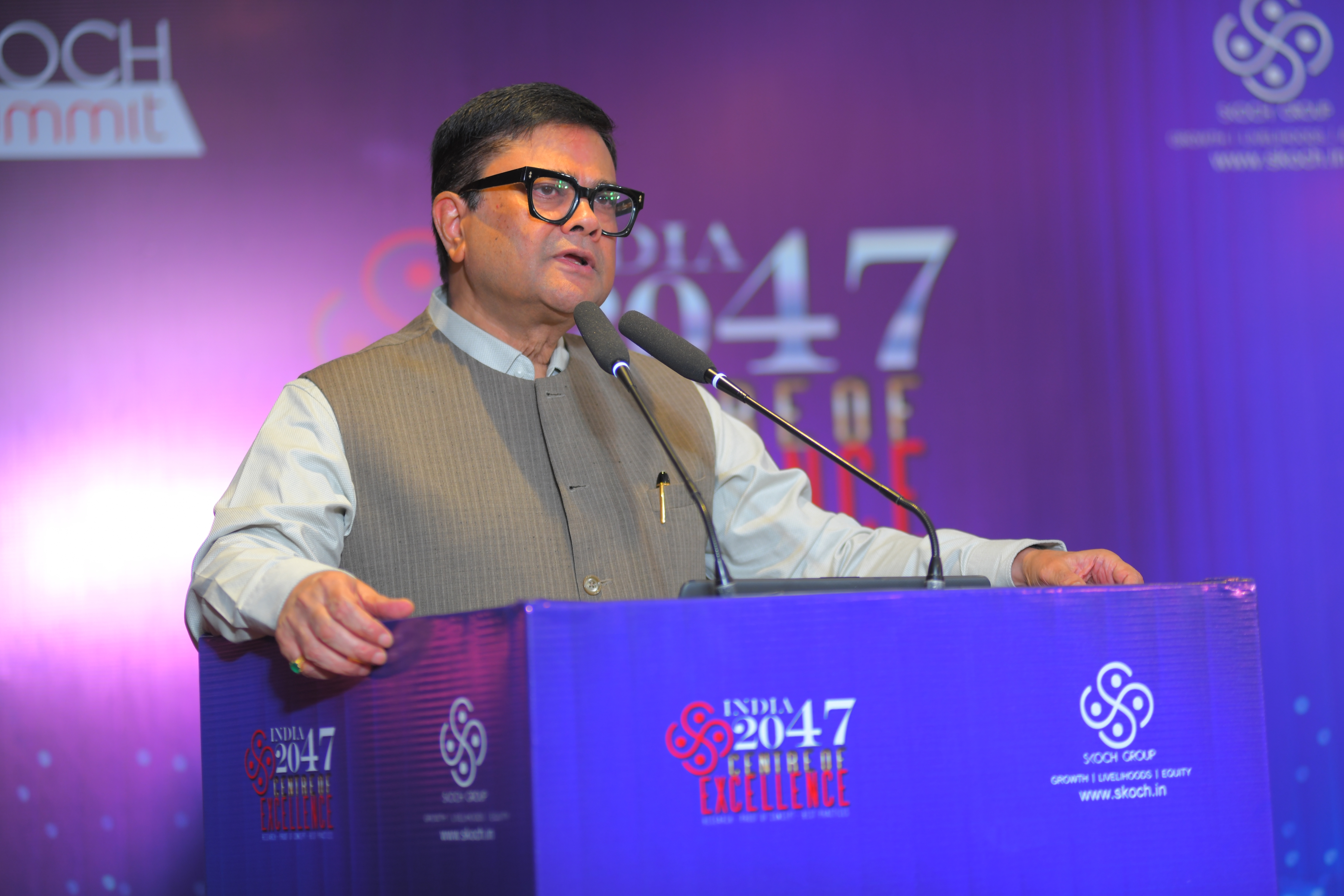
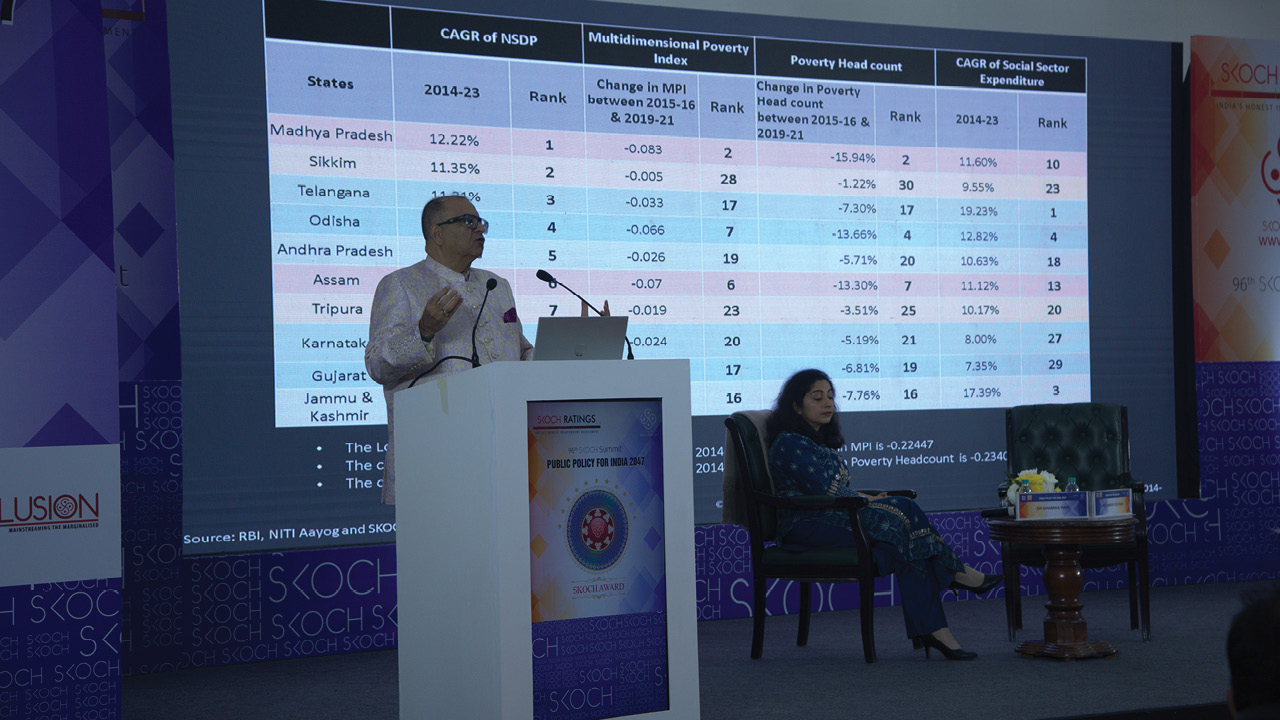
Mr Sanjay Kumar at the 109th SKOCH Summit: financing the foundations of Inclusive Growth
Mr Sanjay Kumar
Former Secretary Government of India
Key Points*
- The speaker highlights Sunita Narain’s contribution to environmental research and evidence-based public discourse.
- He stresses that humans are part of nature and that ignoring this relationship can create serious environmental consequences.
- He points to the gap between India’s cultural respect for nature and actual environmental practices, using the Ganga and urban riverfronts as examples.
- He describes clean air and clean water as public goods that affect everyone, regardless of income or social status.
- He argues that economic growth must be spatially dispersed, job-generative, equitable and sustainable, and that these dimensions are closely interconnected.
- He identifies India’s demographic profile as a major strength, while cautioning that the demographic dividend is only a limited-time opportunity.
- He raises concerns about linking economic progress indefinitely with higher consumption on a planet with finite resources.
- He notes that India is still a young country, but will age rapidly, making the next 15–20 years particularly important.
- He presents education as a key driver of inclusive growth because of its broad distributional impact.
- He emphasizes the need to improve school completion, secondary education, skilling and vocational education.
- He argues that attitudes toward manual work must change and that skilled workers should receive better market rewards.
- He states that India’s next stage of growth will increasingly depend on innovation-led development and manufacturing.
- He links gaps in labour productivity with gaps in education and workforce competencies.
- He says that effective use of AI requires adequate education, understanding of its nuances and awareness of ethical issues.
- He calls for greater investment in higher education, research, R&D and advanced skills.
- He defines successful education as the ability to think independently and make sound decisions without constant external guidance.
- He emphasizes that India’s 2047 goals will require collective participation from government, industry, society and citizens.
- He refers to Atmanirbhar Bharat, Swadeshi and Vocal for Local as part of strengthening India’s domestic capabilities.
- He concludes by calling for stronger use of research and evidence in policymaking and wider public discussion on India’s development path.
* This content is AI generated. It is suggested to read the full transcript for any furthur clarity.
Transcript
Today, we have with us Sunita Narayanji, Arunabhatji, Poonam Gurudevaji, my young friend Rohan, ladies and gentlemen. Today, all of us have gathered here in the pride and glory of Sunitaji. And this pride and glory of Sunitaji is due to her karmas. And I came to Delhi in 1981, and I got a job in 1990. And whenever there was a discussion about the environment, without her name, even that discussion was incomplete. We always heard about you. We also heard what you are doing, and how you brought attention to detail and research into environment. Thank you so much. And I would take this opportunity to thank this course foundation, Sameer Kocharji, for making this point so relevant to us, that it is so important for us.
You know, life on earth has evolved in a particular manner. But this life has always been part of the larger ecosystem in which we are embedded. But I think over the years, the Homo sapiens have become very successful on their own. And sometimes we feel that we can terra-engineering the world. We are distinct from nature. And we forget that it is only to our own peril that this thought process is going to continue. We are part of nature. We have to live with nature. And I think whenever there is a confrontation between nature and civilization, who is going to win is very clear.
I think in India, sometimes I wonder why we live at two levels. At a conceptual level, I think our worldview is pretty good. We consider ourselves to be part of nature, subservient to it. We pay a lot of respect to it. And yet, when you actually see in life, you see a dichotomy. You know, I come from, my hometown is Patna. It's on river Ganga. And I don't know how many of you have got an opportunity to go to Patna. It's a city which has got its back to the river. And I have always wondered why that a city which is on river Ganga has got its back. There is no river front. Nothing opens on to the river. And what we did was that we made a road called Ashok Rajpath, which runs approximately 200 meters away from the river. And everything opens on to the road. And your back is to the river. We call Ganga our mother. And yet, we don't shy in creating a situation in which the river is not clean. And I think this is at the core of it, that sometimes we say many things, but we don't quite do it.
How many cities in this country actually have a river front? How many of us have actually gone to the Jamuna river front and enjoyed a stroll there? Do we have a Jamuna river front? If you see cities abroad, especially in other places, you have a very, very active river front where people go, spend time in the evening. We don't do that. The other thing which we don't quite realize is that environment is one word which is a public good in the real sense. No matter how affluent you may be, if you live in Delhi, you will breathe the same air. And the water quality is also going to affect you in a similar manner. So there is an imperative, a very strong imperative, that everyone must come together and do something about it.
Economy is like an elephant in the room. When you start talking about economy, then you don't know what you are talking about. So when you talk about economic progress, growth, development, we all mean very differently for each of the topics which we are mentioning. I think it was very well summed up in the first presentation that we are looking at economy as spatially dispersed, job-generative, equitable and sustainable. Though you have divided it into four parts, if you think a little deeply, you will find that all the four are interlinked with each other. And nothing can exist distinct from another. So if it has to be job-generative, then it has to be spatially dispersed. That only will bring in equity and make it sustainable in the long run. So all these four things, everything is combined.
I think in India our strongest strength is our demographics. And this is what we are talking about. I think my previous speaker Poonamji spoke about the demographic dividend. Long back whenever I used to cross the AIIMS crossing, there used to be a population clock there. And I am very happy to see that it has been reactivated. So nowadays if you cross the AIIMS intersection and if you look towards the hospital, you will see a large population clock. It says about 147 crores. And while the car or the vehicle you are travelling in takes a little time, you see how the number of people we have added in that time. It used to frighten me earlier. Now the discourse says that I should not be frightened about it because it is a dividend. Now dividend and sustainability, I think it makes things more difficult.
We all want to consume more. And all the economic philosophy is based on consumption. The more you consume, the more the economy develops. And yet it is a finite earth and finite resources. To what extent we can continue indefinitely is a larger question. But then this is a larger philosophical question that to what extent progress can be linked to conspicuous consumption. We need to think about it. But I think it is a very complex question and it will require deeper thinking at all levels. We have got approximately 147 crore people now.
I think the population is going to peak in the year 2061 depending on the kind of model you are looking at. And then after that our fertility levels are also going down. As Poonamji mentioned, we are at about 1.9. And my particular feeling is that once the 2027 census data is there with us, we might see a greater fall. You know, I was Health Secretary in Bihar when Covid started. And all the Biharis were coming back and they were under lockdown. And I was extremely scared. And I was very scared that, oh my God, what is going to happen to the population now? And what kind of a situation would arise after nine months from that date? You know, I was so wrong because nothing happened absolutely. And after nine months, I think the fertility level did not surely rise. In fact, it fell down further.
What happened? That is the larger question. And the larger question is, I started talking to people that what probably resulted in this. And people told me that people are scared to bring a new life in a world which is a little insecure. And that is a question which is there with us. What kind of a world are we creating for ourselves? Are we creating more security or are we creating greater insecurity? And I think collectively we need to find a solution for it. The government is definitely there and the government is steering the economy, the growth, everything. But as a society also we need to contribute to it.
We are a young nation. Our median age is approximately going to be a little less than 29. We have an advantage over the rest. The US is 37 median age. The Chinese are 42. Japanese are 48. But we are also going to age. We are also going to age and we are aging faster. We have a window of about 15-20 years ahead of us which coincides with the Honourable Prime Minister's vision of India by the year 2047. But this window is going to be a one-time window in front of us. And this is the time when we must get our act together and be able to do things.
A lot of things can be talked about. But let me give you a little bit of perspective from one sector where I have worked in the recent past and that is education. I think if you are looking at the four pillars, if you want spatially dispersed growth, job-generative, equitable and sustainable growth, then I think education is the best way to reach out to each and every person because it has the most distributional effect. I was watching a video by Jeffrey Sachs sometime back in which somebody asked him a question that how do you decide a society is doing well? And he said that if you want to see whether a society is doing well or not, look for four things. The first one is, are the children learning well? Number two is, are they innovating? And if you are learning well and if you are innovating, then is new technology being created? And the fourth one was, is household income going up or not? Because that forms the basis of investment in the economy. Three out of four is coming out of the education system.
And I think we need to do that. The National Education Policy 2020 is there. It is endeavouring to do things, bringing foundational learning in the language you are comfortable in. But the challenges remain with secondary education in the country. Out of every hundred children who are coming in Class 1, 76 are going up to Class 10 and 62 in Class 12. Can we make this and ensure that by 2030 or a little beyond that, everyone who gets into Class 1 goes up to Class 12 and finishes there? And while you do that, you will pick up some kind of competency in a skill.
We don't do skilling at all. Only about 9% of our children who are in secondary school are picking up some kind of skilling. If you look at South Koreans, this figure is beyond 90%. Most of the OECD countries are in the 70s and 80s. And we are at 9%. But then I think there are cultural issues with working with hands. A large number of people are actually going to school because they want to escape from working with hands. This is the aspect which needs to be discussed, reimagined and talked about. And the markets have a great role to play because if you are paid better, then it doesn't make a difference how you work. If you work with hands and are paid very low, then chances are that you would want to avoid it.
So the markets, the industrial bodies, the investment bodies, they all need to look at it as to how we treat our people who work with hands. Can we bring them greater competency and ensure that markets are kinder to them? So that's one particular issue which we need to keep in mind. The second portion is as you climb up on the per capita curve, the next level of development, the next shot is going to come from innovation-led development and manufacturing. And that remains an issue for us.
If you look at the labor profile in the country, almost 45% of people are still in agriculture, which is giving you 16-17% of the GDP. So you can see a relative impoverishment of people who are part of agriculture. Manufacturing is giving you 15-16% of the GDP, but it is employing 25% of people. And the rest are in services. But where the problem is, the problem is that a large number of people who are in the workforce are not suitably educated or do not have that level of competencies. If you look at India, almost two-thirds of people who are in the labor force are having less than basic education.
And if you juxtapose this and compare it with labor productivity, I think it tells a story. The story is that our labor productivity in India is $8 per hour. If you compare it with the U.S., which is about $90, Ireland is $140. What is explaining this variance in labor productivity? There could be several issues, but we tried and looked at it from the point of view of the educational background of the labor force, and we found that in the U.S., almost 51% of the labor force has tertiary degrees in higher education. And if you add secondary education, it's almost about 75%.
Education does make a difference, and I think to that extent, if you are planning to innovate and have innovation-driven growth, look at AI. Who's going to consume AI? You can only use AI if you understand the nuances of it, understand the ethics of it, and you need to have a certain educational background to be able to use it. So the next level of growth is going to be innovation-driven, and we must be prepared for it. Otherwise, those of you who read economics, people will tell you that if you want to escape the middle-income trap, then you need to do that much amount on the education front.
If you look at higher education, the number of people who are going to higher education is about 30%. The NEP says that by 2035, we should take it up to 50%. Almost everyone who is doing Class 12 today is going into higher education. That's a quantity of more than a crore. And the drop-offs are very fast. But the larger question I'm leaving behind for you is that of all the people who are in higher education, 80% are doing undergraduate. And the ones who are doing research, PhD, postdoctoral studies, that's 0.5 or 0.6%.
Again, if you look at it and say that, okay, we are spending only about 0.7% of our GDP in R&D, where are the people who are going to be in R&D and take this 0.7% to 2.5% or maybe 3% or 4.5% as the Israelis are doing? China is doing 2.8%. So we need an upgradation of skills. We need to make sure that our school education system works well, we adequately invest in education, and make sure that every Indian is empowered to be able to think for oneself. There is cognitive development of each and every one of us.
So many things have been said, but I always say that the larger issue with education is: are you able to think when there is no one to tell you what to do and what to think? If you can think at that particular juncture and still do the right thing, I think education has done its job. I am very happy to be here, to be talking to you, but I see great hope in front of us. And I see great hope because we are thinking big.
If India is going to be there by 2047, then as a society we all need to come together. And I would reiterate once again what the Prime Minister has said, that we must create an Atmanirbhar Bharat. It cannot be a blind Atmanirbhar Bharat, but then the fact of the matter is that the kind of geopolitics we are seeing, we need to have strength of our own. And that is based on Swadeshi. Swadeshi again does not mean the Swadeshi of 1905. It's a different kind of Swadeshi. And how do you create a demand for something which is being generated and produced locally? So he said, be vocal for local. We need to have a milestone in 2047 to see how we are progressing.
But there needs to be much greater discourse on what we are going to do. And I think platforms like this create an ecosystem where people come together and start talking about it. This conversation needs to be amplified. It needs to be taken to each and every person because we are all in the business of development of India and equitable growth. But I think eventually leadership is extremely important. And I come back to Sunita Narayanji once again because we need more people like you who are able to imagine and bring things together.
I would want to end with something which happened when I joined the IAS in the year 1990. One of my friends rang me up and told me, congratulations Sanjay, you have got into the service where policy making has become research neutral. I guess it was a perception. I think this perception to a very large extent has been demolished, but we need to bring in more research, more evidence in what we say and the way we formulate policy.