SKOCH Summit
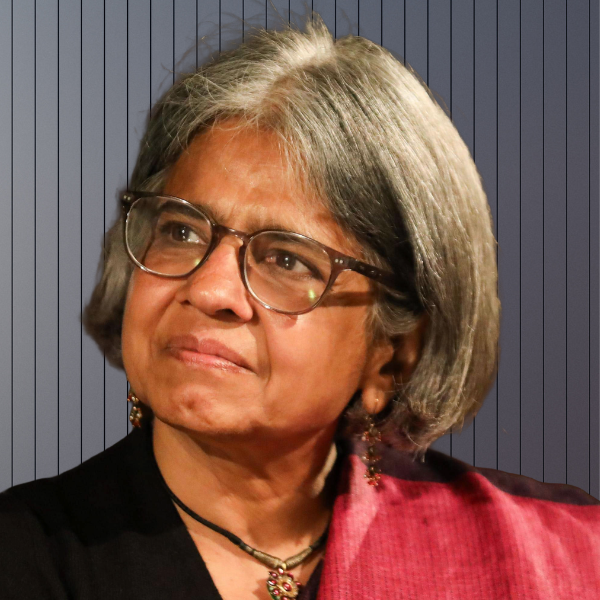
Ms Sunita Narain
Director General, Centre for Science and Environment (CSE)
Sunita Narain is a renowned environmentalist, writer, and the Director-General of the New Delhi-based Centre for Science and Environment (CSE). She also serves as the Editor of Down To Earth, India’s leading environmental magazine. For over four decades, Narain has been a driving force in shaping public discourse on environmental challenges and sustainable solutions, particularly in the Global South. Her work blends science-based evidence with a pro-poor perspective, advocating for the integration of environmental concerns into public policy and societal priorities. Through her leadership and advocacy, Narain has championed critical issues such as air pollution control, community water management, pesticide regulation, and sustainable urbanization. She consistently emphasizes that environment and developments are interdependent, arguing that inclusive and equitable growth must form the foundation of true sustainability. Narain’s contributions have earned her wide recognition in India and globally. She has been honoured with the Padma Shri by the Government of India and the Stockholm Water Prize for her pioneering efforts in water conservation. Internationally, she has received the Prince Albert II of Monaco Foundation Award, The Order of the Polar Star (Sweden), and the Edinburgh Medal for her leadership on climate and environmental issues.. She has served as a member of the Prime Minister’s Council on Climate Change, advising on national strategies to address climate impacts. Narain also chaired the Tiger Task Force in 2005, which developed a comprehensive action plan for tiger conservation, and contributed to the National Ganga River Basin Authority, guiding policy for the rejuvenation and protection of the river. Recognized as one of the world’s top 100 public intellectuals by Foreign Policy and Prospect magazines, and featured in Time Magazine’s list of the 100 most influential people Narain continues to inspire collective action for a water-secure, climate-resilient, and environmentally just world..
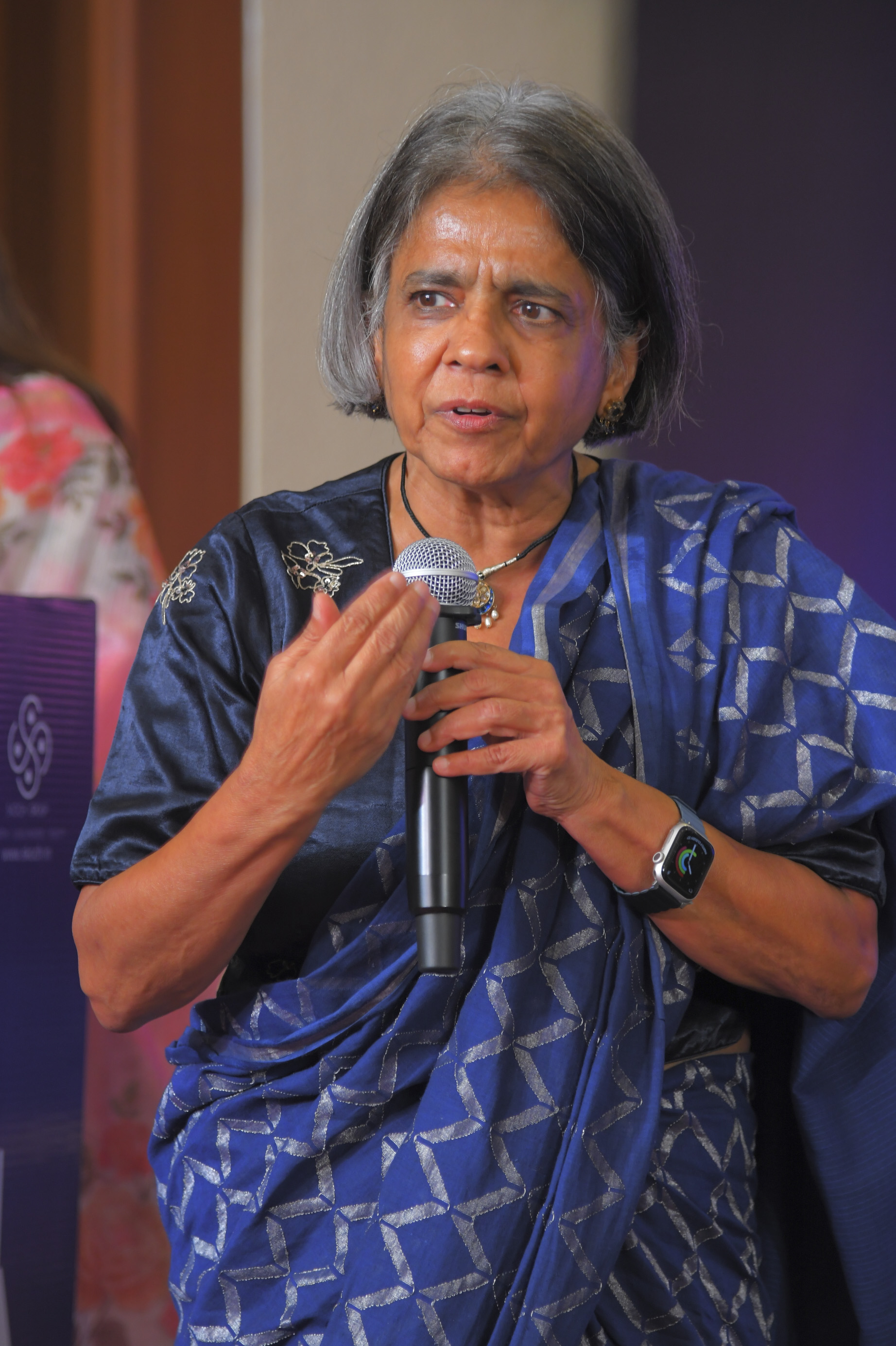
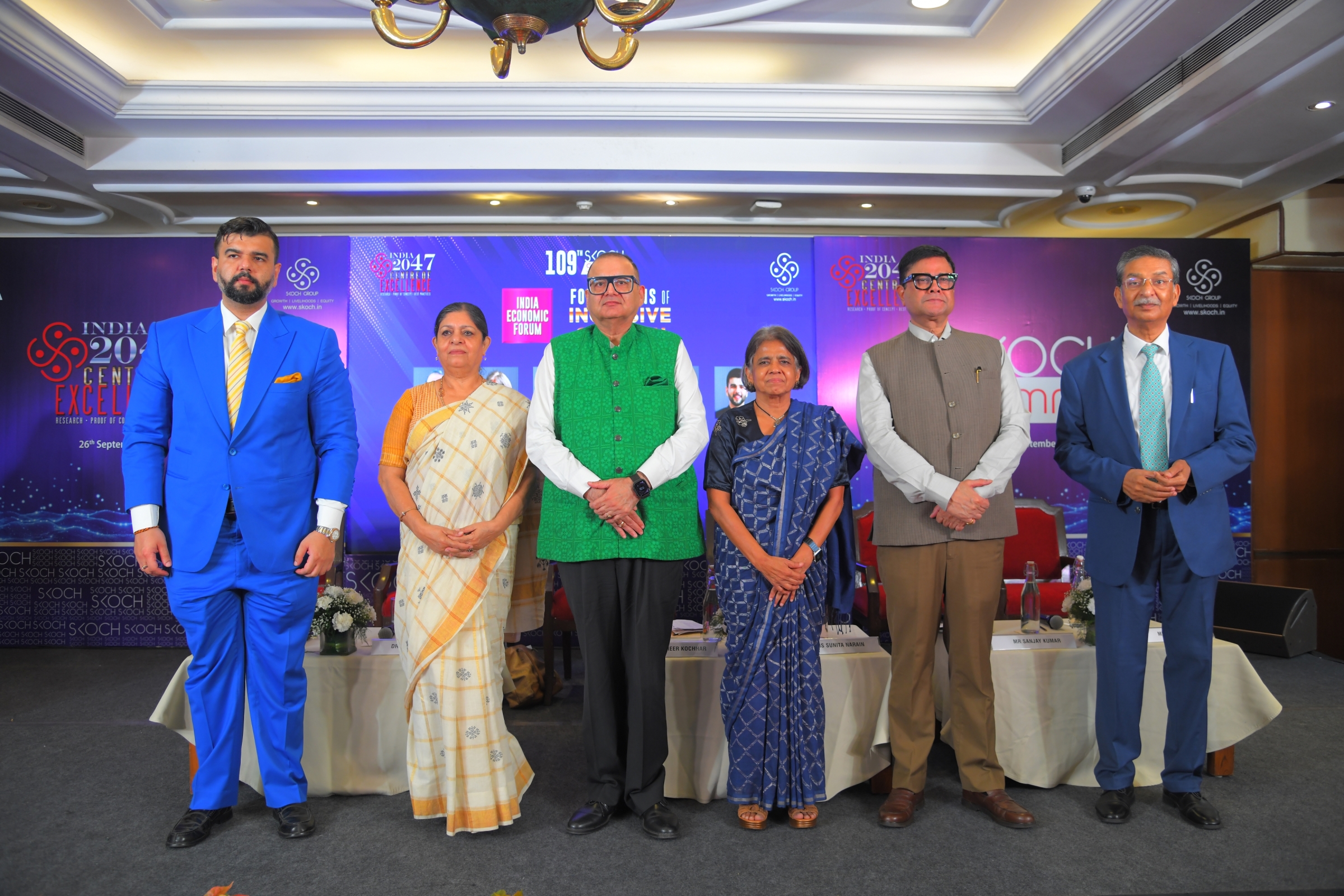
Ms Sunita Narain at the 109th SKOCH Summit: foundations of Inclusive Growth
Ms Sunita Narain
Director General, Centre for Science and Environment (CSE)
Key Points*
- The speaker presents environmental issues as fundamental foundations of economic growth, not separate concerns.
- She argues that growth without clean water, clean air and public health cannot be considered meaningful growth.
- She emphasizes that sustainability is only possible when growth is both affordable and inclusive.
- She explains that in India, environmental challenges are directly linked to the way economic growth and development are designed.
- Using Delhi air pollution as an example, she argues that clean air requires a mobility system that moves people efficiently, not just vehicles.
- She highlights the importance of walkability, safe road crossing and inclusive public mobility in reducing urban air pollution.
- She states that clean rivers depend on sanitation systems that are affordable and capable of reaching every person, including the last mile.
- She argues that inclusiveness and affordability are central to improving water quality and environmental outcomes.
- On agriculture, she stresses the importance of soil health, biodiversity and improving farmer incomes while reducing input costs.
- She cautions against agricultural systems that depend on increasing subsidies while delivering lower returns.
- She describes inclusive and affordable growth as the core environmental message for sustainable development.
- She says the award also recognizes the role of serious research in identifying environmental problems and pointing toward practical solutions.
- She highlights the work of the Centre for Science and Environment and Down To Earth in documenting change, identifying change makers and supporting solutions.
- She concludes by expressing gratitude to the SKOCH Foundation and says the recognition will encourage continued work on environmental research and solutions.
* This content is AI generated. It is suggested to read the full transcript for any furthur clarity.
Transcript
My height does not... No, this is fine, this is fine. So, thank you so much Sameerji, thank you Rohan. Fascinating discussion as well this morning.
Thank you for this award. It's a real honour and I'm really privileged to receive it. I think also why I'm really privileged, and I wanted to speak about that in my acceptance speech, is that this award for me today is really a recognition of two important issues.
One, very much as Rohan put in his presentation today, it is a recognition that environmental matters are matters of our foundation. These are issues that we cannot ignore even as we do growth, even as we need to have more and more economic growth.
Growth without clean water, without clean air, without health will not be growth. So, I think it is very important and I'm really grateful for this recognition because it really puts into focus that very critical issue.
And why it is also important, and I think that is why I'm very honoured to be here today, because Sameerji very correctly said that it is about inclusive growth.
In the work that we have done over these last many decades, when we have understood the environmental concerns, one of the key issues that has come to light, which has become the most abiding issue of our times, is that we cannot have sustainability without affordable and inclusive growth.
So, for us in India, and this is different from the rest of the world, the rest of the world has practiced environmental management as divorced from the issue of the nature of growth.
For us in India, every environmental issue is about the method of growth. How we will do growth, how inclusive it will be, is how sustainable it will be.
I'll give you a clear example. We are now in October, close to October, we are going to start the season of despair, the season of air pollution in the city of Delhi.
But the fact is we know that unless we have a mobility system that can move all, not a mobility system that can move few, we will never have the right to clean air.
If we do not have the right to walk, if we do not have the right to cross the road, if we do not have the right to be able to move people, not vehicles, we will not have clean air.
Bharati is here. In all the work that he has done on water, on sanitation, he will tell you that without the ability to reach everybody, the last person, you can never have clean rivers.
You need to make sure that there is an affordable sanitation system. So it's not about sanitation, it is not about sewage, it is about affordability.
It is about inclusiveness, which then leads to how clean your rivers are, how clean your water is. And that really has been the most fundamental learning of the environmental movement in India.
You can take the issue of agriculture, Rohan, you talked about it. The issue of agriculture for us, the issue of agriculture today is about soils.
It's about the biodiversity in the soils because of which you have productivity in the soil. It is about creating a method of agriculture so that farmers get more income by investing less.
Because it is not about an unaffordable system of agriculture in which we subsidize more and more and we get less and less.
So the whole nature of thinking about growth, about development, is what is at the core of the environmental message.
And that is why for me this honor, this award today is so important because it recognizes not just that environment is important, but also that the environmental message is that without inclusive affordable growth, it can never be sustainable.
But secondly, the reason I believe this award means so much, and many of my colleagues are here in the room today, is because it recognizes the kind of work that we have done to bring forth the environmental issue.
CSE, the Center for Science and Environment, Down To Earth, we are chroniclers. We document what is happening in the country. We point to what is happening, what is changing, the change makers, and we stand behind the solutions.
So the award also recognizes that good research, serious research, research which can point to the solutions, is something that society values.
So for me that matters a lot. So thank you very much, Sameerji.
Thank you, SKOCH Foundation, for this award. And I hope that it will give us the courage to continue to do, I know it will give us the courage to continue to do much more of this.