SKOCH Summit
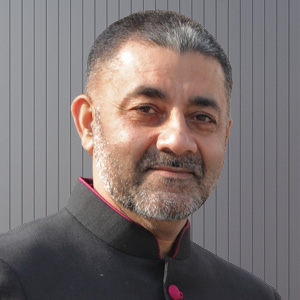
Dr Gursharan Dhanjal
Vice Chairman, SKOCH Group
Dr Gursharan Dhanjal, MA, MPhil, PhD from Delhi University and an expert in strategic affairs, is Vice Chairman, SKOCH Group. He is also the Editor of INCLUSION—a quarterly publication that focuses on development and addresses inclusive growth-related issues. INCLUSION has completed six years. He has over 20 years of work experience ranging from academics to research and business journalism to consulting. He started his career as an Assistant Professor and taught at Delhi University for five years before joining Asia Business News (India)—Dow Jones, a premier broadcaster of business and financial news during the mid-90s. He also worked for CNBC for over three years during the late 90s.
Dr Gursharan Dhanjal at the 110th SKOCH Summit: Banking Bharat for Inclusive Growth
Dr Gursharan Dhanjal
Vice Chairman, SKOCH Group
Key Points*
- The speaker welcomes participants to the Banking Parliament's 110th SKOCH Summit and frames the discussion around the next phase of inclusive growth.
- He recalls that formal access to credit emerged as a major policy concern after liberalization, especially for cultivator households.
- He notes that informal credit has long existed in India, but the need for wider formal credit access became increasingly important.
- He highlights the launch of Jan Dhan Yojana in 2014 as a major step toward institutionalizing financial inclusion.
- He identifies three connected priorities: credit access, financial inclusion and inclusive growth.
- The focus of the summit is not only on reviewing past progress, but on identifying what needs to be done next.
- He says that over the last decade, financial inclusion has become more formalized and institutionalized.
- He argues that the conversation has moved beyond simply opening bank accounts toward entitlement, empowerment and credit linkage.
- He points to government schemes aimed at linking small entrepreneurs, MSMEs and micro enterprises with formal credit.
- He defines inclusive growth as job-generative, spatially dispersed, equitable and sustainable.
- He explains that banking, MSMEs, microfinance and development together form an ecosystem that supports inclusive growth.
- He describes the desired transformation as savings becoming investments, credit becoming entrepreneurship and financial inclusion becoming empowerment.
- He says that the speakers at Banking Bharat will bring perspectives from different parts of the inclusive growth ecosystem.
- He concludes by formally opening the 110th SKOCH Summit, SKOCH BASI Forum, Banking Bharat.
* This content is AI generated. It is suggested to read the full transcript for any furthur clarity.
Transcript
Dignity is on the dice, ladies and gentlemen. It is my pleasure to welcome you all to this gathering, Banking Parliament's 110th SKOCH Summit. As it is already visible and seen that we are at the 110th mark, meaning to say that we have led this agenda towards inclusive growth via various means, various forums, various stakeholder consultations, and that brings us together once again to talk about, as we move forward, what do we do and where do we go.
Ten years into liberalization, we started focusing on credit. Somewhere around the next three to four years, another fact came to light, which was pointed out by the then Finance Minister, that less than 50% of cultivator households had formal access to credit. That means to say the need was felt even at that time for formal credit. Informal credit has always been available in the Indian financial ecosystem for centuries together.
Come 2014, this was taken up in mission mode with the launch of Jan Dhan Yojana, and somewhere in between it was also seen that the concept of inclusive growth was born. So three things came together. One, we talked about credit and the requirement for that. Second was financial inclusion. And third was the need to move forward in the form of inclusive growth.
And that is precisely what we are discussing today. We are not going over what has happened. That's there, that's the guiding force. But we are discussing what do we need to do moving forward.
Therefore, what we have seen in the last one decade is a formalization of the process and institutionalization of the concept of financial inclusion. India became a fully financially included country at the household level more than four years back.
And we are devoted as a SKOCH reporter. We also find that we have moved beyond opening bank accounts alone. What we are talking today is entitlement and empowerment and credit linkage.
Absorptive capacity was the need of the hour, which to a great extent has been addressed. Therefore, we have various other schemes which have been launched by the government to credit-link the small entrepreneurs, to credit-link the MSMEs, and also to encourage the micro enterprises. So various schemes, which is what we have seen, have been on the air.
So as SKOCH, we define inclusive growth as job generative, spatially dispersed, equitable and sustainable at the same time. This is not a new mantra. This is only a guiding force to bring everything onto the same platform so that the benefits are dispersed and reach the largest set of audiences.
And this is the reason why we bring together banking, we bring together MSMEs, we bring together microfinance and development. We have also seen that together these constitute an ecosystem of growth which we translate as inclusive growth in those four components, where we see that savings become investments, credit becomes entrepreneurship and financial inclusion becomes empowerment.
So our speakers today, ladies and gentlemen, bring perspective from different aspects to inclusive growth. And this is precisely what the purpose of Banking Bharat is today. So with this, I welcome you all once again.
Thank you very much for joining us today. I declare the 110th SKOCH Summit, SKOCH BASI Forum, Banking Bharat, open.
.JPG)
.JPG)