SKOCH Summit
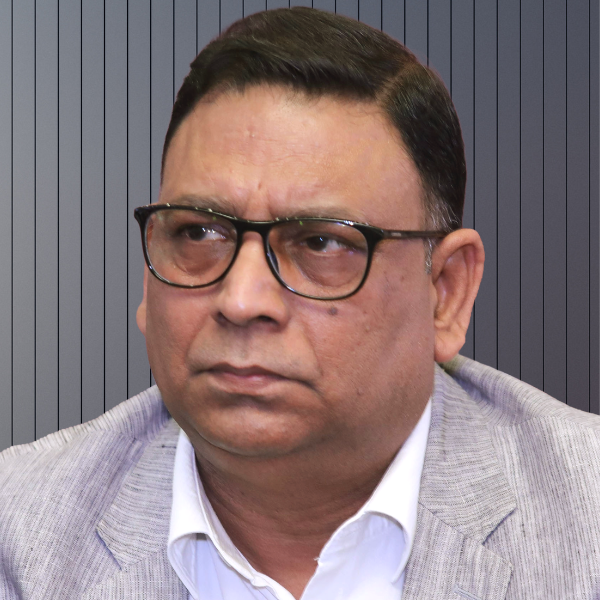
Mr Anil Bhardawaj
Secretary General, FISME
Anil Bhardwaj is Secretary General of the Federation of Indian Micro Small & Medium Enterprises (FISME). He has worked extensively in the fields of international trade and SME development. He has advised or led several SME development projects supported by multilateral and bilateral donor agencies in India. His recent engagements include Member, Damodaran Committee for Reforming the Regulatory Environment for Doing Business in India (Ministry of Corporate Affairs); Member, Drafting Committee for ‘National Voluntary Guidelines on Social, Environmental and Economic responsibilities of Business’ since notified by Ministry Corporate Affairs (Govt. of India).
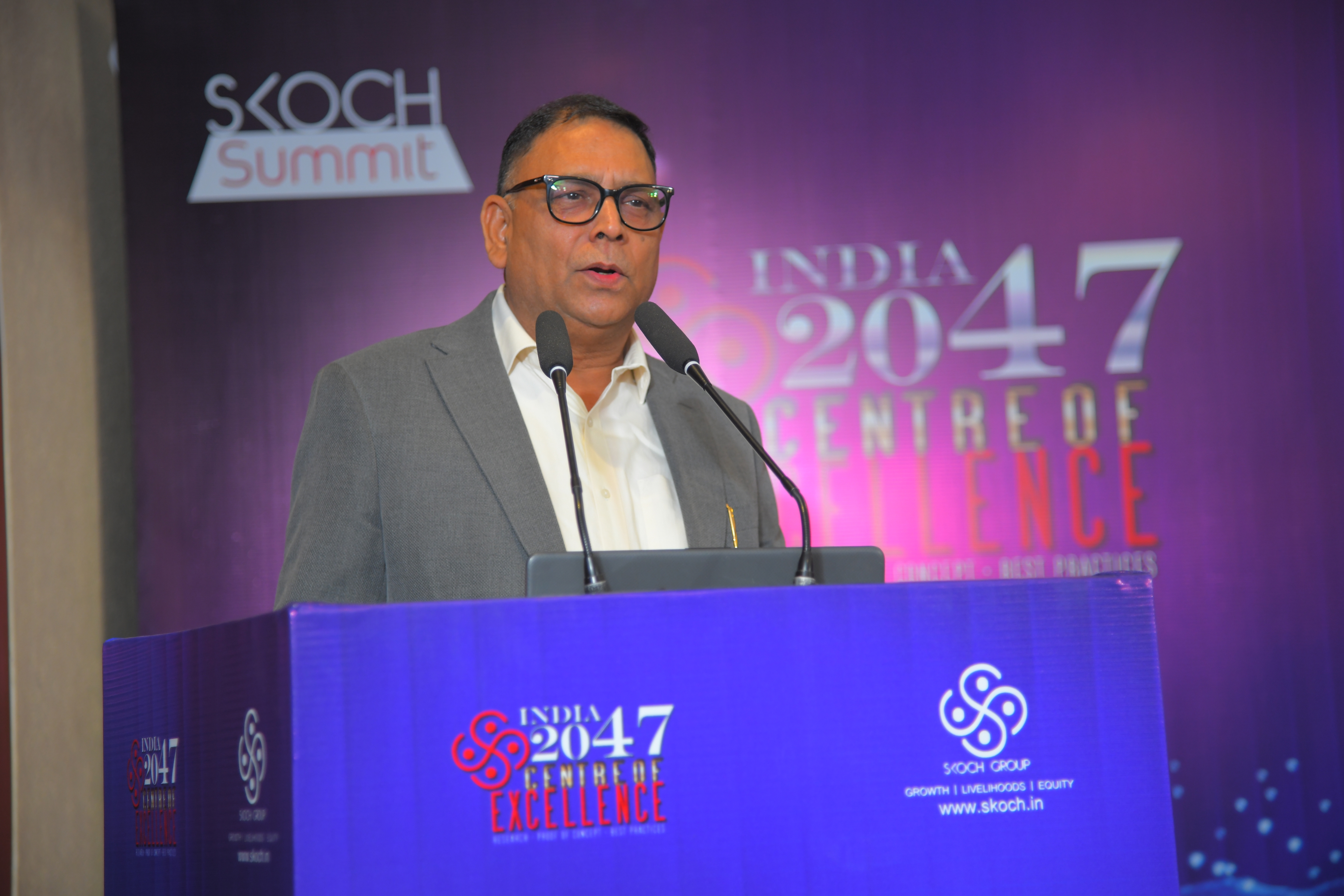
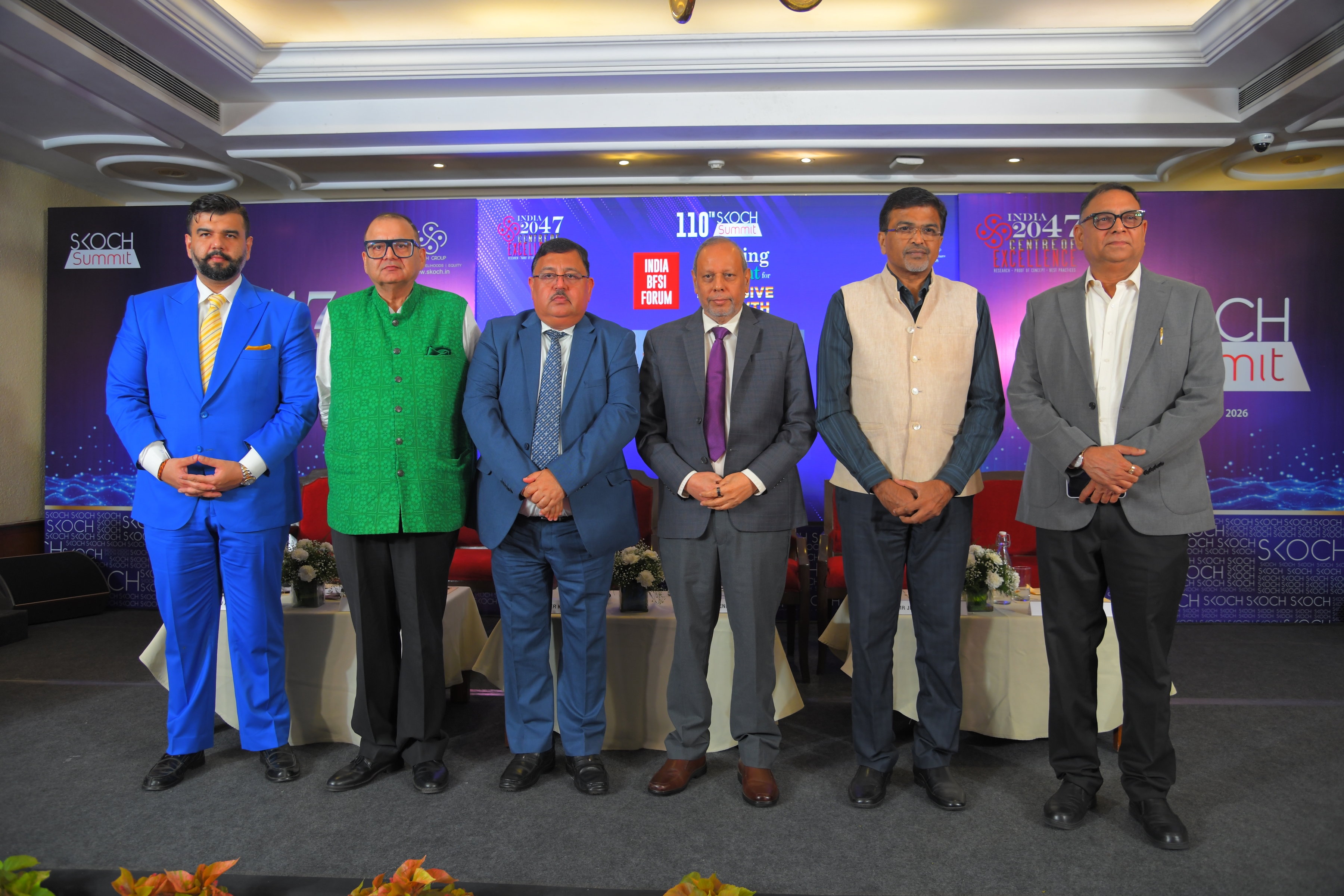
Mr Anil Bhardawaj at the 110th SKOCH Summit: Banking Bharat for Inclusive Growth
Mr Anil Bhardawaj
Secretary General, FISME
Key Points*
- The speaker argues that financial inclusion in India has undergone a major transformation over the last decade, driven by Digital Public Infrastructure, Jan Dhan accounts, Aadhaar, mobile connectivity, UPI and Direct Benefit Transfers.
- He says that earlier discussions on inclusion focused mainly on opening bank branches and accounts in villages and remote areas.
- He describes the recent change in India’s financial ecosystem as a civilizational shift.
- He highlights the growing financialization of household savings, with families increasingly moving beyond gold and traditional bank deposits.
- He points to the sharp rise in mutual fund assets and demat participation as evidence of changing household investment behaviour.
- He notes that India’s financial system is now generating large and continuous pools of capital looking for investment opportunities.
- He argues that the situation has reversed from a decade ago: earlier businesses chased capital, while today capital is increasingly chasing good opportunities and ideas.
- He uses the example of a medium-sized company IPO to illustrate the strong demand from retail and institutional investors.
- He highlights that India has substantial available capital but comparatively few companies operating at sufficiently large scale.
- He points out that despite India’s huge MSME base, only a relatively small number of firms employ more than ten people.
- He says that MSME finance has expanded significantly, but a large financing gap still remains.
- He emphasizes that the current challenge is not simply a shortage of capital, but a shortage of investible opportunities at scale.
- He argues that India’s next major challenge for 2047 is to create more companies, enterprises and investment opportunities capable of absorbing the capital being generated by the economy.
- He concludes that India must focus on deploying available capital meaningfully and effectively rather than only concentrating on generating more capital.
* This content is AI generated. It is suggested to read the full transcript for any furthur clarity.
Transcript
Ladies and gentlemen, I must thank Mr. Kaushik for giving me this opportunity to invite me and giving me this opportunity to share something with you. Today, for the last two days actually, we have been organizing an international conference of media at O.P. Jindal Global University in Sonipat, and it was difficult to come out. But Mr. Kaushik's order was there, and the subject was very close to my heart, that of inclusiveness. So, I thought that I should take it. I am happy that I was able to make it, enter the hall and accept his warm welcome. Thank you for having me here.
When I came here, Mr. Kaushik was talking to me about the challenge of giving big accounts. Twenty years ago, any conversation about inclusiveness would have been very different. Ten years ago, the discussion would have been about how many branches we can open in villages and remote areas, and how many accounts can be opened with targets of 50 or 100 branches. Suddenly, in the last ten years, something of a civilizational change has taken place, as I put it.
It is difficult to believe unless you visit other countries and see how they have progressed. And suddenly, in the last ten years, an explosion has taken place, thanks to Digital Public Infrastructure, of course. Whether it is Jan Dhan accounts, Aadhaar and mobile, and then after that UPI or DBT, in short, a civilizational change has taken place.
And it has led to some very interesting follow-up events. For example, financialization of families and household savings. Some years ago in India, the concept of household savings was that if we had money, we bought gold or put it in the bank. In the last ten years, the assets under management of mutual funds have increased six times. It has never happened before.
Around Rs. 85 lakh crore is the amount that has come under management of mutual funds. Apart from this, participation through demat accounts has also increased massively. And the result of this is that suddenly, in our financial system, there is a continuous cash flow of around Rs. 30,000 crore per month chasing investment opportunities. And this is a completely opposite situation.
Ten years ago, you were chasing capital. Now, capital is chasing opportunities and ideas. I am an independent director in a medium-sized company. It got listed on the NSE. It was an IPO of Rs. 1,000 crore. It got six times subscribed at the retail level.
And guess what was the investment response from institutional investors. Not five times, not ten times, not twenty times, but around 200 times. India's best mutual funds and investment bankers were chasing a medium-sized company. And it was not making IT products or AI products that could multiply ten times or a hundred times over a period of time. It was because of the power of available investment capital.
And then we had a discussion with these bankers. Let me share what they said. They said that we have so much funds, but we have very few companies. There are hardly around 1,000 companies that come to a turnover of Rs. 1,000 crore. We have around 9 crore MSMEs, but we have just about 2.5 lakh companies that employ more than 10 people.
So the base is very small. When we talk about inclusiveness, certainly dramatic changes have taken place. When it comes to MSME finance, something very interesting has happened in the last ten years.
Around Rs. 64 lakh crore worth of opportunities exist for financing in the MSME sector. Around Rs. 34 lakh crore is backed by the banking sector. If you bring in NBFCs as well, roughly 75% is financed by banks and 25% by NBFCs. Still, around Rs. 30 lakh crore is left to be financed.
So it is not that all MSMEs have got the money. But the point I am trying to make is that we are chasing very few opportunities and we have so many funds available to us.
So the next challenge for India 2047 is not really how to generate more capital, but how to generate such opportunities and such companies at such scale that this investment which the Indian economy has started generating could be meaningfully and effectively employed.
With this, I close. Thank you very much.