SKOCH Summit
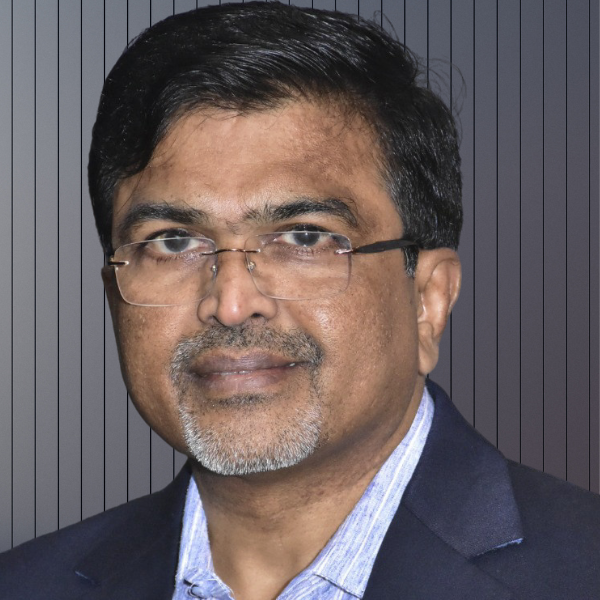
Mr Jiji Mammen
xecutive Director & CEO, SaDhan
Mr Jiji Mammen is the Executive Director & CEO of Sa-Dhan, a position he has held since June 17, 2022. With almost four decades of distinguished experience in microfinance, agriculture, and rural development, he is widely regarded as a leading voice in India’s inclusive finance ecosystem. Before joining Sa-Dhan, Mr Mammen served as Managing Director of NABFINS, an NBFC-MFI promoted by NABARD. He was also the Founder, Managing Director & CEO of Micro Units Development and Refinance Agency Ltd. (MUDRA), established in 2015 to support the Government of India’s flagship initiative, the Pradhan Mantri Mudra Yojana. During his long association with NABARD, he held senior leadership roles including Chief General Manager, where he headed key regional offices in Rajasthan, Andhra Pradesh, and Telangana, and led the Department of Refinance at the national level. Mr Mammen holds a postgraduate degree from the Indian Agricultural Research Institute, New Delhi, as well as a law degree. He is a Certified Associate of the Indian Institute of Banking and Finance (IIBF) and has also served as a faculty member at the Bankers Institute of Rural Development, Mangaluru. A frequent speaker at national and international forums, he brings deep insights and practical perspectives on advancing financial inclusion and strengthening the microfinance sector..
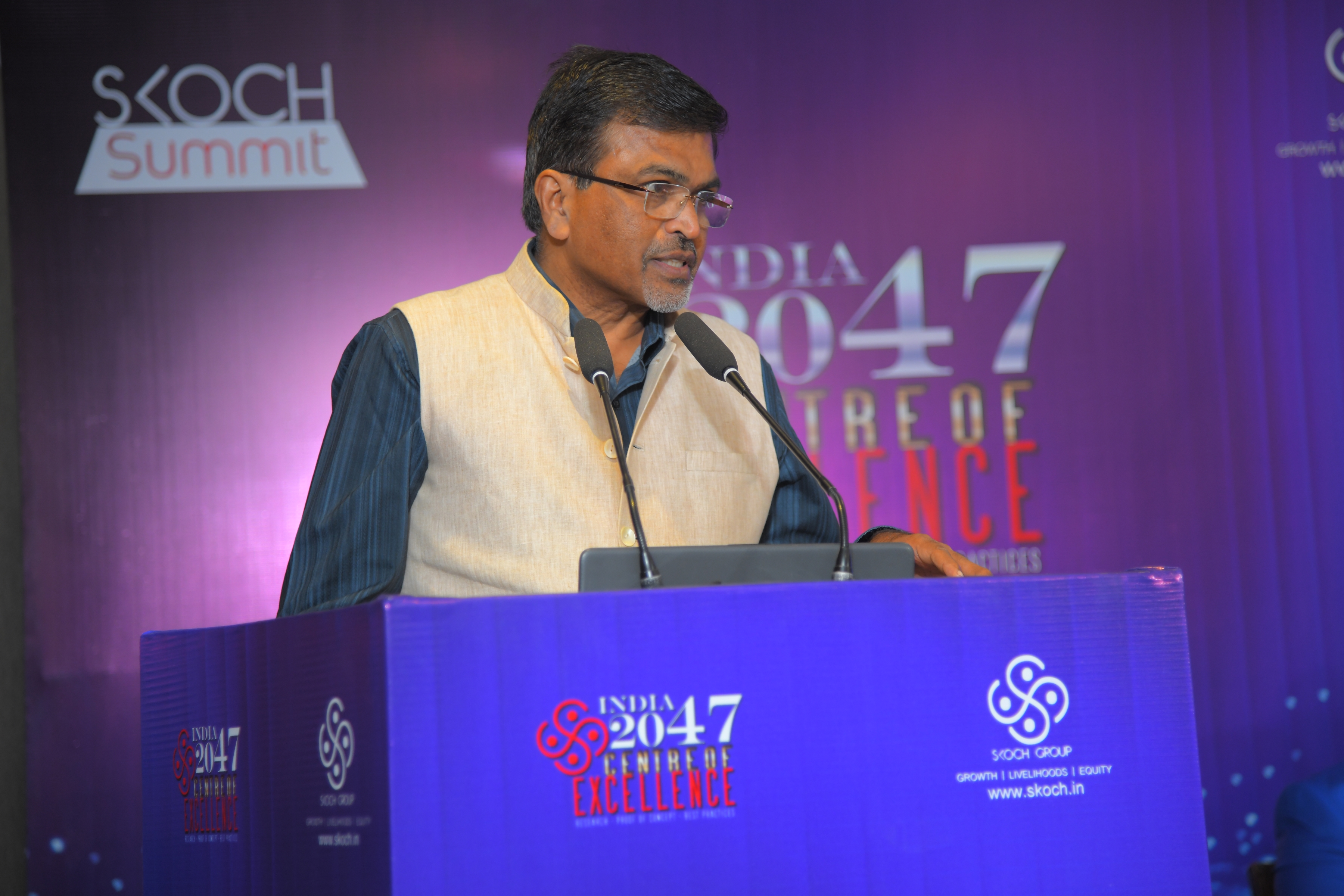
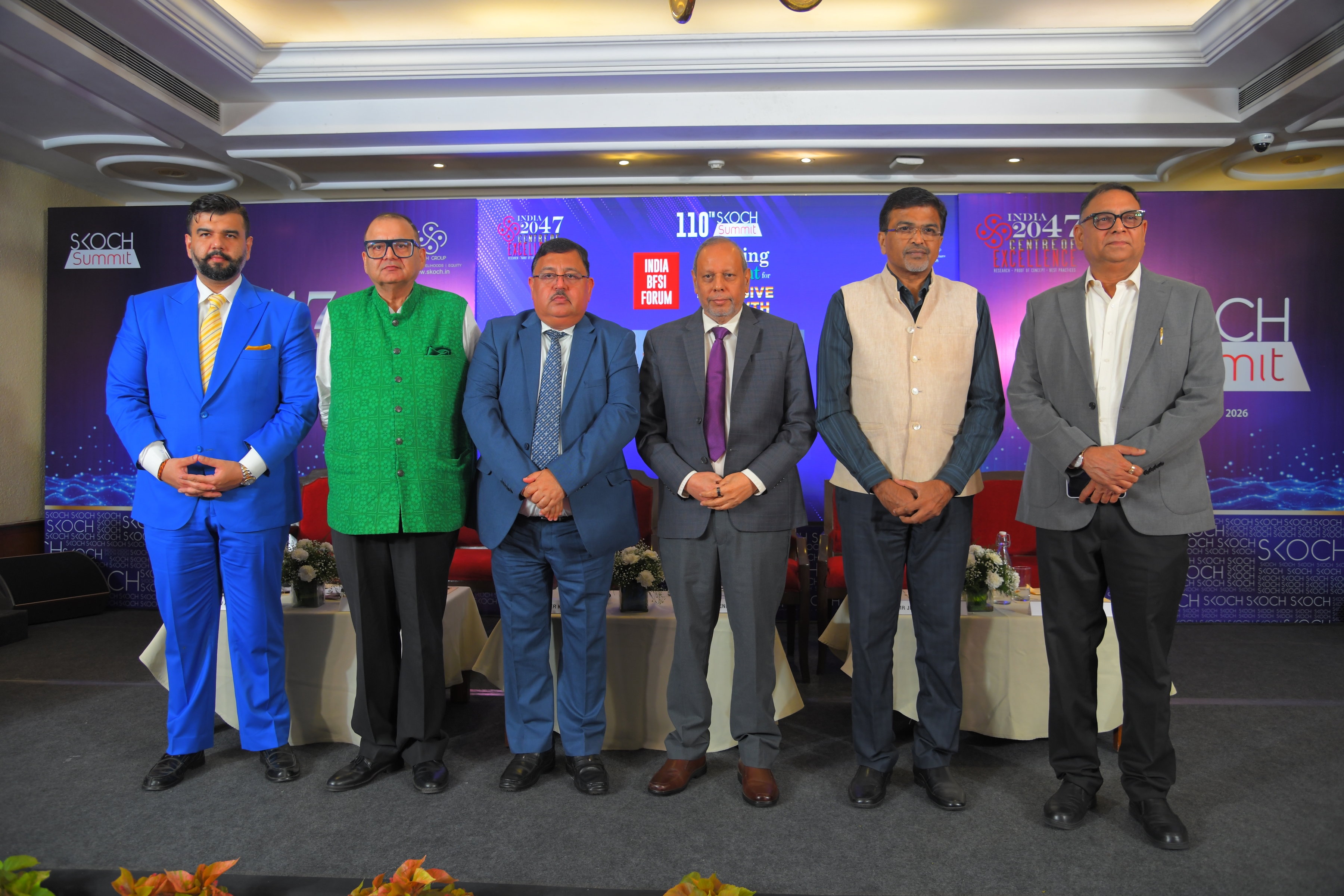
Mr Jiji Memmon at the 110th SKOCH Summit: Banking Bharat for Inclusive Growth
Mr Jiji Memmon
Executive Director & CEO, SaDhan
Key Points*
- The speaker explains that financial inclusion has been a long-standing development objective in India, even before the term itself became widely used.
- He traces the history of financial inclusion from cooperative credit in 1907 to bank nationalisation, Regional Rural Banks, NABARD and self-help groups.
- He argues that providing formal credit to farmers and poorer sections has always been essential for national development.
- He says financial inclusion in the true sense must go beyond opening bank accounts or providing credit lines.
- He emphasizes that citizens also need access to a full range of financial services, including insurance, pensions, credit and wealth management.
- He highlights financial education and financial literacy as essential for helping people use credit responsibly and manage their finances effectively.
- He argues that the ultimate objective should be to move from financial inclusion to financial well-being and financial prosperity.
- He notes that successive governments have contributed to expanding banking access through institutional reforms and financial inclusion initiatives.
- He identifies 2014 as an important turning point, with stronger emphasis on financial inclusion through bank accounts, insurance, pensions, Mudra and Stand-Up India.
- He says India has already achieved a substantial level of basic financial inclusion, making financial prosperity the next major goal.
- He stresses that financial inclusion should enable people to manage wealth, improve financial security and build better economic lives.
- He appreciates SKOCH for consistently keeping financial inclusion and inclusive development at the centre of its discussions.
- He concludes that the next stage of India’s financial inclusion journey should focus on financial well-being, prosperity and meaningful use of financial services.
* This content is AI generated. It is suggested to read the full transcript for any furthur clarity.
Transcript
Thank you very much. Good evening to all of you. Respected Mahendra Devji, Honourable Chairman of EAC-PM, Mr. Sameer Kocharji, Chairman of SKOCH Group, Shri Narasimhaji, Executive Director, Shri Anil Bhardwaj, Secretary General, Mr. Rohan Kochar, Mr. Sahaji, who was there online, and all my friends sitting here. Good afternoon and good evening to all of you.
First of all, let me thank the SKOCH Group, Mr. Sameer Kocharji, Rohan and the entire team for inviting me for today's event. I have become a part of this SKOCH family, I believe, because I have been attending some of these events for the last several years, and I find that every time the programme becomes one better than the other. So this time also I am seeing a lot of good things happening here.
Let me first of all congratulate and compliment all those who have received the Challenger Award today, including Mr. Swaroop Kumar Saha. Morning also, I have been told, several awards were distributed and maybe there will be some more awards. So I congratulate each one of you for receiving this recognition.
Financial inclusion has become a buzzword in the last maybe 10-15 years. But let me tell you, even before that, although we may not have used the word financial inclusion or may not have had a specific programme of financial inclusion, there has always been a concern for the government, whoever was in power at that time, that there has to be greater accessibility to banking facilities for the people.
If you go back to 1907, when the British were ruling our country, the first cooperative law was introduced. It was basically to provide formal credit to farmers. So it started from there. Although we may not have used the term financial inclusion, the concern of extending credit to the people, particularly poor people and farmers, has always been there. Any developed nation has to have financial inclusion as part of its agenda. Only then can it grow.
When we talk about 2047, we have to reach a level where financial inclusion exists in the true sense. It should not be just about opening an account or having a credit line open. In the true sense, it should provide all kinds of financial services.
Last time you talked about financial prosperity. Yes, financial inclusion itself is not the final thing we are looking at now, because almost every household has a bank account today. Almost all households get some kind of loan, either from the banking system, the non-banking system or even a microfinance institution.
But beyond that, people also need other financial services, financial education and financial literacy. They need to know how to utilise credit, how to manage wealth and how to manage their finances. This kind of education is required so that people are in a better position to manage their financial lives and achieve prosperity. So financial inclusion should lead to financial well-being and eventually to financial prosperity. That should be the aim we are working towards.
When I was talking about the cooperative system starting in 1907, if you look at the period that followed, various governments after independence also played a role in bringing banking closer to the people. In 1955, the State Bank and its associates were created. In 1969, banks were nationalised. In 1980, another six banks were nationalised.
Regional Rural Banks were opened. At one point of time there were 196 Regional Rural Banks. They are still there, but they have now been consolidated into a much smaller number. The idea was that every district should have access to a Regional Rural Bank.
Then NABARD was formed in 1982. After that came the promotion of self-help groups. These are all financial inclusion initiatives. But the real push came in 2014 when the new government came into being. I think this government has contributed significantly to the financial inclusion aspect of the country.
If you see, right from having a bank account, to having insurance products, pension products, schemes like Mudra and programmes like Stand-Up India, these are all part of the financial inclusion agenda. And I find that this government has given greater focus to financial inclusion. That is why we are in a position today where we have already achieved a substantial level of financial inclusion.
But the next step, financial prosperity or financial well-being, is what we should now be looking at. I am really happy that SKOCH has always given focus to financial inclusion as an agenda. Various SKOCH Summits have consistently focused on this subject.
And I am sure that going forward also, we will see more such events and programmes. I thank the organisers for arranging this kind of event and for creating awareness in the country.
So once again, thank you for inviting me for this event here. And I once again congratulate everyone who has received the awards today. We also received an excellent message through today's discussions. Thank you so much.
With this, I conclude. Thank you.