SKOCH Summit
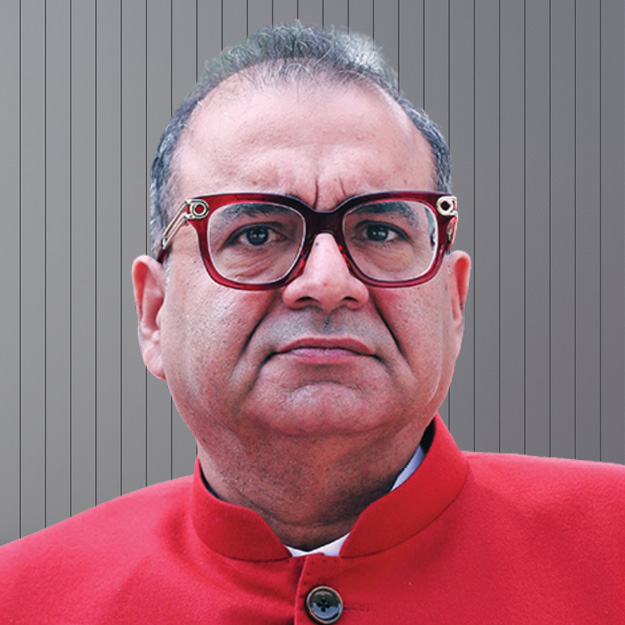
Mr Sameer Kochhar,
Chairman, SKOCH Group
Reforms historian and author of best-seller ModiNomics, Sameer Kochhar is Chairman, SKOCH Group. He is a passionate advocate of social, digital and financial inclusion and is a foremost expert on governance and inclusive growth. His work has been acclaimed globally and endorsed by Mr Narendra Modi, Mr M Venkaiah Naidu, Dr Manmohan Singh, Mr Arun Jaitley, Mr P Chidambaram, Mr Yashwant Sinha, Dr C Rangarajan and Dr Montek Singh Ahluwalia and so on. In his thinking and writings and activities, his profound admiration for India's economic reforms and in extension, those outstanding personalities who strive to make these reforms more meaningful and broad-based comes out clear and unambiguous..
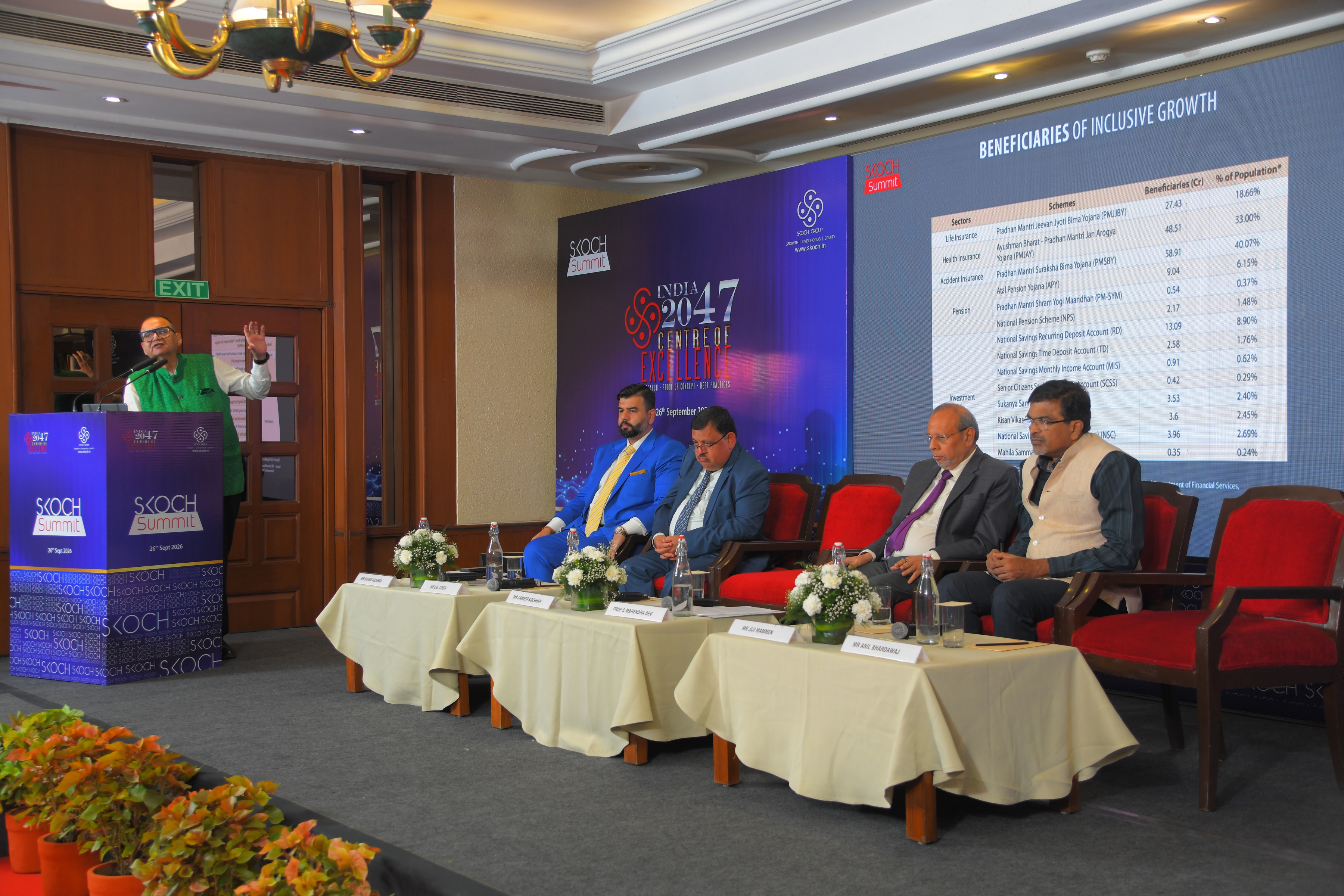
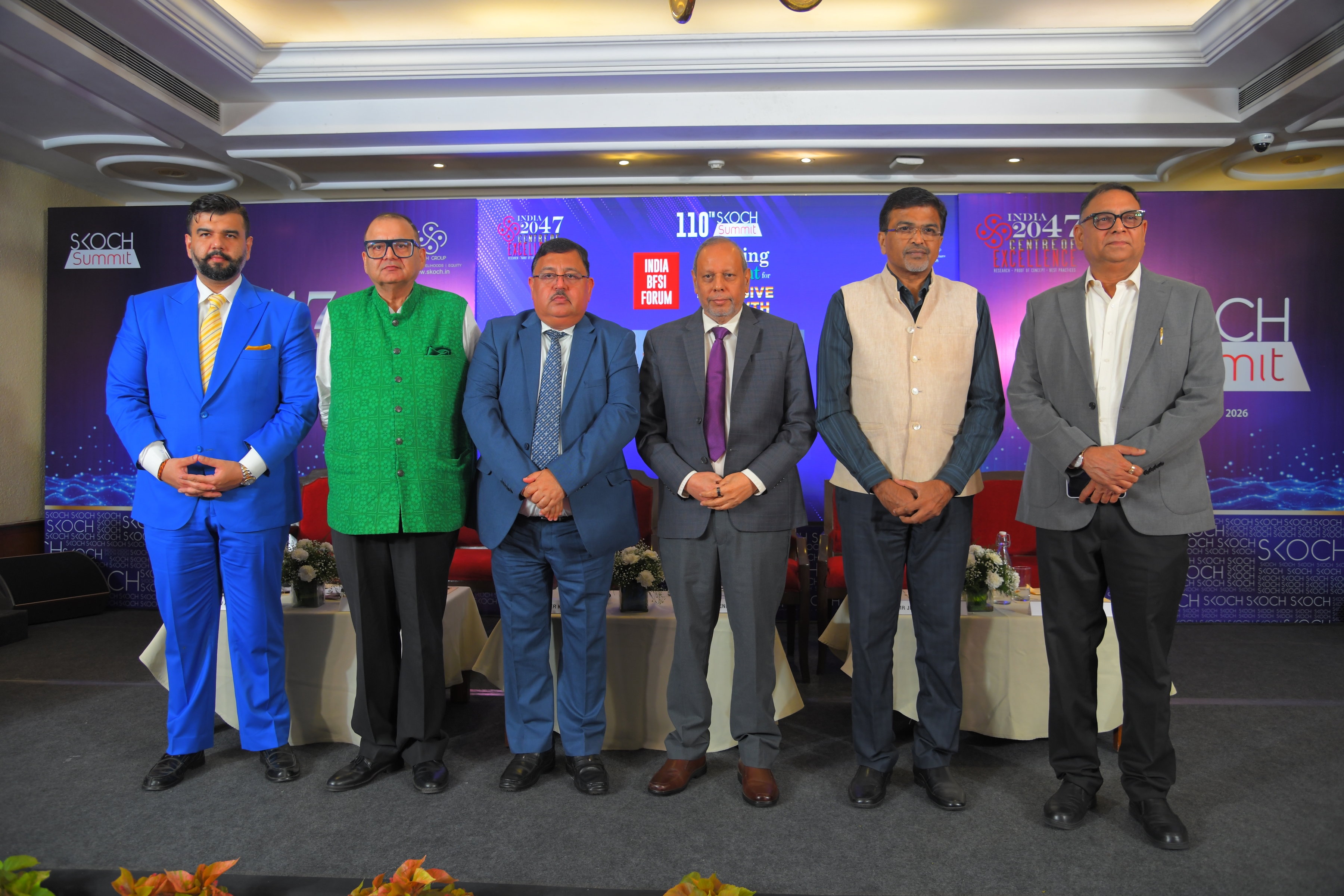
Mr Sameer Kochhar at the 110th SKOCH Summit: Banking Bharat for Inclusive Growth
Mr Sameer Kochhar
Chairman, SKOCH Group
Key Points*
- The speaker traces India’s journey from poverty alleviation to a broader framework of inclusive growth.
- He defines inclusive growth as job-generative, spatially dispersed, equitable and sustainable.
- He argues that poverty is not only an economic issue but a socio-economic problem requiring both inclusive governance and an inclusive economy.
- He emphasizes the importance of absorptive capacity, empowerment and economic enablement in helping citizens use credit and financial support productively.
- He highlights financial literacy as a critical component of inclusive growth and financial inclusion.
- He explains that bank branches, CSCs, post offices, banking correspondents, MFIs, NGOs, cooperatives and technology together form the outreach architecture for financial inclusion.
- He argues that inclusive growth requires relevant financial products such as savings, micro-investments, micro-insurance and micro-credit.
- He identifies coordination failures, implementation gaps and the not-for-profit mindset as major historical barriers to expanding financial services.
- He notes that the inclusive growth framework was later expanded to include education, health, sanitation and multidimensional poverty.
- He says that India’s financial inclusion performance should also be judged by population coverage, not only by financial depth as a percentage of GDP.
- He identifies two major current gaps: weak financial literacy and lack of relevant financial products.
- He argues that excessive regulation and non-viable funding models have weakened financial literacy programmes.
- He calls for a serious review of regulatory guidelines governing financial literacy.
- He highlights progress in insurance coverage but points to pensions and investments as major areas of weakness.
- He proposes using Jan Dhan accounts as a common platform for savings, insurance, pensions and micro-investments.
- He argues that convergence through Jan Dhan accounts can reduce fragmentation across multiple government channels.
- His recommendations include improving financial literacy, making financial literacy funding viable, expanding insurance and pension coverage and using Jan Dhan Yojana more effectively.
- He concludes by calling for an integrated framework of banking, savings, insurance, pensions and investments to achieve complete financial inclusion.
* This content is AI generated. It is suggested to read the full transcript for any furthur clarity.
Transcript
Thank you Rohan for giving us that macro view of financial debt. Unlike Rohan and most of you, I belong to a generation that I call the Roti-Kapda-Aur-Makaan generation. You know the famous film where the biggest and overwhelming problem that India faced was poverty. And it kind of continued well past 2000, 2010, 2011 and 2012. Poverty was the number one problem that India faced. So whenever we would discuss historically over these decades the poverty problem, the first question people would ask is, what is poverty? That was a typical government response to poverty.
So they would form a committee to define what poverty is. It started with the Alagh Committee, then there was the Lakdawala Committee, then there was the Tendulkar Committee, and finally there was the Rangarajan Committee with their own definitions of poverty. So since they could not conclude what poverty was, the schemes to alleviate poverty obviously had to lag behind. So to me, who is uneducated and not an economist, I would say poverty is very simply a lack of money. If I don't have money, I am poor. So if 30-40% of the population is very poor, whatever policies you make, you make sure that that population is taken care of.
Inclusive growth is a new term, but we found that there were different kinds of poverty and inequalities. So when we talk of poverty alleviation today, we call it inclusive growth. And SKOCH's definition of inclusive growth is that it must be job-generative. Now you will find that if the number one problem in 2010-2011 was poverty, today whenever there is a discussion, the discussion is about jobs. According to you, we don't have a job problem, we have a quality-of-job problem.
Whether they are well paid enough, whether they are educated enough or not. But yes, jobs are the number one problem in today's discourse. Is it spatially dispersed? Are these jobs concentrated in metro cities, big cities, or are they uniformly spread across? Is it equitable? Is everybody getting the benefits of growth, or is it just the top 5% or 10% of business people who are benefiting from it? And finally, last but not the least, is it sustainable? So all these things which look self-evident today have actually been part of our work since 2008.
This is a series of books that I published covering all these areas. Now 2008 was the time when we came out with SKOCH's model of inclusive growth. I am not suggesting even for a minute that the governments of the time formally adopted what the SKOCH model of inclusive growth was. All I am saying is that what we have covered over 20 years in different books and documented, eventually the policy panned out in a very similar way. And what is the result of that policy? That is also what we are going to be discussing here now. My last book on this subject was The Journey of Inclusive Growth, which covered 25 years of Modiji's public life.
So in 2008, when poverty was another problem, everybody was sensitive to poverty depending on where they were sitting. If you were sitting in the Ministry of IT, you would say that give everyone internet and poverty will reduce. Or if you were sitting in some other ministry, you would say let's have common service centres. If people can access government services without intermediaries, then poverty will be less. Then if you were the RBI or the Department of Financial Services, the view was that everybody should have a bank account and then poverty will be removed.
Now the thing is that actually all of these were parts of the solution. It was not a complete solution. For the first time, we conceptualised a socio-economic model which got published in my book Speeding Financial Inclusion in 2008. There we said inclusive governance and inclusive economy have to work together. Poverty is not just an economic problem, it is a socio-economic problem. So you have citizens, you have 1.47 billion of those who lack absorptive capacity. And whenever you give them credit or you give them money, are they able to utilise it productively?
They lack empowerment, they don't know what their rights and entitlements are, and they lack economic enablement. So how can this be addressed? This can be addressed in two ways. One is self-help groups, second is individual initiatives. And later on schemes have come out that have covered these areas. Once you do that, then you need an outreach mechanism. How do you reach out to these people? Financial literacy is a key component. Then you have bank branches, CSCs, post offices, BCs, banking facilitators, local bodies, MFIs, NGOs and cooperatives.
Now you put a technology layer on top of that through computers, connectivity and mobiles to distribute what we call products which come from financial institutions. These products could be micro-investments, savings, micro-insurance and micro-credit. Holistically, unless both sides perform, there can be no inclusive growth.
And in all these policies there was no single chain of command. Even today there is no single chain of command. No one person owns this entire command. So there were obviously several points of failure. The biggest point of failure at that point in time was the not-for-profit mindset. If you wanted banking services to reach everybody in the country, the RBI policy at that time said it had to be not-for-profit. BCs could not make money. Now where will you find 1.2 million people who, for no commercial interest, will give banking services to people?
So what happened was that they started an industry which was very funny where there was a not-for-profit NGO owning a technology company. So each banking correspondent had two companies. They had a technology company which would sell the technology to the BC. And the BC would get paid a per-transaction fee to the technology company.
And since the fee was per transaction, it became a business of depositing money and taking out money. One person would get up in the morning, take out Rs. 100, deposit Rs. 100, take out Rs. 100 and deposit again. The policy used to support that. And so there were big problems. So right now this seems like common sense, but there was a huge learning curve that the country had to go through and we have been partners in this journey.
We have been studying these problems and giving policy advice from time to time as to what needs to be done. So in 2012, when some of this was implemented and some of these problems like banking correspondence and not-for-profit etc. were evident, we did the second set of challenges and looked at what challenge was being faced at each tier. Implementation was a problem. Political will was a problem. There was vested interest in not getting things done through organised channels. Coordination failure was another problem because things were not working together, and there was also a lack of test cases.
There were pilots, enough number of pilots, but there was nothing that kind of scaled. So these were the challenges we had identified and we will see how we move forward on these. In 2014 again, we revised this model and we brought in things like education, health and sanitation into this. This was in time with Modiji's taking over the government. Now this is 2012 and 2014 and we are seeing the first model now of multidimensional poverty.
Just to give you an example, multidimensional poverty as a model was adopted by NITI Aayog in 2020. So this was six years ahead of that. But as I said, we probably had the good fortune of being able to project what could happen, and actually it did happen and it turned out very similarly.
So if today you look at implementation, every year you have got things like skill development, absorptive capacity, empowerment, there are so many schemes out there. For several groups and individuals, the biggest scheme among them is Pradhan Mantri Mudra Yojana. So much credit has been made available and jobs have been made available.
So there are two ways of looking at it. One way is the way Rohan presented in the morning, which is how much is the debt in value accounts as a percentage of GDP. That may not give you the whole picture because India is very frugal in innovation. We use very little money to do a lot of penetration. So if you look at penetration as a percentage of population, the story is far, far better than penetration as a percentage of GDP.
But today again we have a problem in some of the areas. There are two major points of failure. One point of failure is financial literacy. And the second point of failure is lack of products. And these are two areas that I would like to spend some time on.
Financial literacy has become, for some reason, very highly regulated. RBI and SEBI have given guidelines on how financial literacy has to take place. It is micro-managed to the extent of what the course curriculum is, how it has to be imparted, what is the size of the batch, and in what way it has to be done. They have even given clear guidelines on how people who are being trained should be photographed.
So to that extent it is a non-starter. It is a deterrent. And also the problem that was there with BCs, that they were supposed to be not-for-profit, the same problem plagues financial literacy today. People are not supposed to make money doing financial literacy. Then who will teach? It is not a self-evident need. You actually have to do a lot of mobilisation to convince people that they need financial literacy.
If they knew that they needed financial literacy, they would not be poor to start with. So that understanding somehow is missing from the system. Our recommendation is that current regulatory guidelines and regulations for financial literacy as given by SEBI and RBI both need serious looking into and an overhaul.
The second problem is the lack of relevant products that are available. Before I come to the products, I will jump a slide. This is the percentage penetration. So if you look at life insurance, you have Pradhan Mantri Jeevan Jyoti Bima Yojana with 27.43 crore beneficiaries, which is 18.66% of the population. It is not a fantastic number, but it is not a depressing number either.
Ayushman Bharat Pradhan Mantri Jan Arogya Yojana has 48.51 crore beneficiaries, about 33% of the population. Pradhan Mantri Suraksha Bima Yojana is doing very well, covering around 40.7% of the population. So on insurance, what Rohan's presentation also showed, life insurance came down, the non-life was flat, but using that money we are being able to cover a lot of population.
So while percentage of GDP may look low, the percentage spread of that is much, much larger than the money being spent because of the state's role there and its subsidies.
The big problem is pension. The pension reforms have become a non-starter, so some have gone back to the old pension scheme. Also the problem with the new pension scheme again was that the margins were micro-managed. There was no way people who were selling pensions could make any money and that problem still remains.
So while there is a gap, and still this tussle between old pension scheme and new pension scheme, the fact is that the new pension scheme is also not viable. So something has to be done seriously about it. Same thing is there with investments.
So when we were children, I remember my parents, who belonged to a poor family, used to buy something called National Savings Certificates. They used to come in the denomination of 100 rupees. There used to be Kisan Vikas Patras. There were so many small saving instruments that were available. Now they still exist, funnily enough.
They are not heard of, not talked about, not distributed. I don't know why. So one of the things that we are recommending is that you have a problem with Jan Dhan accounts. There was an RTI reply that there are 59 crore total accounts. 15.37 crore out of these are officially non-functional. There are also zero-balance accounts.
About 5.72 crore accounts are zero-balance. But they still have massive accumulated liquidity. So they have a lot of money sitting there getting a savings bank rate of interest. There is concentrated geographic inactivity. And then there is a gender-positive thing that women and transgenders have a bigger percentage of the accounts.
Now what if we were to make available all these products to Jan Dhan accounts? It is actually a no-brainer as to why they are not available. Now most of these schemes, something is available through post office, something is available somewhere else. Why can't all these things like bancassurance be available through Jan Dhan accounts?
So it solves the problem of small savings. It solves the problem of pensions. It solves the problem of even micro-investments, like some of these mutual fund companies have started. Small investments are doing very well, but they are not available through Jan Dhan accounts.
So one of the recommendations is that if you could converge all these schemes through the Jan Dhan accounts and distribute them through that channel, you don't need multiple channels. Right now the effort is getting diffused through so many different channels, so many different arms and hands of the government. So this convergence is very important for Banking Bharat to take place.
So coming finally to my recommendations: improve financial literacy and awareness, which is a big challenge. Make financial literacy funding viable. Expand insurance coverage. Push pension inclusion. Leverage Pradhan Mantri Jan Dhan Yojana better. And move towards complete financial inclusion.
Just focus on an integrated framework of banking, savings, insurance, pensions and investments. So that completes our presentation. If there are any questions I would be happy to take. Otherwise we can move on. So with that I now invite Prof. S. Mahendra Dev, who has kindly allocated time for us. He has also been thinking on very similar lines and some pilot projects etc. which he is going to be sharing more with us about.