SKOCH Summit

Ms Geeta Luthra
Eminent Jurist, Writer and Parliamentarian
Abhishek Singhvi is an eminent jurist, writer and parliamentarian. One of the seniormost national spokespersons of the Congress party, he is also the youngest designated Senior Advocate (at age thirty-four), the youngest Additional Solicitor General of India (at thirty-seven) and the youngest elected vice president of the Supreme Court Bar Association (at thirty-nine). He was chairman of the Parliamentary Committee on Law and the AICC Law and Human Rights Department. He was bestowed the Global Leader of Tomorrow Award by the World Economic Forum, Davos in 1999 He has written popular fortnightly columns for the Hindustan Times (Candid Corner”) and the Times of India (‘SubVerse”).Educated at St Columba’s School (all-India topper) and St Stephen’s College in Delhi, and Trinity College, Cambridge, he also did a short summer programme at Harvard. Two recent publications, Legal Eagles and Courting Politics, list Dr Singhvi among the top few lawyers in India. He has endowed many charities in India and abroad.
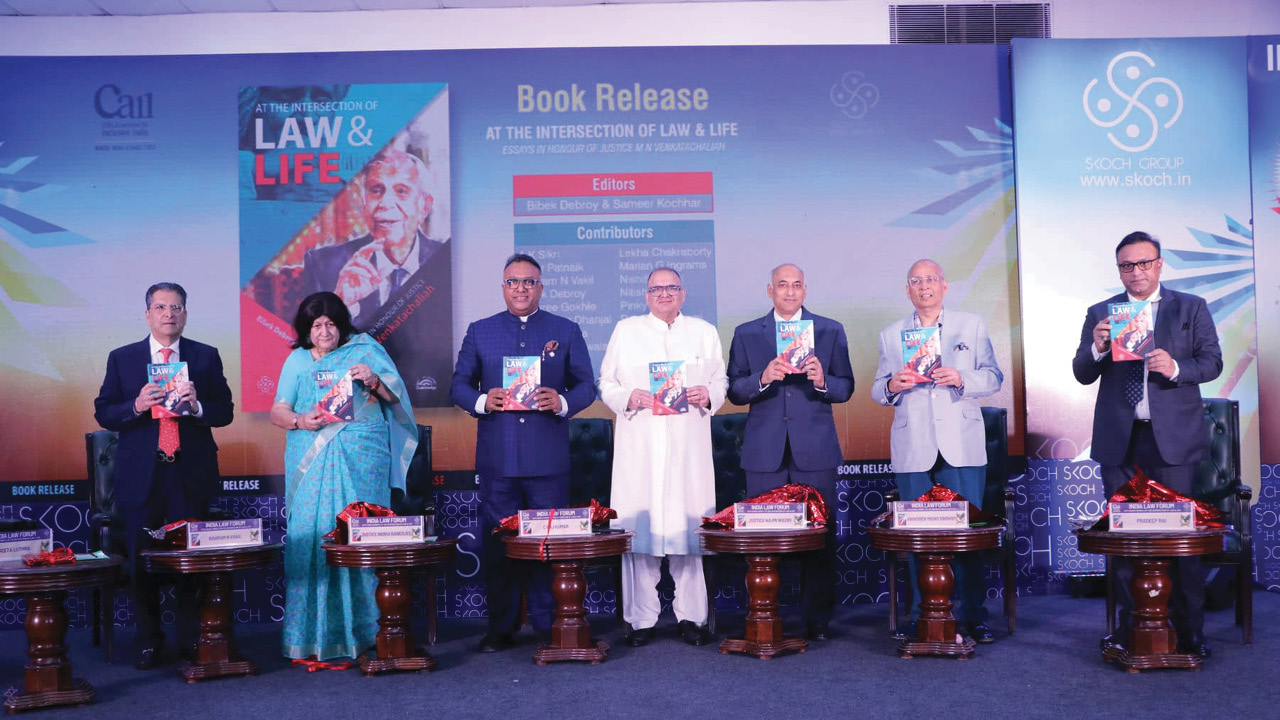
Ms Geeta Luthra at the 94th SKOCH Summit: India Law Forum - Intersection of Law & Life
Ms Geeta Luthra
Eminent Jurist
Writer and Parliamentarian
Key Points*
- The SKOCH platform brings together law, policy, and society through diverse and intellectually rich discussions.
- The speaker’s early legal experiences shaped his appreciation for judicial grace, integrity, and old-world professionalism.
- Past legal luminaries exemplified civility, camaraderie, and an absence of pettiness now increasingly rare.
- The Renaissance ideal of excelling across disciplines defined leaders like L. M. Singhvi and his contemporaries.
- L. M. Singhvi pioneered the idea of the Lokpal after adapting the Ombudsman concept to Indian conditions.
- Political vision and perseverance often take decades to translate ideas into accepted public institutions.
- The concept of celebrating Constitution Day originated from recognizing the completion of the Constituent Assembly’s work.
- Law Day and Constitution Day reflect the importance of honoring constitutional values and institutions.
- India’s global diaspora movement emerged from visionary thinking and dialogue at the highest political levels.
- The speaker emphasizes a return to an era driven by ideas, humility, and collective spirit over rivalry.
* This content is AI generated. It is suggested to read the full transcript for any furthur clarity.
Transcript
Ladies and gentlemen, a man who is really universal and versatile. Let’s put our hands together once again for Justice, who has been awarded with the SKOCH Lifetime Achievement Award. Ladies and gentlemen, we can make it a little huge. Let’s have once again a huge round of applause for sir. Thank you so much, ladies and gentlemen, and thank you. So once again, thank you so much, ladies and gentlemen.
May I now invite Mr. Sameer Kochhar to join us on the stage once again. Ladies and gentlemen, here I announce the SKOCH Star of India Award. This year, the SKOCH Star of India Award is conferred on late L. M. Singhvi, eminent jurist, parliamentarian, scholar, writer, and diplomat.
I request Mr. Sameer Kochhar sahab to kindly do the honor, and at the same time, I request Shri Abhishek Manu Singhvi, eminent jurist, writer, and parliamentarian, to kindly accept the SKOCH Star of India Award presented to Padma Bhushan late L. M. Singhviji.
A huge round of applause, ladies and gentlemen.
Late L. M. Singhvi’s commitment to upholding integrity in governance led him to propose the creation of a robust vigilance body against corruption. His journey continued with impactful roles like High Commissioner to the UK and tenure in the Rajya Sabha. Padma Bhushan Dr. Singhvi was multifaceted and brilliant, spanning law, politics, diplomacy, and literature. Singhvi’s legacy is that of an exceptional scholar and leader whose influence extends far beyond his lifetime.
Ladies and gentlemen, let’s have a huge round of applause once again and celebrate this moment.
Former Chief Justice Lalit, Justice Banerjee, distinguished members of the legal fraternity, distinguished members of the long non-legal fraternity, ladies and gentlemen—this is not intended to be a speech.
Let me start by congratulating Sameer and his son and the entire team for making these SKOCH events, especially its legal forum, an intoxicating cocktail—true to the name “SKOCH”—of diverse things, including a very diverse and interesting panel of topics through the day.
I was particularly intrigued because I happen to be an integral part of most of the themes he just mentioned, starting from same-sex marriage to some of the other themes which are active in court.
I’m reminded, by seeing this short documentary, of my very, very young years in my profession and a well-known reported case of Renu Sagar versus GEC, which traveled to the Supreme Court three times. The middle round traveled from a single judge, then to a division bench of Chittatosh Mukherjee and Sujata Manohar, and then on to the Supreme Court. I had the privilege, as a young lawyer, to appear led by my father. In the initial period, Palkhivala opposed us, and then it went on up to the Supreme Court.
The names which we have and are going to see—Justice Venkatachaliah soon—are all, I think, exemplars of, if you were to force somebody into one word, grace. An old-world charm, sadly, if not already gone, fast disappearing. No rancor, no jealousies, no pettiness—unfortunately things which have increasingly come to characterize our contemporary ambiance.
Sameer has asked me to speak about my father. It’s always difficult and a little unfair for a son to speak about his father, but he also belonged to that world. For example, a Renaissance definition used to be that a person could be good at many things, uh, not that he needs to be only a specialist in one. These narrow walls of specialization were antithetical to Renaissance persons, and I think that characteristic exemplifies several people, including my late father, Justice Venkatachaliah, Justice—since I am not supposed to speak long, let me give you three or four quick examples of how these are people, or men, of ideas.
I remember, again, a very strange quirk of fate, that more than a decade ago, when I was chairing the Parliamentary Standing Committee on Law, I happened to preside over a 31-member parliamentarian committee, a mini-Parliament, which gave the report on Lokpal. The first page of that recounted how, in 1962, as a young parliamentarian of 30 years old, my father had visited Sweden and had got besotted with the Ombudsman concept. When he came back as a young Harvard-trained lawyer and a young parliamentarian, he spoke ceaselessly inside and outside Parliament about a parliamentary commissioner and ombudsman.
This story is recounted on the first page of our report, that Nehru, the then Prime Minister, told him, he said, “Young man, you constantly speak about Ombudsman. You must indigenize this concept.” He therefore coined the words Lokpal and Lokayuktas, which of course have gone into the Indian lexicon.
It is ironical that almost eight attempts, four during his term, to create a Lokpal failed, and the report which finally recommended it and was largely accepted was chaired by his son almost 40–50 years later.
The second thing I remember is how, in my presence more than 30–35 years ago, he said, “Why don’t we ever celebrate the day our Constitution framing was completed?” Twenty-six January is when we became a republic, but at that time nobody celebrated the completion of the rigors and the vigors of the Constituent Assembly, which finished its work officially on 26th November 1949.
He therefore, on the spot, drafted by hand the Law Day Charter, which has now become an established part of the legal world, celebrated every year by the Supreme Court Bar Association and by diverse High Courts. A few years ago, the Honorable Prime Minister declared it to be Constitution Day.
A third example was when he explained the concept to Mr. Vajpayee, and they shared a very strange chemistry of poetry and Hindi literature. He immediately got interested in the idea, which led to the entire diaspora report. The entire NRI movement, the diaspora, owes itself to that conversation. He decided to appoint the chairman of a high-powered committee to make the diaspora report, and that came about, and you have the entire diaspora movement thereafter.
There are many more such examples, but I think we all need to hearken back to that era—an era of ideas, of less pettiness, and much more camaraderie and spirit.
Thank you very much for the award, which I accept humbly, and congratulations again for all these diverse functions which the SKOCH Foundation does. Thank you.